Viking Yachts Sportfishing Yachts
Viking 58 for Sale, a Two-Generation Buyer's Guide
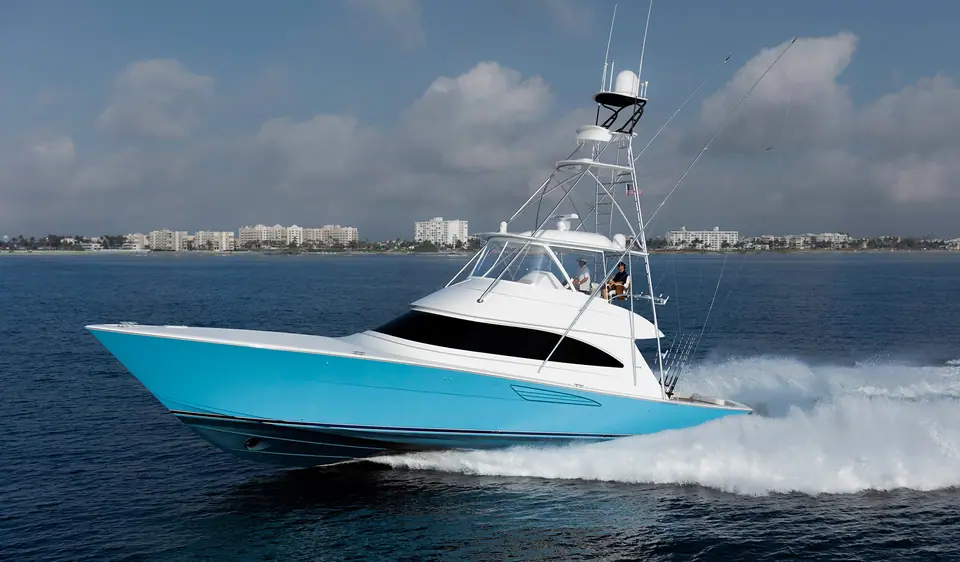
The 58 that built Viking's sportfishing reputation in the 1990s came back in 2018 as a 42-knot owner-operator tournament boat.
- Length
- 58.9 ft17.96 m
- Beam
- 17.8 ft5.41 m
- Cruise
- 36 kn
- Cabins
- 3
- Used price
- $300K to $4.8M
On this page
- Overview
- Two very different boats wear the 58 badge
- The 1991 to 2000 original, fairbody and all
- What changed in the 2018 boat
- The 165 square foot cockpit and how it is rigged
- Bridge and three-stateroom interior
- Test numbers with MAN and MTU power
- Owning a 58, old or new
- Specifications
- Price and value
- Strengths and weaknesses
- Used buyer checklist
- Rivals
- Our verdict
- FAQ
Viking sold 110-plus original 58 Convertibles from 1991 to 2000, then launched a new 58 in 2018 with a 165 sq ft cockpit, MAN or MTU power to 1,900 hp and a 36-knot cruise.
- Owner-operators who fish tournaments
- Teams stepping up from a 46 to 50 foot convertible
- Budget buyers wanting a refit project (first generation)
- Bahamas and canyon fishing
Viking 58 Convertible by the numbers
- Speed to length ratio at cruise
- 5.03A planing cruise. Fast passages in exchange for much higher fuel burn per mile.
- Estimated range at cruise
- 377 nmUsing 90 percent of tank capacity at the cruise speed and fuel burn listed on this page.
- Fuel economy at cruise
- 0.28 nmpgNautical miles per gallon at cruise, both engines combined.
- Horsepower per ton
- 95 hpVery high power to weight, built for speed.
- Length to beam ratio
- 3.32 : 1Moderate proportions.
Two very different boats wear the 58 badge
Anyone searching for a viking 58 for sale will find two boats under the same name. The original 58 Convertible ran from 1991 to 2000, and Viking sold more than 110 of them. It is the model that turned the New Gretna builder into a sportfishing heavyweight after the luxury tax nearly sank the company in the early 1990s, and its era also produced the 58 Valhalla of 1996, the first enclosed bridge convertible Viking built.
The second-generation 58 Convertible premiered at the 2018 Fort Lauderdale International Boat Show and is still in the 2026 lineup between the 54 and the 64. It is not a facelift. The hull, deck, interior, construction method and engine room are all new, and the only real link is the job description: a three-stateroom convertible an owner can run himself and still fish in serious tournaments.
Price is the obvious difference. A good 1990s 58 costs about one-tenth of a late-model boat, which makes it one of the most affordable ways into a 58-foot tournament hull. It also comes with 25-plus years of systems aging, which is what this guide helps you weigh.
The 1991 to 2000 original, fairbody and all
Viking's own brochure for the first 58 describes a deepened forefoot with a sharp entry, reverse chines for tracking and a steady fishing platform, flared bow sections to keep the bridge dry and an aft-planing fairbody that gets her up quickly. Ample tumblehome in the transom reduced wash when backing down. These are the classic Viking hull traits of the period, and the old 58 still rides well in a head sea.
The interior was a three-stateroom, three-head plan on an 18-foot beam, with a king-size bed in the midship master, a walk-around queen in the forward guest suite and over-under bunks in the third cabin, all trimmed in satin-finished golden Burmese teak. The cockpit carried a walk-through transom door, a tuna-sized recessed fishbox, a molded-in tackle cabinet with top-loading freezer and a bait-prep center with sink. Up top, the raised wraparound helm sat aft so the captain could see the cockpit, with seating for about a dozen guests forward.
Factory power varied over the decade, and most surviving boats have had at least one round of major engine work or a repower. Ask exactly what was done, when and by whom, because that single fact defines the value of an original 58 more than paint or electronics.
What changed in the 2018 boat
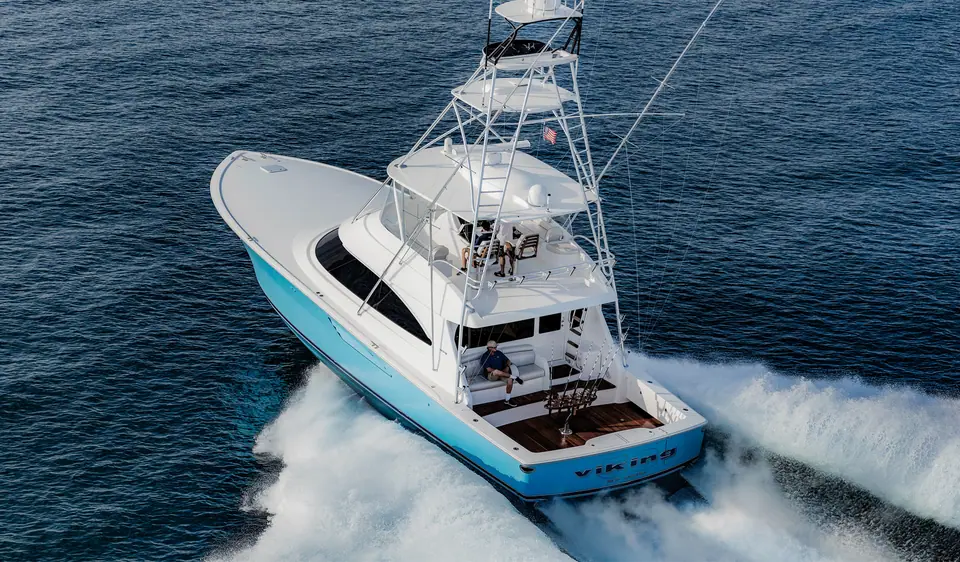
The new 58 is resin infused, with end-grain balsa sandwiched in fiberglass and hybrid carbon-fiberglass fabrics, and the bulkheads are composite as well. Viking refined the running surface with computational fluid dynamics and kept weight at about 80,400 pounds with standard fuel. Lonni Rutt, Viking's head of design, admits the old boat had the bigger engine room, but the new one trades that space for more accommodation volume and a larger cockpit with a mezzanine.
The design brief was deliberately owner-operator. Viking fitted one 21.5 kW Onan generator where two would fit, a Seakeeper 9 where a Seakeeper 16 could go (Viking's current spec sheet lists Seakeeper 10 or 18 options), and a 700-gallon-per-day Sea Recovery watermaker so a small crew is never tied to the dock. The result is a boat with fewer systems to maintain than the 64 or 68, which matters if you plan to run it without a full-time captain.
The 165 square foot cockpit and how it is rigged
Viking calls the 58 cockpit the largest in its class at 165 square feet, 12 square feet more than its nearest competitor at launch. It is teak covered on most boats, with flush rod holders, rounded coaming bolsters, fresh and saltwater washdowns and a walk-through transom door with a lift gate.
Fish storage is split by job. A full-length insulated fishbox runs down the starboard side of the sole, two in-deck storage boxes sit to port, and the forward box is rigged as a livewell. A second livewell is built into the transom. The mezzanine adds a freezer and a tackle cabinet, and refrigerated bait boxes, drink coolers and more freezer space are built into the mezzanine steps. A teak rocket launcher with 11 rod holders was on the test boats.
This is a real tournament cockpit. A team can run a chair or a stand-up setup, keep two livewells going for a sailfish or kite-fishing event, and still have a full-length box for a bigeye or a big wahoo. The mezzanine seating under the bridge overhang is where guests watch the spread in the shade.
- 165 sq ft cockpit, teak or nonslip
- Full-length insulated starboard fishbox, two port storage boxes, forward box rigged as livewell
- Transom livewell and lift-gate tuna door
- Mezzanine with freezer, tackle cabinet and refrigerated bait storage
- Optional Palm Beach Towers tower and Release Marine rocket launcher
Bridge and three-stateroom interior
The bridge is a walkaround center console layout with a teak helm pod, single-lever controls and lounge seating on three sides, enough for half a dozen guests. Sightlines to the cockpit and over the bow are clear, which is what you want when a single operator is backing down on a fish.
Inside, a pocket door slides open from the mezzanine to a saloon with about 7 feet of headroom, a walnut interior in high gloss or satin, Sub-Zero refrigeration and Miele appliances. The companionway sits on centerline. The master is amidships to port with a queen, the VIP forepeak has a centerline queen or crossover berths, and a third stateroom to starboard has side-by-side bunks. Two heads serve the three cabins.
Test numbers with MAN and MTU power
Standard power is a pair of 1,400 hp MAN V12 1400CRM diesels, with MAN options at 1,550, 1,650 and 1,900 hp and an MTU 10V2000 M96L option at about 1,600 hp. Hull No. 1 had the MTUs, and Yachting recorded a 36.5-knot cruise burning 129 gallons per hour for a 424-nautical-mile range, and 42.5 knots at wide open throttle on 176 gallons per hour.
Marlin magazine saw 41.8 knots and about 401 nautical miles of range at 35.7 knots with the same package, and Power and Motoryacht called 33 knots the optimum cruise in sloppy conditions. The optional 1,741-gallon fuel tank adds roughly 15 percent more range, which is worth having for Bahamas or Gulf canyon trips. Viking has not published test figures for the standard MAN 1400s, so expect somewhat less speed than the MTU numbers.
Owning a 58, old or new
A second-generation 58 run by an owner with a part-time mate costs about $280,000 to $480,000 a year once you add insurance, dockage, fuel, Seakeeper and engine service and a yearly haul. Hire a full-time captain and the top of that range is easy to pass.
Original 58s cost less to insure and dock but more to keep alive. Fuel tanks, exhaust, wiring, air conditioning and teak joinery are 25 to 35 years old, and a thorough refit can reach several hundred thousand dollars. The best values are boats where a previous owner already paid for repowers or a full systems refit and kept the receipts.
Viking 58 Convertible specifications
| Length overall | 58.9 ft17.96 m |
|---|---|
| Beam | 17.8 ft5.41 m |
| Draft | 5 ft1.52 m |
| Displacement | 80,379 lbs36,459 kg |
| Fuel capacity | 1,502 gal5,686 L |
| Fresh water | 207 gal784 L |
| Cabins | 3 |
| Berths | 6 |
| Heads | 2 |
| Standard engines | 2 x MAN V12 1400CRM, 1,400 hp each |
| Optional engines | 2 x MAN V12 1550CRM, 1650CRM or 1900CRM; 2 x MTU 10V2000 M96L 1,622 hp |
| Maximum power | 3,800 hp |
| Cruise speed | 36 knots |
| Top speed | 42 knots |
| Range | 424 nm |
| Hull type | Modified-V planing hull, CFD-refined running surface |
| Hull construction | Resin-infused end-grain balsa core with fiberglass and hybrid carbon-fiberglass fabrics (second generation) |
| Builder | Viking Yacht Company, United States |
| Naval architect | Viking in-house design and engineering team |
| Production | 1991 to present |
| Status | In production |
Figures come from builder documentation and independent tests where available. Displacement is usually quoted light, so a loaded cruising boat will weigh more. Compare these specs with another model.
How much does a Viking 58 Convertible cost?
This is really two markets. First-generation 58s from the 1990s trade from roughly $300,000 to $650,000 depending on repowers, paint and electronics, while second-generation boats built since 2018 start near $2.5 million and climb past $4.5 million for late hulls. The base price in 2019 was $2.935 million; engine choice (the MTU and 1,900 hp MAN packages), a Seakeeper, tower and the optional 1,741-gallon fuel tank move values most.
Estimate your yearly cost
A planning estimate using common rules of thumb: insurance near 1.5 percent of value, maintenance near 3 percent, haul out and bottom paint by length. Your marina, region and use will move these numbers. Open the full cost calculator.
Versions and options
- 58 Convertible, first generation (1991 to 2000)
- Three staterooms and three heads on an 18 ft beam, reverse chines and fairbody hull, satin teak interior. More than 110 sold.
- 58 Valhalla (1996)
- Viking's first enclosed bridge convertible, launched in 1996 while the original 58 Convertible was in production.
- 58 Convertible, second generation (2018 on)
- Resin-infused hull, 165 sq ft cockpit, three staterooms and two heads, MAN 1,400 to 1,900 hp or MTU 10V2000 power.
Viking 58 Convertible timeline
- 1991First-generation Viking 58 Convertible launched
- 199658 Valhalla introduces Viking's enclosed bridge concept
- 2000Original 58 ends production after more than 110 boats
- 2018All-new 58 Convertible debuts at the Fort Lauderdale show
- 2019Tests record 42.5 knots and a 424 nm range at 36.5 knots
Strengths and weaknesses
What owners like
- Class-leading 165 sq ft cockpit with two livewells
- 36-knot cruise and low-40s top speed
- Owner-operator friendly systems on the current boat
- Original 58 offers a cheap entry to a proven tournament hull
- Wide choice of MAN and MTU engine packages
What to weigh up
- New boats now cost well over $4 million
- Only two heads for three staterooms on the current model
- Original 58s need systems refits at this age
- Engine room is smaller than on the 1990s boat
Used Viking 58 Convertible buyer checklist
Take this list to a viewing. Your ticks are saved in this browser so you can come back to it.
Always commission an independent marine survey and an engine survey before you buy. How a marine survey works.
Rivals to consider
Hatteras GT59
Heavier, with a famously soft ride and a strong following, but slower and with a different interior style.
Compare side by sideViking 54 Convertible
Slightly smaller cockpit at 154 sq ft and lower price, with nearly identical layout and engines.
Compare side by sideBertram 61
A longer alternative with the classic Bertram deep-V pedigree, in a much smaller resale market.
Custom Carolina 58s
Cold-molded builds from yards such as Jarrett Bay and Spencer offer more speed per horsepower and prestige, with longer build waits.
Our verdict on the Viking 58 Convertible
The second-generation Viking 58 is the most complete owner-operator convertible Viking builds, with a cockpit that fishes like a 64, a 36-knot cruise and systems sized for a small crew. The original 1990s 58 remains a smart buy for a fisherman with a refit budget, but only with documented engine work. Decide which 58 you are shopping for before you look at listings, because the two boats share a name and almost nothing else.
Viking 58 Convertible questions answered
How much is a Viking 58 for sale?
Original 1991 to 2000 boats typically ask about $300,000 to $650,000. Second-generation 58s built since 2018 range from roughly $2.5 million to $4.8 million, and a new one costs about $4.3 million to $5.3 million in 2026.
How fast is the Viking 58 Convertible?
With optional MTU 10V2000 diesels the current 58 tested at 42.5 knots and cruised at 36.5 knots burning about 129 gallons per hour.
How many first-generation Viking 58s were built?
Viking says it sold more than 110 of the original 58 Convertible between 1991 and 2000.
How big is the Viking 58 cockpit?
The second-generation 58 has a 165 sq ft cockpit, which Viking says was 12 sq ft larger than its nearest competitor at launch.
Does the Viking 58 have a livewell?
Yes. The current boat has a transom livewell and a forward in-deck box rigged as a livewell, plus a full-length insulated fishbox and mezzanine freezers.
Viking 58 Convertible photos
More sportfishing yachts to explore
Hatteras GT59
Sportfishing Yachts, 60 ft
Used $2.4M to $4.2M
Viking 60 Convertible
Sportfishing Yachts, 61 ft
Used $1.5M to $2.45M
Bertram 54 Convertible
Sportfishing Yachts, 57 ft
Used $150K to $1.5M
F&S Custom Express Sportfish
Sportfishing Yachts, 61 ft
Used $1.4M to $7M