Buying
Center Console Buying Guide
Everything a US buyer needs to choose a center console, from size bands and hull types to outboard packages, layouts, brand tiers, storage, realistic 2026 prices, used-boat inspection points and a sea trial checklist.
On this page
- Why center consoles took over the market
- Pick your size band first
- Hull design, the part you cannot upgrade later
- Outboard packages, how many and how big
- Hardcore fishing or family crossover
- Options that earn their price
- Brand tiers in the US market
- Buying used without inheriting someone's problems
- The sea trial checklist
- What it costs to keep one
- FAQ
Why center consoles took over the market
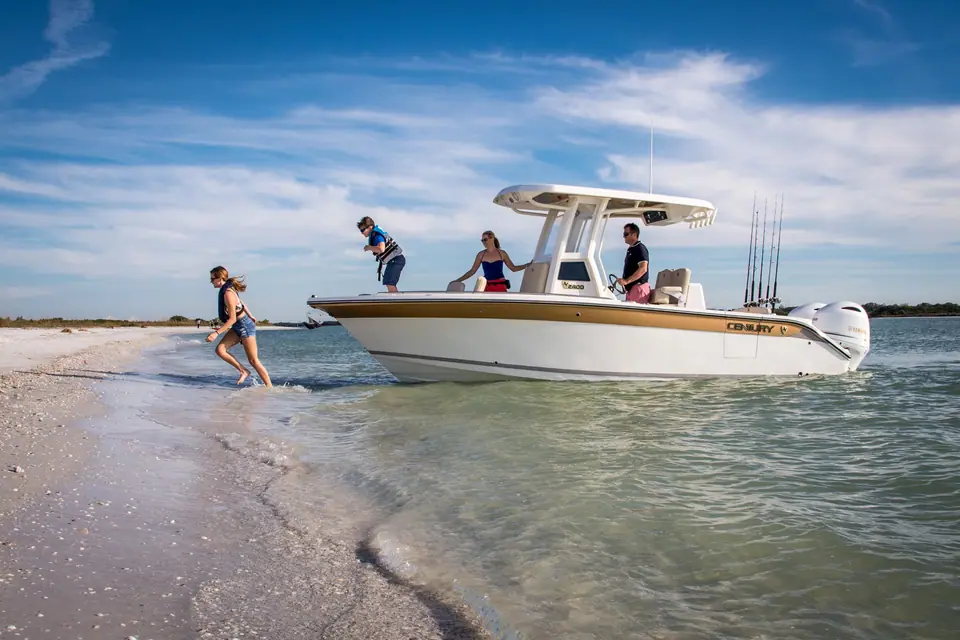
The center console is the most versatile boat layout in the United States. With the helm in the middle and walkaround space on every side, it lets anglers fight a fish around the whole boat, lets families board from any direction and handles offshore water better than most open boats of its size. Modern outboards made the layout even stronger, because they free up the entire cockpit and lift out of the water for storage.
Twenty years ago a center console meant a sparse fishing machine. Today the category runs from 17-foot skiffs to 65-foot flagships such as the HCB 65 Estrella, with air conditioning, cabins and gyrostabilizers on the larger models. That range is why this center console buying guide starts with how you will use the boat, then works down to hull, power and layout.
Pick your size band first
Length drives everything else, from storage and towing to fuel burn and insurance. The table gives typical 2026 new price ranges in USD with popular engine packages. They are estimates for planning, and options, electronics and dealer location move the final number significantly.
| Length | Typical use | Common power | New price estimate (2026) | Storage |
|---|---|---|---|---|
| 18 to 22 ft | Bays, lakes, inshore fishing | Single 115 to 250 hp | $50,000 to $140,000 | Trailer |
| 23 to 27 ft | Bay to nearshore, family day trips | Single 300 or twin 150 to 250 hp | $110,000 to $300,000 | Trailer, rack or lift |
| 28 to 32 ft | Offshore day trips, Bahamas crossings in good weather | Twin 250 to 350 hp | $250,000 to $550,000 | Rack, lift or wet slip |
| 33 to 39 ft | Canyon runs, tournaments, family offshore cruising | Twin to quad 300 to 450 hp | $450,000 to $1,200,000 | Wet slip or lift |
| 40 to 47 ft | Long-range offshore, overnight trips with a cabin console | Triple to quad 350 to 600 hp | $900,000 to $2,200,000 | Wet slip |
| 48 ft and up | Flagship offshore yachts | Quad 450 to 600 hp | $2,000,000 and up | Wet slip |
Hull design, the part you cannot upgrade later
You can repower, rewire and add electronics, but you cannot change the hull. Most offshore center consoles use a deep-V hull, where deadrise around the low to mid 20s of degrees at the transom splits head seas cleanly. Builders such as Regulator, Contender and Boston Whaler built their reputations on deep-V running surfaces that stay dry and soft at speed in rough water. Weight helps too, since a heavier hull of the same shape carries momentum through chop rather than bouncing over it.
Stepped hulls, used by Yellowfin, Midnight Express, Contender and others, cut drag at high speed and improve efficiency, but they reward an experienced driver in tight turns. Power catamarans, as built by Freeman, are a different approach entirely. Two narrow hulls slice through waves with less pounding and offer a wide, stable platform, at the cost of a different motion in quartering seas and wider beam for storage.
The best test is not a spec sheet. It is a sea trial in conditions you actually expect to run in, with the fuel and crew load you will carry.
| Hull type | Strengths | Watch-outs | Examples we cover |
|---|---|---|---|
| Deep-V monohull | Soft head-sea ride, predictable handling, proven | Can roll at rest, needs power to plane | Regulator 37, Grady-White Canyon 456, Boston Whaler 420 Outrage |
| Stepped deep-V | High top speed and efficiency | Sharper handling in turns, driver skill matters | Yellowfin 36, Contender 32 ST, Midnight Express 43 Open |
| Power catamaran | Little pounding, very stable fishing platform | Different motion in following seas, wide beam | Freeman 34VH, Freeman 47 |
Outboard packages, how many and how big
Modern four-stroke outboards are quieter, smoother and longer-lived than the engines of a generation ago, and the top end has grown dramatically. Mercury's V12 Verado produces 600 hp per engine, Yamaha's XTO Offshore V8 line tops out above 400 hp, and Suzuki's DF350A covers the 350 class. Builders now fit quads on 40-footers that once ran triples.
For most buyers, twins hit the sweet spot. You get redundancy if one engine fails offshore, reasonable fuel burn and service costs, and a resale-friendly package. Triples and quads make sense on larger, heavier boats and for owners who prioritize top speed. Every added engine adds an annual service bill, a set of rigging, more weight on the transom and higher fuel burn at cruise.
Joystick systems such as Mercury's Joystick Piloting for Outboards and Yamaha's Helm Master EX have changed docking for multi-engine center consoles, letting one person move the boat sideways into a tight slip. On boats over about 32 feet they are worth serious consideration, and they help resale.
- Ask for a performance report at your expected load, not a light-boat top speed.
- Prefer the builder's recommended engine package rather than the maximum horsepower rating.
- Check warranty terms, since extended outboard warranties often transfer on resale.
- Count the propellers and lower units you will service and insure.
Hardcore fishing or family crossover
Center consoles have split into two families. Tournament-focused boats prioritize open cockpit space, big livewells, insulated fish boxes, rod storage everywhere and tackle stations. Crossover boats keep fishing ability but add forward seating with tables, larger console heads, sun lounges, cockpit kitchens and sometimes air-conditioned cabins inside the console.
Neither is better, but mixing them creates compromise. A family that fishes twice a season will be happier with a Grady-White, Boston Whaler, Scout or Pursuit-style layout. A crew that runs to the canyons every weekend should look at the fishing-first designs from builders like Contender, Regulator or Yellowfin.
| Feature | Fishing-first boat | Family crossover |
|---|---|---|
| Bow | Open casting deck, in-floor fish boxes | Lounge seating, table, sunpad |
| Livewells | Multiple large pressurized wells | One modest well, often optional |
| Console | Tackle storage, simple head | Walk-in head with sink, sometimes a berth |
| Cockpit | Open, with transom livewell and rigging station | Aft-facing seats, fold-down bench, outdoor kitchen |
| Shade | T-top or minimal hardtop | Large hardtop with extensions |
| Typical brands | Contender, Regulator, Yellowfin, Freeman | Boston Whaler, Grady-White, Scout, Pursuit |
Options that earn their price
Center console option lists are long, and dealers make margin on every line. These are the options experienced owners consistently say they would buy again.
- Gyrostabilizer on boats above about 30 feet, since Seakeeper units dramatically reduce roll when drifting or anchored.
- Hardtop with integrated electronics box, LED lighting and enough clearance for the tallest crew member.
- Side dive door for swimming, diving and boarding from the water.
- Electric reels and outlets on fishing boats, wired properly from the factory.
- Integrated electronics package with radar, sonar and a networked engine display.
- Generator and air conditioning on larger cabin-console boats used for overnight trips.
Brand tiers in the US market
Price differences between builders reflect construction methods, hull weight, materials, finish and resale value. Premium boats cost more new, but the best-known names often hold value better on the brokerage market, which narrows the real cost of ownership.
| Tier | Typical builders | What you get |
|---|---|---|
| Flagship offshore | HCB, Valhalla, Midnight Express, Freeman | Very large, fast, highly customized boats with yacht-level systems |
| Premium offshore | Regulator, Contender, Yellowfin, Boston Whaler, Grady-White | Proven hulls, strong resale, wide dealer networks |
| Upper mid-market | Scout, Pursuit, Everglades, Cobia | Strong design and features at a lower entry price |
| Value | Sea Hunt, Robalo, Sportsman, Key West | Practical boats for bays and nearshore, lower entry cost |
Buying used without inheriting someone's problems
A good used center console is often the smartest buy in boating, because a well-maintained boat from a premium builder may have lost much of its early depreciation while the hull has decades left. The risks concentrate in a few places, and a qualified marine surveyor plus a separate outboard mechanic inspection covers most of them.
- Get compression and leak-down tests and download engine hours and fault history from each outboard's computer.
- Pull lower unit drain plugs and look for water or metal in the gear oil.
- Sound the transom, deck and stringers. Older boats with wood in the structure can hide rot.
- Inspect aluminum fuel tanks where accessible for corrosion, especially on older boats with foamed-in tanks.
- Check wiring behind the console for corrosion, loose connections and amateur additions.
- Look for stress cracks around the T-top or hardtop mounts and leaning post base.
- Ask for service records, since regular outboard maintenance is the best predictor of future reliability.
The sea trial checklist
Whether new or used, never buy a center console without running it. A good sea trial lasts at least an hour and includes some rough water.
- Run into a head sea at cruise speed and note pounding, spray and how dry the helm stays.
- Turn across and down sea to judge tracking and any tendency to bow-steer.
- Check time to plane and the lowest speed the boat holds plane comfortably.
- Run every engine to full throttle and confirm rated RPM is reached.
- Drift beam-to with the engines off for five minutes to judge roll at rest.
- Practice docking, including the joystick if fitted.
- Test pumps, livewells, lights, electronics, windlass and trim tabs or interceptors.
What it costs to keep one
Annual costs track size and engine count more than brand. A 23 to 26-foot boat on a trailer is cheap to keep, while a quad-engine 40-footer in a wet slip with a gyro and generator approaches the running costs of a small motor yacht. Fuel is the variable that surprises most new owners. A twin-engine 32 to 35-footer at a fast cruise typically burns in the 20s of gallons per hour combined, and larger multi-engine boats burn much more.
Budget for annual outboard service on every engine, bottom paint on wet-slip boats, insurance, storage, electronics updates and towing membership. Read our yacht ownership costs guide for a full annual model before you commit.
Models mentioned in this guide
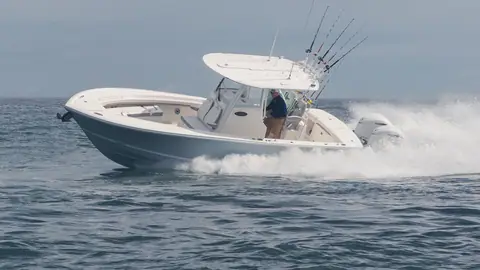
Regulator 28
Center Consoles & Offshore Boats, 28 ft
Used $115K to $380K
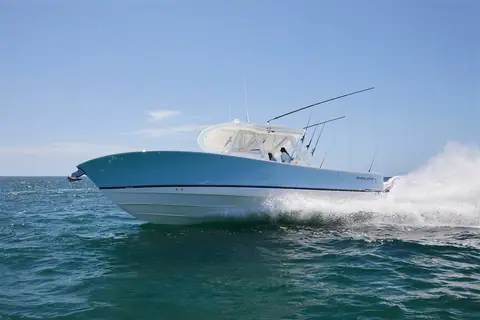
Regulator 37
Center Consoles & Offshore Boats, 38 ft
Used $640K to $1M
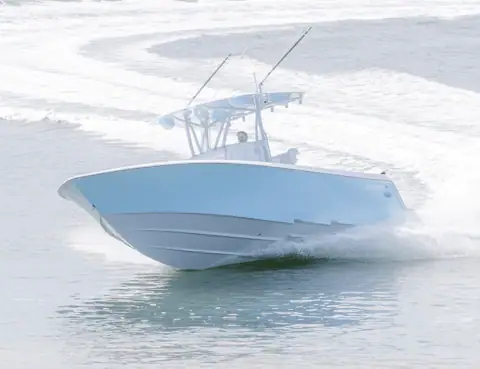
Contender 32 ST
Center Consoles & Offshore Boats, 33 ft
Used $115K to $430K
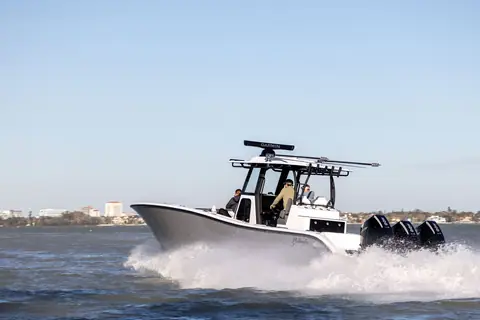
Yellowfin 36 Offshore
Center Consoles & Offshore Boats, 37 ft
Used $140K to $780K
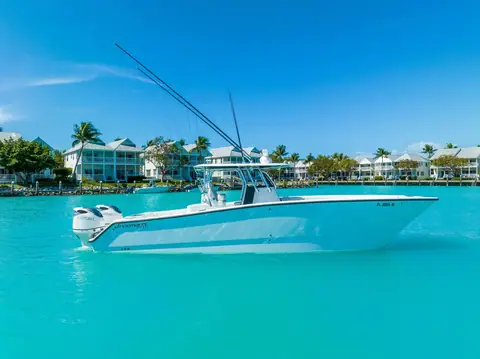
Freeman 34VH
Center Consoles & Offshore Boats, 34 ft
Used $175K to $400K
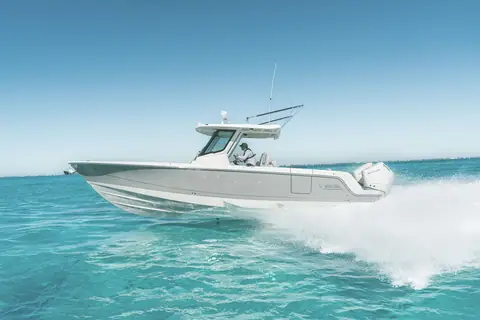
Boston Whaler 330 Outrage
Center Consoles & Offshore Boats, 33 ft
Used $175K to $560K
Frequently asked questions
What size center console do I need to go offshore?
Many experienced captains consider about 25 to 28 feet the practical minimum for regular offshore trips in good weather, with 30 feet and up preferred for longer runs, canyon trips or Bahamas crossings.
Are twin outboards better than a single engine?
Twins add redundancy, better maneuvering and more power, which matters offshore. A single modern outboard is simpler, cheaper and fine for bays and nearshore use.
How much does a new 30-foot center console cost?
A new 28 to 32-foot center console with twin outboards typically costs about $250,000 to $550,000 in 2026, depending on builder, engines and electronics.
Which center console brands hold their value best?
Well-known premium builders such as Boston Whaler, Grady-White, Regulator, Contender and Yellowfin tend to hold value well on the US brokerage market, especially with documented engine maintenance.
Can you sleep on a center console?
On many boats over about 35 feet, yes. Cabin-console layouts fit a berth, head and sometimes air conditioning inside the console, though space is limited compared with an express cruiser.
How many hours do outboards last?
Well-maintained modern four-stroke outboards commonly run well past 1,500 hours, and service history matters more than the number on the meter.
Keep reading
How to Buy a Used Yacht, Step by Step
A step-by-step walkthrough of buying a used yacht in the US, from setting a real budget to closing, documentation and the first…
BuyingMarine Surveys Explained, What a Surveyor Checks
What happens during a pre-purchase marine survey, what it costs, how to choose a surveyor, and how to turn the report into a…
BuyingYacht Loans and Boat Financing Guide
A practical guide to yacht loans and boat financing in the US, covering typical 2026 loan structures, what marine lenders check…
KnowledgeBoat Hull Types Explained, Displacement, Planing and More
How the shape of a hull decides a boat's speed, ride, fuel burn and stability. Covers displacement, semi-displacement and…
OwnershipThe Real Annual Cost of Owning a Yacht
A line-by-line look at annual yacht ownership costs in the US, with worked budgets for four boat sizes and the levers that…