Freeman Boatworks Center Consoles & Offshore Boats
34 Freeman for Sale, a Freeman 34VH Used Buying Guide
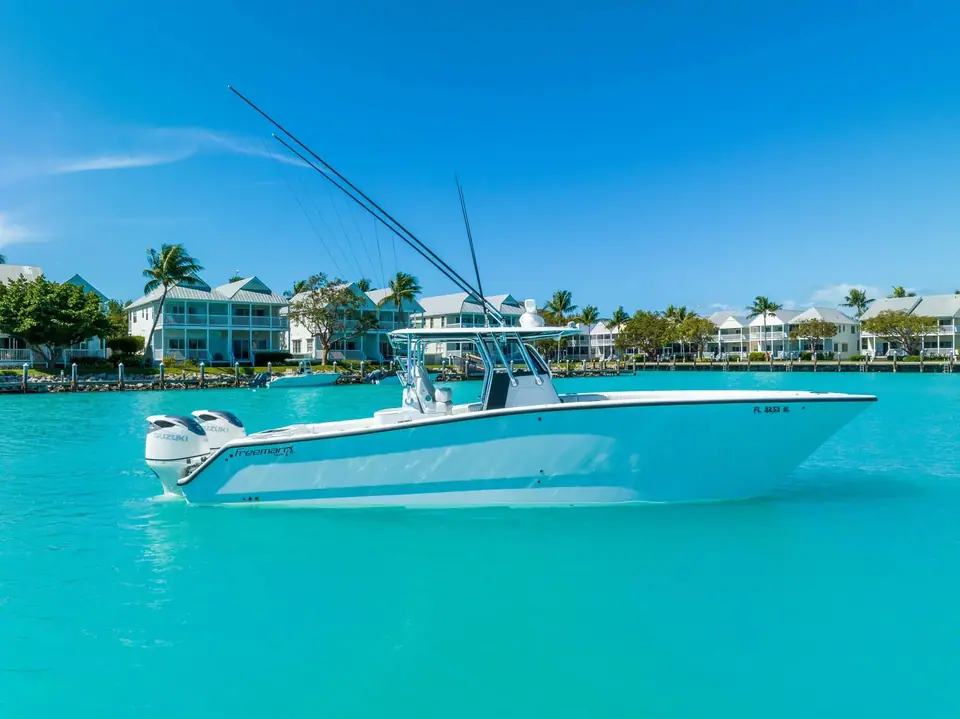
The stepped, vented evolution of Billy Freeman's first 33-foot cat, a twin-outboard fishing machine that runs 65 mph and gets 1.4 mpg at 50.
- Length
- 33.6 ft10.24 m
- Beam
- 10.8 ft3.3 m
- Cruise
- 43 kn
- Cabins
- None
- Used price
- $175K to $400K
On this page
- Overview
- Where the 34VH sits in the Freeman family tree
- What the vented hull changed compared with the original 33
- Twin Yamahas, 65 mph and 1.4 mpg at 50
- A cockpit built around tuna tubes and a 200-gallon coffin box
- Inlets, head seas and the catamaran motion
- Why the 34VH shows up on tournament leaderboards
- Shopping for a 34 Freeman for sale
- Freeman 34VH versus the newer Freeman 35
- Specifications
- Price and value
- Strengths and weaknesses
- Used buyer checklist
- Rivals
- Our verdict
- FAQ
The Freeman 34VH is a 33-foot-7 twin-outboard catamaran center console with 400 gallons of fuel and a vented, stepped hull. Now out of production, it is one of the most sought-after used fishing cats in the Southeast.
- Offshore anglers on a twin-engine budget
- Small tournament teams
- Charter captains running to rigs or ledges
- Buyers moving from a deep-V to a cat
Freeman 34VH by the numbers
- Speed to length ratio at cruise
- 7.61A planing cruise. Fast passages in exchange for much higher fuel burn per mile.
- Estimated range at cruise
- 430 nmUsing 90 percent of tank capacity at the cruise speed and fuel burn listed on this page.
- Fuel economy at cruise
- 1.19 nmpgNautical miles per gallon at cruise, both engines combined.
- Horsepower per ton
- 156 hpVery high power to weight, built for speed.
- Length to beam ratio
- 3.10 : 1Catamaran overall proportions. Wider platforms resist pitching and heel.
Where the 34VH sits in the Freeman family tree
If you are searching for a 34 Freeman for sale, you are almost certainly looking at the Freeman 34VH, the model that took Billy Freeman's original 33-foot catamaran and gave it a stepped, vented running surface. Billy Freeman founded Freeman Boatworks in South Carolina in 2006, and the first Freeman 33, drawn with naval design engineer Jesse Rhodes and built in Charleston, impressed Gulf and Carolina captains with how dry and level it ran. The 34VH kept that hull's proportions, 33 feet 7 inches long and 10 feet 10 inches wide, and made it faster and more efficient.
Sport Fishing described the 34VH as a stepped-hull version of the popular 33 when it appeared in its new boat coverage in 2015. Tested with twin Yamaha F350s, it reached 65 mph and returned 1.4 mpg at 50 mph. For a twin-engine fishing boat with 400 gallons of fuel those were striking numbers, and they explain why the 34VH still sells quickly years after it left the lineup.
Freeman's current small offshore model, the Freeman 35, has since taken over this slot. It is larger and carries more fuel, but it is also much more expensive, which keeps the used 34VH in demand with buyers who want a Freeman ride on a realistic budget.
What the vented hull changed compared with the original 33
VH stands for vented hull. On the 34, each sponson carries a step that draws air into the running surface, breaking the suction of water along the bottom and reducing wetted area at speed. The effect is a hull that lifts onto plane easily, runs freer at cruise, and needs less throttle for the same speed.
The basic Freeman traits remain. The sponsons are symmetrical, the bow has high freeboard and strong flare, and the tunnel is shaped to cushion re-entry rather than slam. Freeman designed his hulls specifically to avoid the bow steer in following and quartering seas that gave earlier American power cats a bad name, and the 34VH carries that behavior. Running down-sea into an inlet it tracks straight, which is the reason many Carolina captains trust it.
Construction follows the Freeman pattern of hand-laid biaxial and triaxial glass in vinylester resin with a closed-cell foam core. These hulls are stout; most problems on used boats are hardware, wiring and engines rather than structure.
Twin Yamahas, 65 mph and 1.4 mpg at 50
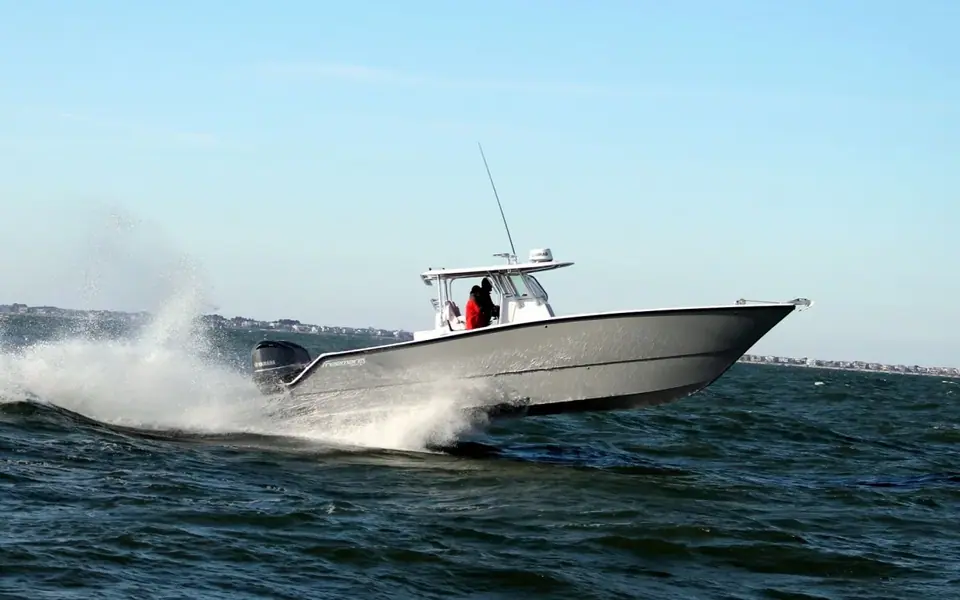
Twin Yamaha F300s were the base package, and twin F350 V8s were the performance choice. The 2015 test boat with F350s ran 65 mph at the top and 1.4 mpg at 50 mph, a burn of roughly 36 gallons per hour at a speed most monohulls of this size cannot sustain in a chop. Older Freeman 33 data suggests a similar pattern: Sport Fishing ran the first 33 at 63 mph on twin Yamaha 350s and recorded a 40 mph cruise at 4,000 rpm on 27 gallons per hour. Freeman's own 2015 spec sheet quoted a typical 45 mph cruise at 1.5 mpg and a top speed of 68 mph at 0.9 mpg.
Do the range math and 400 gallons with a 10 percent reserve gives about 500 statute miles at 50 mph on paper. Even trimmed for real conditions and loads, the 34VH comfortably handles 100 mile offshore runs, a full day of trolling and the ride home.
Many 34VHs are now on their second set of engines. Freeman's spec sheet listed a 700 hp maximum when the boat was new, and later versions of the page showed 800 hp and then 900 hp, so check the capacity plate on the specific hull and the transom and bracket setup before choosing anything heavier than the original twin F350 package.
A cockpit built around tuna tubes and a 200-gallon coffin box
Freeman built the 34VH as an offshore fishing tool first. At launch Sport Fishing reported that it could be outfitted with tuna tubes and three 53-gallon livewells, and that it came with two 50-gallon insulated in-deck fish boxes, lockable rod storage for nine rods and an insulated 200-gallon coffin box forward of the console, along with 18 rod holders in the gunwales. Later Freeman equipment lists describe an 800 quart coffin box, a 400 quart below-deck fish box, a 50-gallon pressurized transom livewell and two 280 quart in-deck boxes that can be plumbed as livewells.
Those numbers are big for a 34-foot boat, and the cat format is the reason. Carrying beam forward and aft lets Freeman put large boxes in each sponson and still leave a flat, open deck. Three livewells allow crews to keep different baits separated, a real advantage for kingfish, wahoo and tuna trips where you want both live and frozen options.
The coffin box in front of the console doubles as seating and a place to brace while running. On a tournament day it holds the catch on ice; on a family day it is the cooler for drinks and lunch.
- Up to three 53-gallon livewells (launch spec)
- Two 50-gallon insulated in-deck fish boxes
- 200-gallon (800 quart) insulated coffin box
- Tuna tubes and storage for nine rods
- Eighteen gunwale rod holders
Inlets, head seas and the catamaran motion
In a head sea the 34VH feels like a bigger boat. The twin hulls cut through chop rather than climbing over each wave, and the cushion of air in the tunnel takes the sting out of re-entry. Captains who switch from a 32 to 35 foot deep-V often say they can hold 10 mph more in 3 foot seas, and fuel economy improves at the same time.
The motion is different at rest. A cat sits flatter on the drift, but in a short beam sea it can snap back level with a quicker motion than a monohull. Most anglers prefer it once they are used to it, especially for standing at the gunwale all day. In tight turns the Freeman leans gently inward, which feels natural to anyone coming from a V-hull.
Why the 34VH shows up on tournament leaderboards
Freeman built its reputation in the charter fleets of Venice, Louisiana, and among Carolina offshore captains, and the 34 sized boats were an important part of that story. A 34VH with twin 350s could make a long run to the fish, keep speed in deteriorating weather and get back to the scale before the cutoff, which is exactly what you need in kingfish, wahoo and dolphin tournaments.
Its relatively modest twin-engine running costs also made it popular with small tournament teams and charter captains who could not justify the fuel and maintenance of a triple or quad boat. That mix of performance and economy is why a well-kept 34VH still attracts serious buyers.
Shopping for a 34 Freeman for sale
Supply is the challenge. Freeman built the 34VH in limited numbers and owners tend to keep them, so good boats rarely stay listed long. Expect asking prices from about $175,000 for an early boat with high-hour F300s to roughly $400,000 for a late hull with a recent repower and updated electronics.
Focus on engines first, then structure. Ask for complete maintenance records, oil analysis and compression on both outboards, and check how many hours they carry relative to their age. Charter boats can show 1,500 hours or more and may need a repower soon, which today costs a large share of the boat's value.
Then look at the hull around the steps and vents for impact damage, and inspect the engine bracket and transom for stress cracking. Finally, check that the hardtop or T-top structure is tight, because years of offshore pounding loosen mounting hardware on any boat that is run hard.
Freeman 34VH versus the newer Freeman 35
Freeman's current Freeman 35 measures 35 feet 10 inches with an 11-foot-6 beam, weighs 12,300 pounds dry with engines, carries 510 gallons of fuel and is rated for 1,200 hp, with twin Mercury V10 400s listed as standard. Freeman quotes it at 43 mph cruising at 1.35 mpg, and it includes an 850 quart coffin box and 70-gallon pressurized livewell capacity. It is a bigger, heavier and more capable boat.
The 34VH counters with simplicity and cost. At 9,000 pounds dry with engines it is more than 3,000 pounds lighter, its smaller engines are cheaper to run and repower, and the used price is a fraction of a new 35. If you fish within 60 to 80 miles of the inlet and want the Freeman ride, a clean 34VH is the value play.
Freeman 34VH specifications
| Length overall | 33.6 ft10.24 m |
|---|---|
| Beam | 10.8 ft3.3 m |
| Draft | 1.5 ft0.46 m |
| Air draft | 9 ft2.74 m |
| Displacement | 9, lbs4,082 kg |
| Fuel capacity | 4 gal1,514 L |
| Fresh water | 13 gal49 L |
| Cabins | None |
| Berths | None |
| Heads | Optional console head |
| Standard engines | 2 x Yamaha F300 outboards |
| Optional engines | 2 x Yamaha F350 V8 outboards |
| Maximum power | 700 hp |
| Cruise speed | 43 knots |
| Top speed | 56 knots |
| Hull type | Planing power catamaran with vented, stepped sponsons |
| Hull construction | Hand-laid fiberglass with vinylester resin and closed-cell foam core |
| Builder | Freeman Boatworks, United States |
| Other design credits | Billy Freeman, developed from the original Freeman 33 he created with naval design engineer Jesse Rhodes |
| Production | 2015 to present |
| Status | Discontinued |
Figures come from builder documentation and independent tests where available. Displacement is usually quoted light, so a loaded cruising boat will weigh more. Compare these specs with another model.
How much does a Freeman 34VH cost?
When new, Sport Fishing listed a 34VH at about $202,000 with twin Yamaha F300s. Today the engines decide the price. Boats on original F300s with high hours sit near the bottom of the range, while hulls with a recent repower, a fiberglass hardtop and modern Garmin electronics ask close to $400,000, which reflects how hard it is to find a used Freeman of any size.
Estimate your yearly cost
A planning estimate using common rules of thumb: insurance near 1.5 percent of value, maintenance near 3 percent, haul out and bottom paint by length. Your marina, region and use will move these numbers. Open the full cost calculator.
Freeman 34VH timeline
- 2006Billy Freeman founds Freeman Boatworks in South Carolina
- 2009Sport Fishing tests the first Freeman 33 at 63 mph on twin Yamaha 350s
- 2015Freeman 34VH introduced as a stepped, vented version of the 33, running 65 mph on twin F350s
- 2024The 34VH is still listed on Freeman's website with a 900 hp maximum
- 2026Freeman's fleet lists the Freeman 35 in the 34VH's place
Strengths and weaknesses
What owners like
- Twin-engine economy, about 1.4 mpg at 50 mph
- 65 mph top speed with twin F350s
- Level, dry Freeman ride in a head sea
- Huge fish box and livewell capacity for the length
- 400 gallons of fuel for long offshore runs
- Strong resale and steady buyer demand
What to weigh up
- Limited supply on the used market
- No cabin, only an optional console head
- Many boats need a repower in the near future
- Snappy cat motion in a short beam sea
Used Freeman 34VH buyer checklist
Take this list to a viewing. Your ticks are saved in this browser so you can come back to it.
Always commission an independent marine survey and an engine survey before you buy. How a marine survey works.
Rivals to consider
Contender 32 ST
A twin-step monohull tournament boat with a classic deep-V feel and broad dealer support.
Compare side by sideYellowfin 36 Offshore
A faster triple-engine stepped monohull with a stronger presence on the kingfish circuit, at a higher price.
Compare side by sideFreeman 35
Freeman's larger current model with 510 gallons, twin Mercury V10 power and a 1,200 hp rating, but far more expensive new.
Invincible 33 Catamaran
The best-known rival fishing cat, with a performance focus and a strong following in South Florida.
Compare side by sideOur verdict on the Freeman 34VH
The Freeman 34VH is one of the smartest used offshore boats in its size range. It gives you the Freeman ride, real long-range fuel capacity and tournament speed with only two outboards to feed and service. Finding a good one takes patience, and engine condition matters more than the year, but a well-kept 34VH delivers the experience of a much more expensive boat.
Freeman 34VH questions answered
How much is a 34 Freeman for sale?
Used Freeman 34VH boats typically list from about $175,000 to $400,000. Engine hours, repower history and electronics drive most of the difference.
What does VH mean on the Freeman 34VH?
VH stands for vented hull. The sponsons have steps that draw air under the boat to reduce drag and improve efficiency.
How fast is a Freeman 34VH?
Sport Fishing reported a top speed of 65 mph with twin Yamaha F350s and 1.4 mpg at 50 mph.
How much fuel does a Freeman 34VH hold?
It carries 400 gallons of fuel, enough for very long offshore runs at its 1.4 mpg cruise.
Is the Freeman 34VH still in production?
No. Freeman's current fleet lists the Freeman 35 instead, so the 34VH is only available on the used market.
How much does a Freeman 34VH weigh?
Freeman lists 9,000 pounds dry with engines and about 12,500 pounds ready to fish, with an 18-inch draft.
Freeman 34VH photos
More center consoles & offshore boats to explore
Grady-White Canyon 336
Center Consoles & Offshore Boats, 34 ft
Used $120K to $700K
Grady-White Express 330
Center Consoles & Offshore Boats, 34 ft
Used $65K to $560K
Grady-White Express 340
Center Consoles & Offshore Boats, 34 ft
Used $820K to $980K
Front Runner 33 CC
Center Consoles & Offshore Boats, 33 ft
Used $280K to $440K