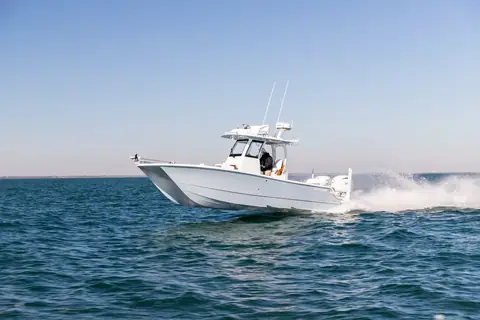
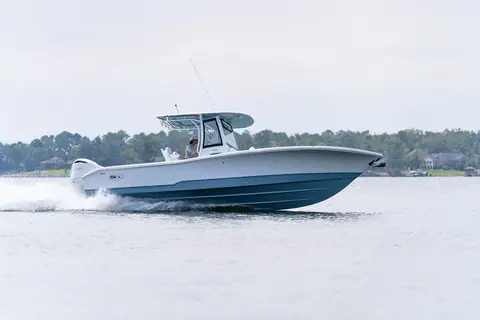
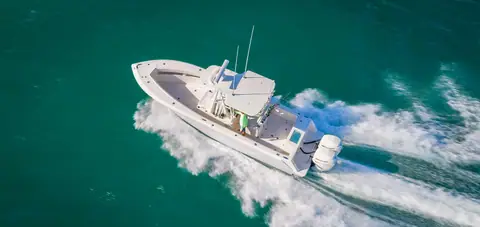
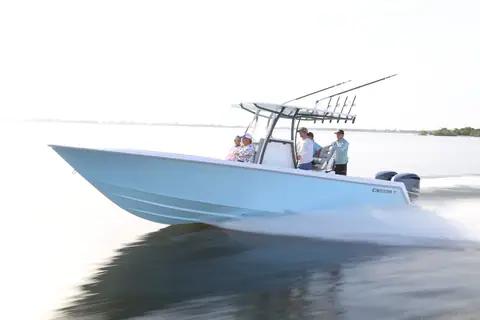
Egret Boats Center Consoles & Offshore Boats
Egret 290 Offshore, the Flats Builder's Bluewater Center Console
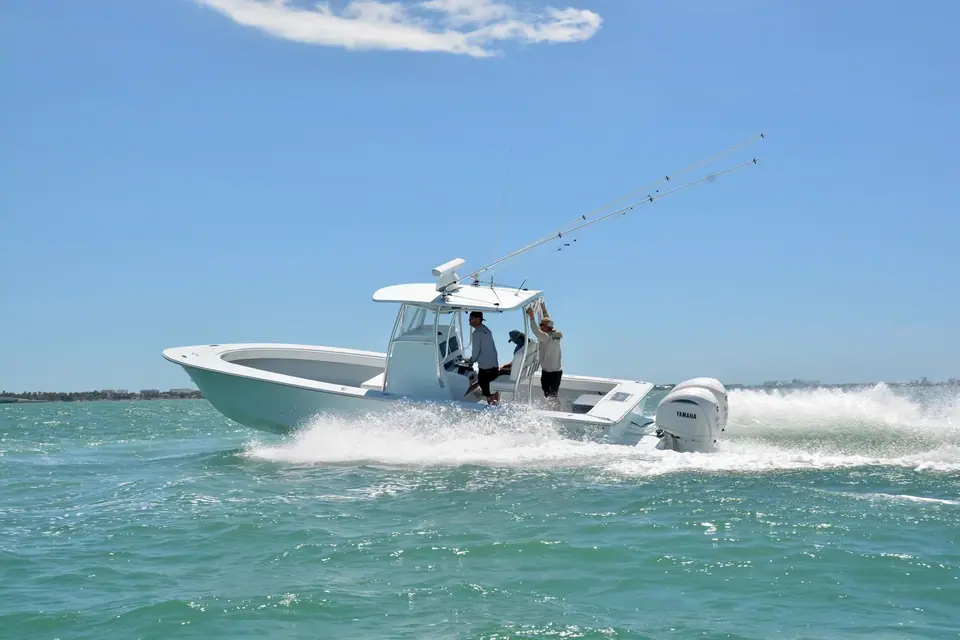
A 29-foot, vacuum-bagged composite center console from the builder of the Egret 189 flats skiff, built to order and now offered as the Egret 29 Offshore.
- Length
- 29 ft8.84 m
- Beam
- 9.5 ft2.9 m
- Cruise
- 2 ft0.61 m
- Cabins
- 0 (console with head)
- Used price
- $60K to $260K
On this page
- Overview
- When Egret boats went offshore
- Light and stiff, the Egret way of building
- Specs across three eras of the same boat
- A 29-footer built for one job
- Performance, and what we could not verify
- Buying a used Egret 290
- Specifications
- Price and value
- Strengths and weaknesses
- Used buyer checklist
- Rivals
- Our verdict
- FAQ
The Egret 290 Offshore (today's Egret 29 Offshore) is a 29-foot custom center console with a 9-foot-6-inch beam, about 250 gallons of fuel, a 23-degree deadrise and up to 800 hp of twin outboards. Introduced in 2006, it is built to order in St. Augustine, Florida.
- Anglers who value a light, efficient hull
- Northeast and Mid-Atlantic offshore fishing
- Owners of Egret flats skiffs moving offshore
- Custom builds without big-brand pricing structures
Egret 290 Offshore by the numbers
- Displacement hull speed
- 6.7 knThe efficient cruising speed for a displacement hull of this waterline.
- Length to beam ratio
- 3.05 : 1Moderate proportions.
When Egret boats went offshore
Egret boats made their name in skinny water. The Egret 189 earned the nickname the Rolls-Royce of flats boats among guides, and the company's own history says the Egret hull design was born, built and tested on several running plugs in the early 1990s, with production starting in Fort Lauderdale. Egret later built boats in Washington, North Carolina, for more than two decades.
In 2006 Egret announced that the Rolls-Royce of flats boats would be joined by the Egret 29 Offshore. The goal, in the company's words, was to do for center console fishing boats what the Egret 16 and 18 had done for flats boats: build a luxury product with outstanding fit, finish and performance, with more than 110 separate features. By the time of that announcement the sold prototype, powered by twin Mercury 225 OptiMax outboards, had already made a maiden voyage to the Bahamas, and the first production boat was in Nantucket with an unusual centerline 420 hp Yanmar diesel driving a Hamilton waterjet, so its owner could run through lobster pots without fouling.
The boat was later sold as the Egret 290 and is now listed as the Egret 29 Offshore. In 2024 new owners bought the company and moved its headquarters back to Florida, to St. Augustine, where it builds the 29 alongside the Egret 16, 18 and 21 skiffs and the Moccasin line.
Light and stiff, the Egret way of building
Weight is the theme of every Egret. The company's archived standard equipment list for the 29 described precision construction with vinylester resin, vacuum-bagged Kevlar or fiberglass laminates, foam-cored hull and deck, a composite stringer and transverse grid filled with flotation foam, and components bonded with aerospace-grade methacrylate adhesive to form a unit-body structure. Stainless hardware, fittings and fasteners were standard.
Egret's 2015 site put numbers to it: about 3,700 pounds for a fiberglass 290 and about 3,100 pounds in Kevlar, apparently hull weights before engines and fuel. That is light for a 29-foot offshore console, and Egret credits the low weight and careful weight distribution for a low center of gravity that keeps the boat stable underway, trolling or drifting. The builder also claimed that no Egret hull, deck or hatch had ever suffered a structural failure; that is a manufacturer's statement, so ask for a survey regardless.
Today's Egret 29 is described as 100 percent composite construction, consistent with that history.
Specs across three eras of the same boat
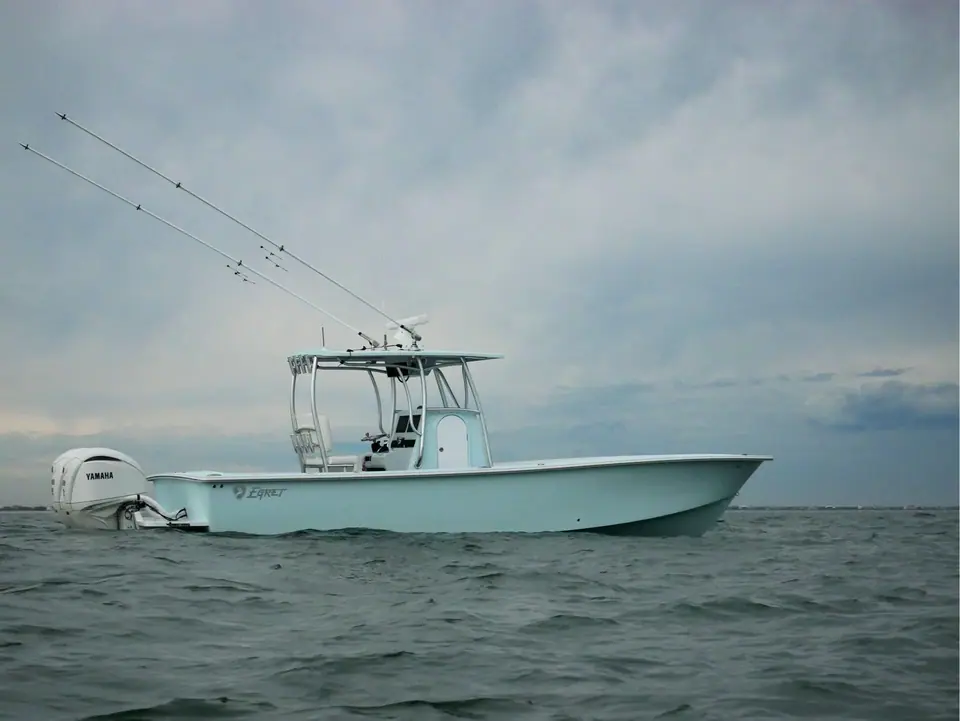
Egret's published dimensions have shifted over the years, which matters when you compare listings. The 2006 and 2007 pages gave 29 feet 6 inches overall, a 9-foot-6-inch beam, a draft of 2 feet with outboards or 3 feet with an inboard, 220 gallons of fuel and up to 600 hp for outboards or inboards. The 2015 page for the 290 quoted 29 feet, a 9-foot-4-inch beam, a 2-foot draft and 238 gallons, with a 236-gallon tank in the feature list and standard engine packages of twin 200, 225 or 250 hp outboards.
The current Egret 29 Offshore page lists 29 feet (31 feet with the bracket), a 9-foot-6-inch beam, a 24-inch draft in the spec list (22 inches in the headline figures), 250 gallons of fuel, a 23-degree deadrise and an 800 hp maximum, meaning twin 400s. Engine options run from twin Yamaha 225s to 350s and twin Mercury 225s to 400s.
The most likely explanation is a hull that has been refined and re-rigged over time, including the move to a flotation bracket, rather than three different boats. Always check the capacity plate and the actual fuel tank on a used example.
- 2006 to 2007: 29 ft 6 in LOA, 9 ft 6 in beam, 220 gal, 600 hp max, outboard or inboard
- 2015: 29 ft LOA, 9 ft 4 in beam, 236 to 238 gal, twin 200 to 250 hp standard
- Current: 29 ft hull (31 ft with bracket), 9 ft 6 in beam, 250 gal, 23-degree deadrise, 800 hp max
A 29-footer built for one job
Egret pitches the current boat to anglers tired of the frills on modern consoles: everything has a purpose, nothing is overcomplicated. Standard equipment includes a 50-gallon transom livewell, Lenco trim tabs, AGM batteries with a charger, two 2,000 gph bilge pumps, fuel-water separators, an aluminum T-top with a fiberglass hardtop, hydraulic steering, six gunwale rod holders, an Armstrong flotation bracket and boarding ladder and an aft fish box that drains to a gulper pump.
The options list lets the boat grow into a tournament rig. Egret offers a 60-gallon cockpit floor livewell, a forward in-deck well, a leaning-post well, acrylic lids, a Hooker electric sea chest with manifold and removable tuna tubes, which the company says brings available livewell capacity to more than 150 gallons. Coffin boxes, Garmin or Simrad electronics with radar and autopilot, FLIR night vision, Starlink, a stand-through second station and rocket launcher or kingfish rod holder packages are all available.
Earlier boats came with a 60-gallon transom well, two insulated fish boxes with macerator pumps, a lockable under-floor rod locker, a built-in cooler seat at the console front and a hardtop with LED courtesy lights, so even a 2006 to 2015 boat should be well equipped.
Performance, and what we could not verify
Egret has published videos of the 290 running but no speed and fuel tables that we could find, and we found no independent magazine test. We therefore leave cruise speed, top speed and range blank. What we can say is that a hull of roughly 3,100 to 3,700 pounds with twin outboards of 500 to 800 hp has a very favorable power-to-weight ratio for its size, and Egret's 23-degree deadrise is moderate for an offshore console, aiming for a balance of ride and stability.
Ask any seller for a sea trial with GPS speed and engine fuel-flow data at several rpm settings. On a custom boat built in small numbers, your own numbers are worth more than any brochure.
Buying a used Egret 290
Egret 290s are uncommon on the brokerage market, so be ready to travel. Expect roughly $60,000 for an early boat with original or tired power and up to about $260,000 for a nearly new Egret 29 with twin 300s or larger and a full electronics package. Kevlar boats, fresh repowers and boats with stand-through second stations command a premium.
Because the company changed hands in 2024, confirm what warranty support applies to older hulls, and ask the factory in St. Augustine for build records by hull number if they are available. Annual running costs of about $10,000 to $24,000 cover insurance, storage, twin-outboard service and a typical season's fuel.
Egret 290 Offshore specifications
| Length overall | 29 ft8.84 m |
|---|---|
| Beam | 9.5 ft2.9 m |
| Draft | 2 ft0.61 m |
| Fuel capacity | 25 gal946 L |
| Cabins | 0 (console with head) |
| Berths | None |
| Heads | 1 (console head) |
| Standard engines | Twin outboards to order (current options run from twin Yamaha 225 to twin Mercury 400) |
| Optional engines | Earlier boats: twin outboards to 600 hp or a single inboard diesel; one early boat used a 420 hp Yanmar diesel with a Hamilton waterjet |
| Maximum power | 800 hp |
| Hull type | Deep-V planing hull, 23-degree deadrise (current spec) |
| Hull construction | Vacuum-bagged foam-cored composite with vinylester resin; fiberglass or Kevlar/fiberglass laminates offered |
| Builder | Egret Boats, United States |
| Naval architect | Egret Boats in-house design |
| Production | 2006 to present |
| Status | In production |
Figures come from builder documentation and independent tests where available. Displacement is usually quoted light, so a loaded cruising boat will weigh more. Compare these specs with another model.
How much does a Egret 290 Offshore cost?
Egret sells factory direct and quotes each boat to order, so there is no published new price; we leave it blank rather than guess. Used values are our 2026 estimates and depend heavily on power and laminate: early boats on two-stroke or first-generation four-stroke twins sit at the bottom, while Kevlar-hull boats with modern twin 300s or larger, a hardtop and full electronics sit near the top. Very few change hands, which makes comparable sales thin and condition all-important.
Estimate your yearly cost
A planning estimate using common rules of thumb: insurance near 1.5 percent of value, maintenance near 3 percent, haul out and bottom paint by length. Your marina, region and use will move these numbers. Open the full cost calculator.
Versions and options
- Egret 29 Offshore (2006 to about 2007)
- Original 29-foot 6-inch spec with 220 gallons; offered with twin outboards to 600 hp or a single inboard diesel.
- Egret 290
- Mid-2010s naming; 238 gallons and standard twin 200 to 250 hp outboard packages; fiberglass or Kevlar laminate.
- Egret 29 Offshore (current)
- Built in St. Augustine; 250 gallons, 23-degree deadrise, bracket-mounted twins up to 800 hp.
Egret 290 Offshore timeline
- 1990sEgret hull design developed on running plugs; Egret Boats established in Fort Lauderdale
- 2006Egret 29 Offshore announced; prototype runs to the Bahamas on twin Mercury 225 OptiMax outboards
- 2015Sold as the Egret 290 alongside the 167, 189, 2011 and 306 models
- 2024New owners buy Egret and move headquarters to St. Augustine, Florida
- 2026Egret 29 Offshore offered with up to twin 400 hp outboards
Strengths and weaknesses
What owners like
- Very light, stiff vacuum-bagged composite build
- Built to order with a long options list
- 250 gallons of fuel on the current boat
- More than 150 gallons of optional livewell capacity
- Rare, distinctive alternative to mainstream consoles
What to weigh up
- No published performance data or independent test
- Specs vary across model years
- Thin used market and resale data
- Ownership changes complicate warranty and support
Used Egret 290 Offshore buyer checklist
Take this list to a viewing. Your ticks are saved in this browser so you can come back to it.
Always commission an independent marine survey and an engine survey before you buy. How a marine survey works.
Rivals to consider
SeaVee 290B
A larger-volume Miami builder of custom tournament consoles with a deep dealer and resale base.
Compare side by sideRegulator 28
A heavier, smoother-riding production alternative with more comfort and family features.
Compare side by sideContender 30 ST
Stepped tournament console of similar size with published test numbers and strong resale.
Compare side by sideFreeman 28
A catamaran approach to the same offshore fishing job, with outstanding efficiency and stability.
Compare side by sideOur verdict on the Egret 290 Offshore
The Egret 290 Offshore is a boat for buyers who care how a hull is built: vacuum-bagged, foam-cored and light, from a company that made its reputation with premium flats skiffs. It offers a sensible 29-foot fishing layout, up to 250 gallons of fuel and a long options list on the current Egret 29. The catches are thin data, with no independent test, shifting specs across model years and a small used market, plus a 2024 ownership change. Survey carefully, sea-trial with instruments, and a good one can be a distinctive, efficient offshore console that stands apart from the mainstream brands.
Egret 290 Offshore questions answered
Where are Egret boats built?
Egret moved its headquarters to St. Augustine, Florida, after new owners bought the company in 2024. For more than two decades before that, Egrets were built in Washington, North Carolina.
Is the Egret 290 the same as the Egret 29 Offshore?
Yes, it is the same model line. Egret introduced it as the 29 Offshore in 2006, sold it as the 290 in the 2010s and lists it again as the Egret 29 Offshore.
How much fuel does the Egret 290 hold?
The current boat holds 250 gallons; earlier versions were listed at 220 gallons (2006 to 2007) and about 238 gallons (2015).
What is the max horsepower on an Egret 29?
The current rating is 800 hp, twin 400s. Earlier boats were rated for 600 hp.
What are Egret boats known for?
Premium, lightweight flats and bay skiffs such as the Egret 189, often called the Rolls-Royce of flats boats; the 290 is their offshore center console.
Are Egret boats for sale new?
Yes. Egret builds to order and sells factory direct, so contact the St. Augustine factory for a quote.