Regulator Marine Center Consoles & Offshore Boats
Regulator 28 for Sale, Specs and Ownership Guide
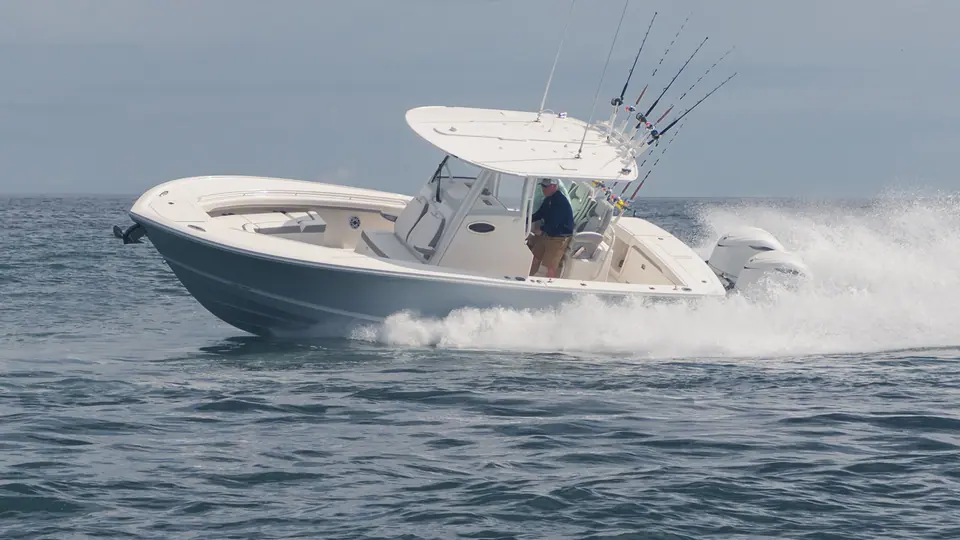
Lou Codega's 24-degree hull in a 9-foot-5 package, refined since the 28 FS of 2011 and now rated for 700 hp with twin Yamaha F350s.
- Length
- 27.7 ft8.43 m
- Beam
- 9.4 ft2.87 m
- Cruise
- 30 kn
- Cabins
- None
- Used price
- $115K to $380K
On this page
- Overview
- Why a Regulator 28 for sale rarely lasts long
- From the 26 to the 28 FS, a flush-deck rethink
- Codega's 24-degree hull in a 9-foot-5 package
- Twin Yamahas, from F300 to F350
- A fishing deck with 1,248 quarts of box space
- The 2026 update, Seakeeper Ride and a new T-top
- Family duty, the console head and forward seating
- Outer Banks roots and a tournament following
- Buying a used 28 FS versus a new 28
- Specifications
- Price and value
- Strengths and weaknesses
- Used buyer checklist
- Rivals
- Our verdict
- FAQ
The Regulator 28 is a 27-foot-8 twin-outboard center console with a 24 degree Codega hull, 219 gallons of fuel and twin Yamaha F350s on current boats. Built in Edenton, North Carolina, it is a benchmark for rough-water ride in its size.
- Offshore anglers who trailer
- Families who fish
- First offshore boat buyers
- Owners prioritizing ride quality
Regulator 28 by the numbers
- Speed to length ratio at cruise
- 6.11A planing cruise. Fast passages in exchange for much higher fuel burn per mile.
- Estimated range at cruise
- 320 nmUsing 90 percent of tank capacity at the cruise speed and fuel burn listed on this page.
- Fuel economy at cruise
- 1.62 nmpgNautical miles per gallon at cruise, both engines combined.
- Horsepower per ton
- 148 hpVery high power to weight, built for speed.
- Length to beam ratio
- 2.94 : 1A beamy hull with lots of volume for its length.
Why a Regulator 28 for sale rarely lasts long
Search for a Regulator 28 for sale and you will notice two things: there are never many listed, and the good ones disappear quickly. The 28 sits in the sweet spot of the offshore center console market. It is big enough to run 40 to 60 miles out to the Gulf Stream or the canyons on a reasonable day, small enough to trailer or keep on a lift, and it carries the Regulator reputation for an exceptionally soft, dry ride.
The 28 first appeared as the 28 FS, shown at the Fort Lauderdale show in October 2010 and tested by Sport Fishing for 2011, a stretched and flush-decked take on the well-loved Regulator 26 that went on to become the brand's core offshore boat. Since then Regulator has updated it several times, and Boating's 2026 test concluded the latest version may be the best yet. That continuity makes the 28 an easy boat to shop across years, because the hull has stayed essentially the same.
From the 26 to the 28 FS, a flush-deck rethink
The original Regulator 26 from the early 1990s put the Edenton, North Carolina, company on the map. When Regulator replaced it with the 28 FS, the main changes were a flush deck that eliminated the step up midship, a forward casting and seating area, and more fishing storage. Sport Fishing's 2011 review said the 28 FS met and surpassed the attributes of the 26.
Later updates dropped the FS suffix from the marketing, so you will see used boats listed both as the 28 FS and simply as the Regulator 28. They share the same Codega hull concept, with the differences concentrated in the console, hardtop, seating, fuel capacity (235 gallons on the 2011 boat, 219 on current boats) and power.
Codega's 24-degree hull in a 9-foot-5 package
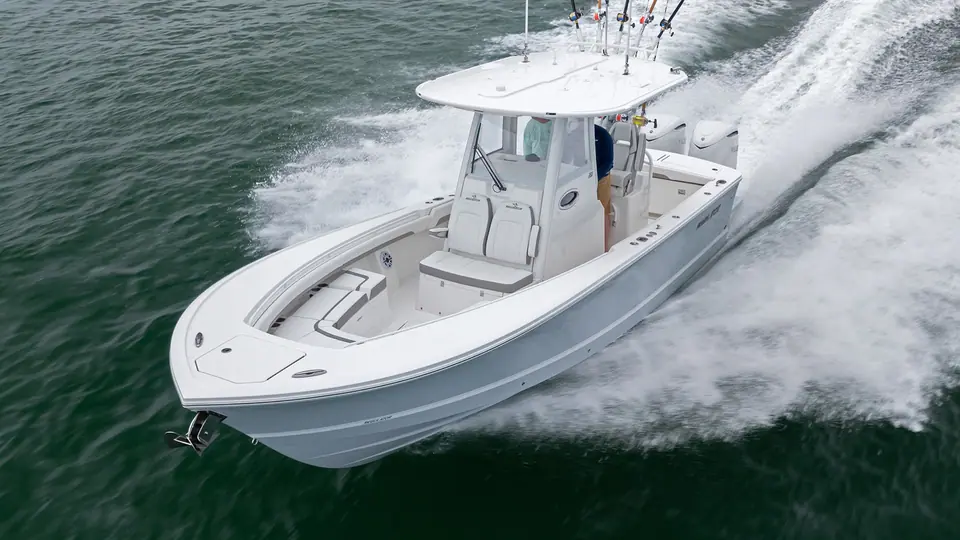
The 28 is a non-stepped deep-V with 24 degrees of transom deadrise, designed by Lou Codega. The bottom is solid fiberglass, and Sport Fishing described a very beefy grid stringer system bonded into the hull. Current boats weigh 9,480 lb dry with engines, heavy for a 28-footer, and that weight is a big part of the ride.
The 9-foot-5 beam is narrow enough for easy trailering with a permit in most states, though at nearly 10,000 lb plus fuel and gear you need a serious tow vehicle and a tandem or triple axle trailer. In rough water, the hull is predictable and soft. Sport Fishing noted a short roll moment with gentle transitions in challenging seas, and Boating described handling as sticky, with minimal sliding in turns.
Draft is 23 inches with engines up and about 36 inches with engines down, and bridge height is 117 inches, useful information for owners who keep the boat behind a fixed bridge.
Twin Yamahas, from F300 to F350
The 2011 test boat with twin Yamaha F300s reached 60 mph at 5,800 rpm on 52.5 gallons per hour and cruised at 34.5 mph at 3,500 rpm on 18.5 gallons per hour, or 1.87 mpg. Those are strong numbers for a heavy deep-V, and they show the efficiency of a well-designed hull.
Current boats come standard with twin 350 hp Yamaha outboards. Boating's 2026 test had the boat planing in about four seconds and praised the extra midrange torque, though the published text of that test does not give a top speed. The power rating has risen over the years: Sport Fishing's 2021 buyer's guide listed a 600 hp maximum, while Boating lists 700 hp for the 2026 boat, so check the capacity plate on any specific boat before repowering.
With 219 gallons of fuel on current boats (235 on the 2011 version), the 28 has range for most offshore trips. At the 2011 cruise figures, a full tank with a 10 percent reserve would give around 370 statute miles; real-world range with modern, heavier boats will be lower.
A fishing deck with 1,248 quarts of box space
Regulator lists 1,248 quarts of total fish box and storage capacity. The largest compartment is a 456-quart in-deck fish box that doubles as locking rod storage, backed by a 256-quart center forward storage box, two 169-quart forward seat boxes, a 74-quart console cooler seat and a 124-quart transom fish box. A 25-gallon transom livewell is standard, and Regulator offers a self-flushing bronze sea chest for anglers who need a faster fill.
The leaning post carries a slide-out cooler, four rod holders and tackle storage with a drawer and tray slots. A tuna door lets anglers bring big fish aboard and makes boarding from the water easier. The raised bullnose toe rail and extra-wide gunwales improve security when fighting fish.
The 2026 update, Seakeeper Ride and a new T-top
The latest Regulator 28 makes Seakeeper Ride vessel attitude control standard, a feature that reduces pitch and roll underway and makes rough water runs more comfortable. The T-top has been updated with a ventilation system and integrated handrail, and the helm carries twin 16-inch Garmin touchscreens.
Other details include a raised bullnose toe rail, ladder-back helm chairs, an engine flush and an oversized bilge access hatch. Boating priced the 2026 model at $392,495 to start.
Family duty, the console head and forward seating
The 28 is not just a fishing boat. Forward seating converts into a casting platform when the cushions come off, and the console hides a head compartment with a 6-gallon holding tank. A 33-gallon freshwater tank supplies the washdown and a transom shower, which is enough for a day of swimming or a dive trip.
Compared with dedicated family boats, the 28 gives up lounge space and a cabin. What it gives back is the ability to keep everyone comfortable on the run home when the afternoon sea breeze has built to 3 or 4 feet, which in many coastal areas is exactly when families get scared off boating. That is why so many Regulator owners describe the 28 as the boat their spouse actually likes.
The broad buyer pool, anglers on one side and families on the other, is also what keeps the used market liquid and resale values firm.
Outer Banks roots and a tournament following
Regulator's reputation was built off Oregon Inlet and Hatteras, some of the most demanding inlets on the East Coast, and the 28 inherits that pedigree. It is a common sight in Mid-Atlantic and Carolina offshore tournaments, especially small-boat divisions and kingfish, dolphin and wahoo events where a two-engine boat is the practical choice.
It is not the fastest 28 on a flat day. Lighter stepped boats will beat it to the fish in calm conditions. When the wind is blowing against the Gulf Stream, though, the Regulator's ability to hold 30 mph or more in a nasty sea often makes it the quicker boat in practice, and that is the reputation anglers pay for.
Buying a used 28 FS versus a new 28
Used Regulator 28s range from about $115,000 for early 28 FS boats with original engines to around $380,000 for nearly new boats. Early boats offer good value, but plan for a repower if the engines have high hours. Mid-generation boats from about 2017 to 2022 offer a good balance of price and features.
A new 28 costs around $392,000 to $460,000 depending on options. The jump in price over a decade reflects inflation, more powerful engines and standard Seakeeper Ride. Annual running costs including engine service, insurance, storage and maintenance run around $14,000 to $30,000 excluding fuel and depreciation.
Regulator 28 specifications
| Length overall | 27.7 ft8.43 m |
|---|---|
| Beam | 9.4 ft2.87 m |
| Draft | 3 ft0.91 m |
| Air draft | 9.8 ft2.97 m |
| Displacement | 9,48 lbs4,3 kg |
| Fuel capacity | 219 gal829 L |
| Fresh water | 33 gal125 L |
| Cabins | None |
| Berths | None |
| Heads | 1 (console, 6 gallon holding tank) |
| Standard engines | 2 x Yamaha F350 outboards (700 hp rating) |
| Optional engines | Earlier boats 2 x Yamaha F300 outboards |
| Maximum power | 700 hp |
| Cruise speed | 30 knots |
| Top speed | 52 knots |
| Hull type | Non-stepped deep-V monohull, 24 degree transom deadrise |
| Hull construction | Hand-laid solid fiberglass bottom with bonded fiberglass grid stringer system |
| Builder | Regulator Marine, United States |
| Naval architect | Lou Codega |
| Production | 2011 to present |
| Status | In production |
Figures come from builder documentation and independent tests where available. Displacement is usually quoted light, so a loaded cruising boat will weigh more. Compare these specs with another model.
Performance data
| Test rig | RPM | Speed (mph) | Fuel (gph) |
|---|---|---|---|
| 2 x Yamaha F300 (2011) | 3500 | 34.5 | 18.5 |
| 2 x Yamaha F300 (2011) | 5800 | 60 | 52.5 |
Sport Fishing 2011 test of the 28 FS with twin Yamaha F300s, 30 mph in about seven seconds. Boating's 2026 test of the twin F350 boat did not publish speed or fuel figures in its text.
How much does a Regulator 28 cost?
Sport Fishing listed the 2011 Regulator 28 FS at $159,995 with twin Yamaha 300s, while the 2026 model starts at $392,495 with twin F350s and Seakeeper Ride. On the used market, engine hours and repower history matter most, followed by electronics, hardtop condition and whether the boat has a tuna door and later-style T-top.
Estimate your yearly cost
A planning estimate using common rules of thumb: insurance near 1.5 percent of value, maintenance near 3 percent, haul out and bottom paint by length. Your marina, region and use will move these numbers. Open the full cost calculator.
Regulator 28 timeline
- 1988Regulator Marine founded in Edenton, North Carolina
- 1990Original Regulator 26 launched
- 2011Regulator 28 FS introduced with twin Yamaha F300s
- 2021Updated 28 listed at 219 gallons of fuel
- 2026Latest update adds standard Seakeeper Ride and twin F350s
Strengths and weaknesses
What owners like
- Soft, dry Codega ride
- Efficient twin-engine economy
- Trailerable with a permit
- Strong resale
- Versatile fishing and family layout
- Standard Seakeeper Ride on 2026 boats
What to weigh up
- Heavy for its size
- Limited supply on the used market
- No cabin
- New price has risen sharply
Used Regulator 28 buyer checklist
Take this list to a viewing. Your ticks are saved in this browser so you can come back to it.
Always commission an independent marine survey and an engine survey before you buy. How a marine survey works.
Rivals to consider
Grady-White Canyon 306
A larger family offshore boat with a cabin and a Hunt-designed hull.
Pursuit OS 325 Offshore
A larger, more luxurious option for buyers stepping up in size.
Compare side by sideOur verdict on the Regulator 28
The Regulator 28 is one of the best 28-foot offshore boats for owners who value ride quality and versatility. Its Codega hull handles rough water exceptionally well, twin engines keep costs reasonable, and the layout works for both fishing and family days. It is heavy and expensive new, but its resale and reputation make it a sound choice.
Regulator 28 questions answered
How much is a Regulator 28 for sale?
Used Regulator 28s range from about $115,000 to $380,000. New boats start around $392,000.
What are the Regulator 28 specs?
The Regulator 28 measures 27 feet 8 inches with a 9-foot-5 beam, weighs 9,480 lb with engines, carries 219 gallons of fuel and has a 24 degree deadrise.
How fast is a Regulator 28?
Sport Fishing recorded 60 mph at 5,800 rpm with twin Yamaha F300s in 2011. Boating's 2026 test of the twin F350 boat did not publish a top speed in its text.
What is the difference between the Regulator 28 FS and 28?
The 28 FS was the original version introduced around 2011. Later updates dropped the FS name but kept the same Codega hull.
Is the Regulator 28 trailerable?
Yes, with a wide-load permit and a heavy-duty tow vehicle, since the beam is 9 feet 5 inches and weight is close to 10,000 lb.
Regulator 28 photos
More center consoles & offshore boats to explore
Boston Whaler 285 Conquest
Center Consoles & Offshore Boats, 28 ft
Used $90K to $330K
Rambo 27
Center Consoles & Offshore Boats, 28 ft
Used $25K to $75K
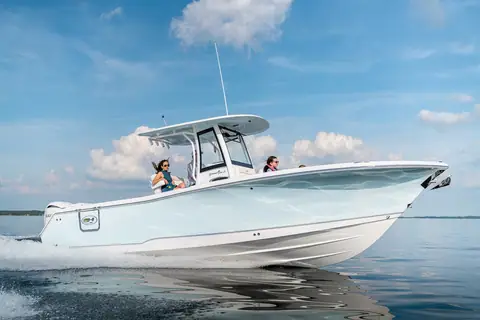
Sea Hunt Gamefish 27FS
Center Consoles & Offshore Boats, 28 ft
Used $70K to $210K
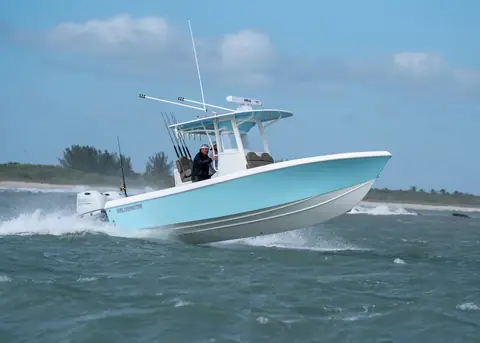
Bluewater 25T
Center Consoles & Offshore Boats, 28 ft
Used $165K to $215K