Contender Boats Center Consoles & Offshore Boats
Contender 25T Review and Used Buying Guide
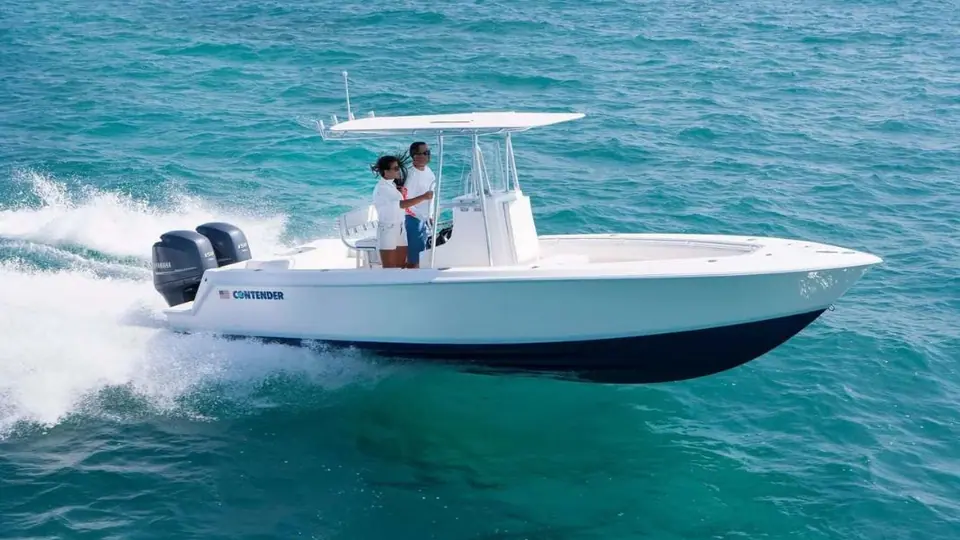
Contender's smallest three-piece tournament boat, a 25-foot 3-inch deep-V with a 24.5-degree transom and a fishing deck built for kingfish weigh-ins.
- Length
- 25.3 ft7.7 m
- Beam
- 8.5 ft2.59 m
- Cruise
- 28.4 kn
- Cabins
- 0
- Used price
- $35K to $175K
On this page
- Overview
- Why a Contender 25T for sale rarely sits long
- From 23 Tournament to 25T, untangling the name
- Big-boat construction in a three-piece 25-footer
- A deck laid out for the weigh-in
- Factory fuel numbers on twin Yamaha 150s
- Single or twin power on a 25-foot tournament hull
- Ownership costs and life on a trailer
- What the used market looks like
- Specifications
- Price and value
- Strengths and weaknesses
- Used buyer checklist
- Rivals
- Our verdict
- FAQ
The Contender 25T is a 25-foot 3-inch, 8-foot 6-inch beam tournament center console with a 24.5-degree deep-V, 145 gallons of fuel on current boats, up to 450 hp and a 140-gallon forward fish box.
- Kingfish and sailfish tournament teams on a budget
- Trailer anglers who want an offshore-capable ride
- Divers and spearfishermen in South Florida
- Owners stepping up from bay boats
Contender 25T by the numbers
- Speed to length ratio at cruise
- 6.06A planing cruise. Fast passages in exchange for much higher fuel burn per mile.
- Estimated range at cruise
- 267 nmUsing 90 percent of tank capacity at the cruise speed and fuel burn listed on this page.
- Fuel economy at cruise
- 2.04 nmpgNautical miles per gallon at cruise, both engines combined.
- Horsepower per ton
- 167 hpVery high power to weight, built for speed.
- Length to beam ratio
- 2.97 : 1A beamy hull with lots of volume for its length.
Why a Contender 25T for sale rarely sits long
Look at any South Florida ramp on a kingfish tournament morning and you will see why a Contender 25T for sale tends to change hands quickly. The boat is the entry ticket to Contender's Tournament series, it fits on a single-axle-friendly footprint of 25 feet 3 inches by 8 feet 6 inches, and it rides on the same 24.5-degree deep-V philosophy that made the brand famous among Gulf Stream anglers. Buyers who cannot justify a 32ST or a 35ST get most of the ride and all of the attitude for roughly half the money.
Contender was founded in 1984 by Joe Neber, a free diver and spearfisherman who still owns and runs the company. Its first boat was the Contender 25 Classic, and Sport Fishing describes the current 25T as the newest iteration of that original idea. Today the boats are built in two Florida plants: Homestead is the headquarters and builds the big custom boats, while Fort Pierce builds models of 32 feet and under, which includes the 25T.
The 25T sits in the current lineup alongside the 24S, the 28T and the bay boats, and for model year 2026 it comes standard with Seakeeper's Ride system, which Contender says cuts up to 70 percent of pitch and roll at cruise. That is a meaningful upgrade for a narrow, deep hull that can feel lively at rest.
From 23 Tournament to 25T, untangling the name
Used shoppers need to understand Contender's shifting model names, because listings mix them freely. Contender's own spec sheets from 2010, preserved on the company's old contenderoffshore.com site, show a boat called the 23 Tournament measuring 25 feet 3 inches overall with an 8-foot 6-inch beam, about 4,200 pounds dry, 6,250 pounds ready to fish, 175 gallons of fuel and a 400 hp rating. By 2011 the same dimensions were being sold as the 25 Tournament, and that is the boat the 25T name descends from.
The numbering refers loosely to the running hull, while the overall length includes the integrated transom that replaced a bolt-on bracket. Contender argued at the time that the integrated transom adds running surface and is structurally stronger because it is molded as part of the hull. The 2016 and 2019 factory pages list the 25T at the same 25 feet 3 inches, 4,200 pounds dry and 6,250 pounds loaded, with 178 gallons of fuel.
The current boat keeps the length and beam but the published numbers changed: 145 gallons of fuel, 5,400 pounds ready to fish, 20 gallons of water and a 450 hp maximum. Treat any listing that quotes 175 or 178 gallons as an earlier-generation boat, and confirm tank size against the hull identification number with Contender, which will provide fuel capacity for boats built from 2000 onward.
Big-boat construction in a three-piece 25-footer
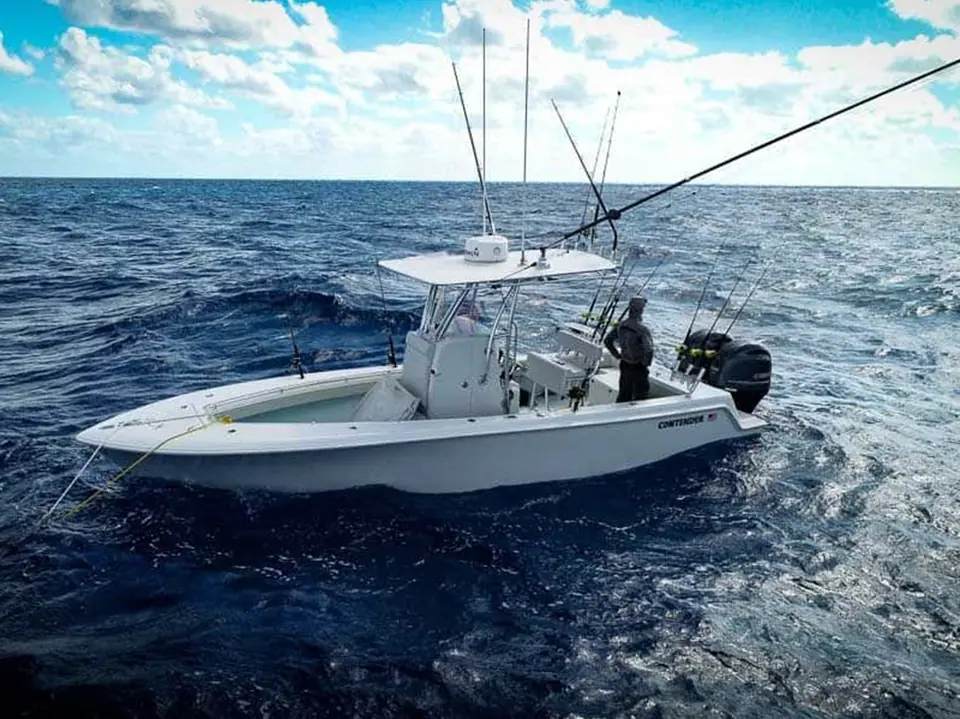
Contender describes the 25T as one of the smallest three-piece boats on the market, meaning a separate hull, liner and cap rather than the simpler two-piece construction common at this size. The hull is hand-laid fiberglass using biaxial and triaxial cloth, with balsa coring and strake reinforcement in the bottom laminate and a hand-laid, PVC-cored stringer grid. Fuel tanks are foamed and glassed in, and polyurethane foam fills most voids for flotation and sound deadening.
The deep-V carries 24.5 degrees of deadrise at the transom and a reverse-radius chine that Contender credits for knocking spray down and adding lift. In practice that combination gives the 25T a sharp, soft entry in a head sea and a dry ride for its size, at the cost of some roll at anchor. The new standard Seakeeper Ride system addresses running attitude rather than rest stability, so anglers who chum on anchor should still expect a deep-V's motion.
A deck laid out for the weigh-in
The standard deck on the current 25T is spare and purposeful. Forward is a 140-gallon fish box under the bow, two 76-gallon fish boxes sit aft in the sole, and a 40-gallon transom livewell keeps a load of goggle-eyes or threadfins alive. Two under-deck rod lockers flank the console and six under-gunwale racks hold spare outfits, so the T-top can be kept for trolling rods.
The console is Contender's M-Series unit with a side entry door, clear acrylic windshield and a built-in front seat with cushion and cooler. Behind it is a mini fixed-back aluminum leaning post with backrest, tray, four rod holders and a folding footrest. A laceless soft T-top with lighting and four rod holders is standard, and the full transom includes a dive door and an integral swim platform, which matters for divers and for anyone wiring a big fish to the boat.
Options run long because every boat is built to order: Yamaha Helm Master EX, a fiberglass hardtop, second station, electric head, clear enclosures, upgraded leaning posts, rear bench seat, coaming bolsters, outriggers, electric reel outlets, fresh and saltwater washdowns, gulper pumps in the aft boxes and forward seating. A boat set up for family cruising with forward and rear seating can look very different from a stripped tournament rig, so judge each used boat on how it was ordered.
Factory fuel numbers on twin Yamaha 150s
Contender's own performance bulletin for the 25 Tournament, archived from the factory site, lists a run with twin Yamaha F150 four-strokes swinging 13-3/4 by 19 Reliance propellers. The boat planed in just under 4 seconds and reached 52.2 mph at 6,000 rpm. The sweet spot came between 3,500 and 4,000 rpm, where the boat ran 26.4 to 32.7 mph while burning 10.7 to 13.9 gph, roughly 2.4 to 2.5 mpg. At 5,000 rpm it made 42.3 mph on 22 gph.
Those are factory figures on the earlier 175-gallon generation, so treat them as a ceiling rather than a promise for a loaded boat. Still, they show why the 25T has a following: a cruise in the low 30s mph at about 2.3 mpg means a day trip to the edge and back on a fraction of the tank. Contender did not publish a comparable curve for current single-engine packages, and buyers should ask the dealer for a sea trial with the exact power they intend to order.
Single or twin power on a 25-foot tournament hull
Contender has always rigged Yamaha outboards, and the 25T has been offered with single or twin engines. Earlier boats were rated to 400 hp and commonly carried twin 150s, twin 200s or a single 250 to 300. The current 450 hp rating opens the door to a single Yamaha V8 or twin 200 to 225 hp engines.
For a tournament angler running 40 miles offshore, twins buy redundancy and a get-home engine. For most owners, a modern single 300 to 350 hp is lighter, cheaper to maintain and easier to trailer, and the hull's weight distribution was designed to work with either. On the used market, twin-engine boats usually command a premium, but they also carry twice the gearcase, water pump and lower unit bills, so price the service history accordingly.
Ownership costs and life on a trailer
At 8 feet 6 inches of beam the 25T can be towed without a wide-load permit, and the 5,400-pound ready-to-fish figure means a capable half-ton or three-quarter-ton truck once you add a trailer, engines and fuel. Many owners keep these boats on lifts or in dry stack, which keeps the bottom clean and avoids the cost of bottom paint.
Our estimate for annual running costs is $9,000 to $20,000 excluding depreciation: insurance, storage or a slip, annual outboard service, a few hundred gallons of fuel a season and routine canvas and electronics upkeep. Tournament anglers who fish every weekend will burn through the top of that range quickly, mostly in fuel and engine hours.
What the used market looks like
Contender boats hold value better than most production center consoles of their size because they are built to order, they have a strong tournament reputation, and the 25T is the cheapest way into the Tournament series. Expect older 25 Tournaments with repowered engines to trade in the $35,000 to $60,000 band, mid-2010s boats from roughly $50,000 to $80,000, and late-model boats from about $105,000 upward depending on power. Options matter more than model year: a hardtop, Helm Master, outriggers and quality electronics all add real value.
Contender 25T specifications
| Length overall | 25.3 ft7.7 m |
|---|---|
| Beam | 8.5 ft2.59 m |
| Draft | 1.5 ft0.46 m |
| Displacement | 5,4 lbs2,449 kg |
| Fuel capacity | 145 gal549 L |
| Fresh water | 2 gal76 L |
| Cabins | 0 |
| Berths | 0 |
| Heads | Optional electric head in console |
| Standard engines | Built to order: single or twin Yamaha outboards |
| Optional engines | Yamaha Helm Master EX joystick package |
| Maximum power | 450 hp |
| Cruise speed | 28.4 knots |
| Top speed | 45.4 knots |
| Hull type | Deep-V planing hull, 24.5-degree transom deadrise, reverse chines, integrated transom |
| Hull construction | Hand-laid fiberglass with PVC-cored stringer grid; three-piece hull, liner and cap |
| Builder | Contender Boats, United States |
| Naval architect | Contender Boats in-house design team |
| Status | In production |
Figures come from builder documentation and independent tests where available. Displacement is usually quoted light, so a loaded cruising boat will weigh more. Compare these specs with another model.
Performance data
| RPM | Speed (mph) | Fuel (gph) | mpg |
|---|---|---|---|
| 1000 | 5.3 | 1.7 | 3.1 |
| 2000 | 8.6 | 4.4 | 1.95 |
| 3000 | 18.3 | 9.4 | 1.95 |
| 3500 | 26.4 | 10.7 | 2.47 |
| 4000 | 32.7 | 13.9 | 2.35 |
| 4500 | 38.1 | 17.9 | 2.13 |
| 5000 | 42.3 | 22 | 1.92 |
| 5500 | 47.3 | 29.2 | 1.62 |
| 6000 | 52.2 | 33.1 | 1.58 |
Contender factory performance bulletin for the 25 Tournament (earlier 175-gallon generation), twin Yamaha F150 outboards, 13-3/4 x 19 Reliance propellers, 0 to 5 mph wind, time to plane 3.98 seconds. Figures in mph and gallons per hour total, as published by Contender.
How much does a Contender 25T cost?
Contender does not publish retail prices and every boat is ordered semi-custom, so the new range is our estimate for a single or twin Yamaha package with a T-top, electronics and the now-standard Seakeeper Ride. Used prices split sharply by generation. Older 25 Tournaments with twin 150s or a single 250 to 300 sit at the bottom, while late boats on the 450-hp-rated current deck command the top of the range, especially with Helm Master, a hardtop and a trailer.
Estimate your yearly cost
A planning estimate using common rules of thumb: insurance near 1.5 percent of value, maintenance near 3 percent, haul out and bottom paint by length. Your marina, region and use will move these numbers. Open the full cost calculator.
Versions and options
- 23 Tournament (circa 2010)
- Factory spec sheet name for the 25-foot 3-inch hull: 8-foot 6-inch beam, about 4,200 lb dry, 6,250 lb ready to fish, 175 gallons, 400 hp maximum.
- 25 Tournament / 25T (2011 to 2019 pages)
- Same dimensions under the new name, with 175 to 178 gallons, a 400 hp rating and an optional fuel upgrade quoted at up to 240 gallons on the 2011 site.
- Current 25T
- 25 feet 3 inches, 145 gallons, 20 gallons of water, 5,400 lb ready to fish, 450 hp maximum, M-Series console, and Seakeeper Ride standard from model year 2026.
Contender 25T timeline
- 1984Joe Neber founds Contender Boats and builds the original 25 Classic
- 1997Contender opens a new production facility to meet demand
- 2010Factory spec sheets list the 25-foot 3-inch hull as the 23 Tournament
- 2011The same hull appears in the fleet as the 25 Tournament
- 202625T gains Seakeeper Ride as standard equipment
Strengths and weaknesses
What owners like
- Genuine 24.5-degree deep-V ride in a trailerable package
- Three-piece hull, liner and cap construction at 25 feet
- Huge fish storage with a 140-gallon forward box and twin 76-gallon aft boxes
- 40-gallon transom livewell and six under-gunwale rod racks
- Semi-custom ordering lets owners spec a pure tournament rig
- Strong resale and tournament reputation
What to weigh up
- Narrow, deep hull rolls more at anchor than flatter rivals
- Fuel capacity dropped to 145 gallons on the current boat
- No published retail pricing, so new quotes vary by dealer
- Minimal seating as standard; family comfort costs extra
- Model-name changes make used comparisons confusing
Used Contender 25T buyer checklist
Take this list to a viewing. Your ticks are saved in this browser so you can come back to it.
Always commission an independent marine survey and an engine survey before you buy. How a marine survey works.
Rivals to consider
Regulator 25
More beam, a plusher family layout and Lou Codega's hull, at a higher price.
Compare side by sideSea Hunt Gamefish 25
A value-priced fishing console with a softer ride and much lower entry cost.
Compare side by sideBluewater Sportfishing 25T
A narrow, deep tournament hull with a similar philosophy and a cult following.
Compare side by sideEverglades 243 Center Console
Foam-filled RAMCAP construction and more family seating on a shorter hull.
Compare side by sideOur verdict on the Contender 25T
The Contender 25T is the purest small tournament boat Contender builds, a narrow, deep, three-piece 25-footer that rides far bigger than its size and carries enough box space for a serious day offshore. It is not a family dayboat out of the box, and the current boat carries less fuel than the 25 Tournaments of the 2010s, but for anglers who care about getting to the fish fast and dry, a well-kept 25T is still one of the smartest buys in the class. Shop by generation, insist on engine records, and pay up for boats ordered with the options you would have chosen yourself.
Contender 25T questions answered
How big is the Contender 25T?
The 25T is 25 feet 3 inches long with an 8-foot 6-inch beam and an 18-inch draft. Current boats weigh about 5,400 pounds ready to fish.
How much fuel does the Contender 25T hold?
The current 25T carries 145 gallons. Earlier 25 Tournaments were listed at 175 to 178 gallons, so check the specific boat.
What is the max horsepower on a Contender 25T?
The current boat is rated for 450 hp. Earlier versions were rated to 400 hp and were often rigged with twin Yamaha 150s.
How fast is a Contender 25T?
Contender's factory bulletin for the 25 Tournament with twin Yamaha F150s shows 52.2 mph at 6,000 rpm and an efficient cruise of about 32.7 mph at 13.9 gph.
Is the Contender 25T the same as the 23T?
Essentially yes. Contender's 2010 spec sheets called the 25-foot 3-inch hull the 23 Tournament before it was renamed the 25 Tournament and later the 25T.
Where is the Contender 25T built?
Contender builds boats of 32 feet and under, including the 25T, at its Fort Pierce, Florida plant, with headquarters in Homestead.
Contender 25T photos
More center consoles & offshore boats to explore
SeaCraft 25 Open
Center Consoles & Offshore Boats, 25 ft
Used $15K to $48K
Parker 2520 XLD Sport Cabin
Center Consoles & Offshore Boats, 25 ft
Used $50K to $200K
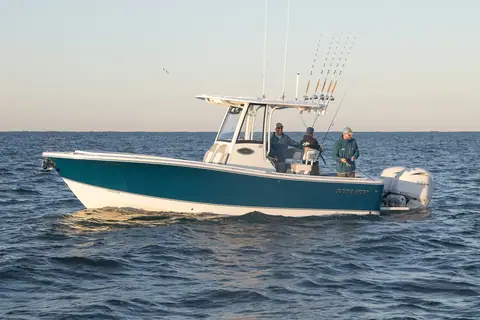
Regulator 25
Center Consoles & Offshore Boats, 25 ft
Used $80K to $250K
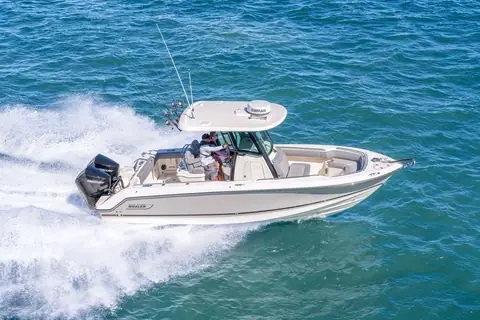
Boston Whaler 250 Outrage
Center Consoles & Offshore Boats, 25 ft
Used $55K to $200K