Freeman Boatworks Center Consoles & Offshore Boats
42 Freeman (Freeman 42LR) Review, Specs and Price Guide
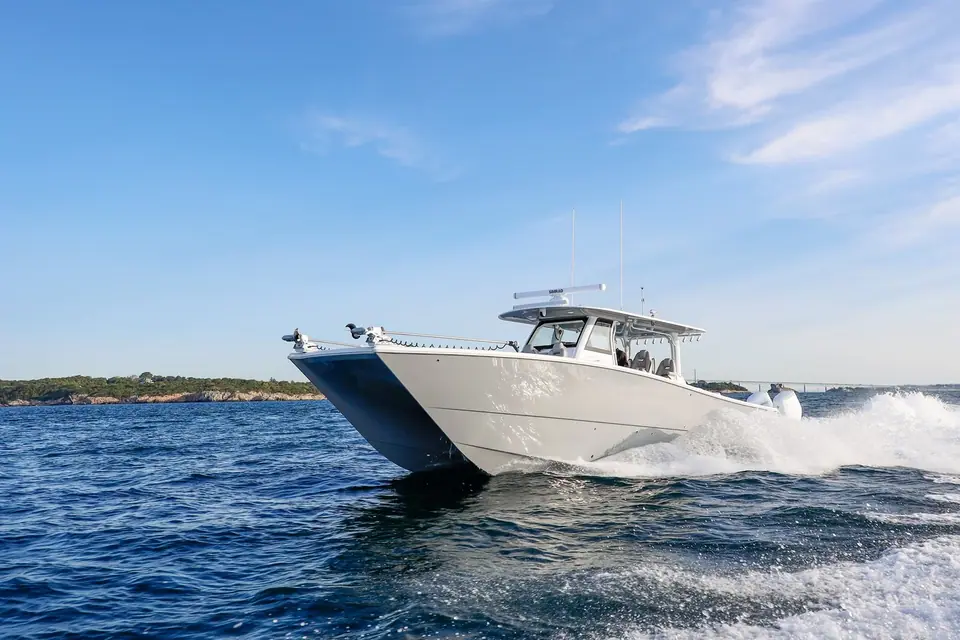
An 800-gallon, quad-outboard catamaran built in South Carolina for anglers who measure a fishing day in hundreds of miles.
- Length
- 42 ft12.8 m
- Beam
- 11.8 ft3.58 m
- Cruise
- 39 kn
- Cabins
- None (walk-in console compartment)
- Used price
- $425K to $1.2M
On this page
- Overview
- How the 42 Freeman became the long-range cat everyone copies
- Two sponsons, a tunnel and why the 42 does not bow steer
- 800 gallons at 45 mph, the range math
- Choosing among the quad outboard packages
- Cockpit, livewells and the long-range fishing layout
- Helm, console and what is inside
- Venice captains, rig runs and tournament credibility
- Owning a 42 Freeman, slips, trailers and service
- Shopping the 42 Freeman for sale market
- Specifications
- Price and value
- Strengths and weaknesses
- Used buyer checklist
- Rivals
- Our verdict
- FAQ
The Freeman 42LR is a 42-foot center console power catamaran with 800 gallons of fuel, up to 1,800 hp of outboards and a cruise of about 45 mph at 0.95 mpg. It is the long-range workhorse of the Freeman line.
- Canyon and rig anglers who run 80 to 150 miles
- Tournament teams chasing distant fish
- Gulf Coast and Carolina charter captains
- Bahamas crossings without fuel stops
Freeman 42LR by the numbers
- Speed to length ratio at cruise
- 6.17A planing cruise. Fast passages in exchange for much higher fuel burn per mile.
- Estimated range at cruise
- 597 nmUsing 90 percent of tank capacity at the cruise speed and fuel burn listed on this page.
- Fuel economy at cruise
- 0.83 nmpgNautical miles per gallon at cruise, both engines combined.
- Horsepower per ton
- 248 hpVery high power to weight, built for speed.
- Length to beam ratio
- 3.57 : 1Catamaran overall proportions. Wider platforms resist pitching and heel.
How the 42 Freeman became the long-range cat everyone copies
Billy Freeman started Freeman Boatworks around 2006 after running an old cat and deciding he could build something bigger and better. With naval design engineer Jesse Rhodes he drew a 33-footer, finished the first hull in a shed behind his Charleston house in 2007 and took it to Venice, Louisiana, where charter captains became his first buyers. The model that turned the company into a serious offshore brand, though, is the 42. Freeman calls it the 42LR, for long range, and most anglers simply call it the 42 Freeman.
The 42 earns that name with 800 gallons of fuel and a hull that lets four outboards push nearly nine tons of boat at 45 mph while still returning close to one mile per gallon. That combination made it the default choice for Venice, Louisiana, charter captains running to the deepwater rigs, for Carolina crews chasing tuna on the edge of the Gulf Stream, and for owners in the Bahamas who want to cross and come back without hunting for fuel.
Jimmy Buffett's team was a Freeman customer too. According to Power and Motoryacht, Buffett bought a one-off Freeman pilothouse boat from its first owner and then asked the yard for a custom pilothouse 42, a project Billy Freeman said was beyond what his production-focused shop could take on at the time. When a buyer with unlimited choice goes looking for a Freeman hull, the platform has arrived.
Two sponsons, a tunnel and why the 42 does not bow steer
Traditional power cats earned a mixed reputation in the 1990s. They were efficient and level in a head sea, but many tripped or steered with their bows in a following or quartering sea, the exact conditions you face running home with the wind behind you. Billy Freeman designed his sponsons specifically to cure that, with high freeboard, a lot of flare forward and a tunnel shaped to cushion rather than slam.
Freeman's sponsons are symmetrical, meaning each hull is a small V with the same shape on its inboard and outboard side, where rivals such as Invincible use asymmetrical sponsons that are flat on the tunnel side. Freeman's case for symmetry is the head-sea ride, and he says the real design work is making the bottom behave at both light and heavy loads. The VH suffix on the 34VH and 37VH stood for vented hull, with air fed into the running surface to cut drag; the 42 was sold alongside them as the 42LR.
Construction is hand-laid biaxial and triaxial glass in vinylester resin with closed-cell structural core, as Sport Fishing described on the 37VH. The headline specifications have barely changed since at least 2017 (42 feet, 11 feet 9 inches of beam, 800 gallons), but Freeman raised the maximum power rating from 1,600 hp to 1,800 hp, so power, electronics and finish are what separate an early boat from a late one.
- Beam 11 feet 9 inches, comfortably narrow for a 42-foot catamaran
- Draft roughly 24 inches, useful on Gulf Coast flats and passes
- Dry weight about 14,500 lb with engines, about 17,500 lb ready to fish
- Trailer height with radar listed at 14 feet 3 inches
800 gallons at 45 mph, the range math
Freeman quotes a typical cruise of 45 mph at 0.95 mpg for the 42. Do the arithmetic and that is a fuel burn of roughly 47 gallons per hour across all engines, which is about what a modern 39-foot monohull center console burns at a slower cruise. Keep 10 percent of the 800 gallons in reserve and the theoretical range at that speed is close to 680 statute miles, or roughly 590 nautical miles.
Real ranges are lower, because nobody runs a fishing boat at one steady throttle setting, and because a fully fueled 42 with ice, bait, crew and tackle is heavier than the brochure boat. Still, owners routinely run 100 miles out to the canyons or the floaters, fish all day and come home with a comfortable margin. That is the point of the LR. You stop planning trips around fuel docks.
Choosing among the quad outboard packages
The 42LR is rated for up to 1,800 hp today, which in practice means four 450 hp class outboards; in 2017 Freeman listed a 1,600 hp maximum, the equivalent of quad 400s. Most boats on the water carry quads, and the Venice charter boat Sport Fishing rode on ran four Yamaha 300s. Later boats move to 400 to 450 hp class engines from Yamaha or Mercury. Some owners order triples to save weight and maintenance, accepting a slower top end.
For a long-range fishing boat, quads of moderate horsepower are often the smartest choice. Four 350s or 400s turning at a relaxed rpm deliver the 45 mph cruise with headroom, and if one engine fails 150 miles offshore the boat still gets home on plane with three. Quad 450s add top speed that you rarely use offshore and more weight on the transom.
- Quad 300 to 350 hp: lowest acquisition and repower cost, typical of older hulls
- Quad 400 to 450 hp: strongest hole shot with full fuel and tower, highest top speed
- Triple 450 class: lighter transom, simpler maintenance, gives up redundancy
Cockpit, livewells and the long-range fishing layout
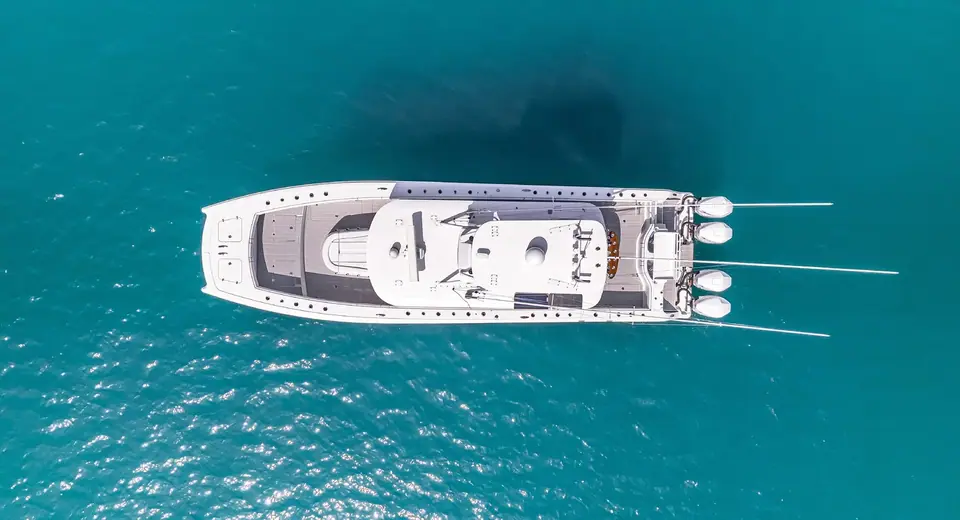
Freeman describes the 42 cockpit as oversized, and it is. A catamaran carries its beam further aft than a deep-V, so the back deck stays wide all the way to the transom. Two transom livewells with pumpout hold a combined 110 gallons, and each of the floor wells holds 70 gallons, so a crew can carry pogies, goggle eyes and blue runners separately and still have room for a load of live chum.
Forward, insulated boxes total about 400 quarts, with extra-large dry storage boxes and midship storage for everything from harpoon gear to foul weather clothing. Gunwale rod holders, rocket launchers on the hardtop and a console with tackle drawers are standard fare, and most owners add tuna tubes. On a deep-drop or swordfish boat the cockpit easily handles electric reels on both corners with a third angler working the middle.
The other fishing advantage is stability at rest. A catamaran rolls less on the drift than a narrow monohull, which matters when four people are standing on the gunwale watching a chunk slick or working jigs over a rig. It is not perfect, because a cat can develop a short, snappy motion in a steep beam sea, but most anglers find it far easier to stand up in all day.
Helm, console and what is inside
The helm on recent boats is built around two large-format multifunction displays, and many owners spec dual Garmin screens in the 22 to 24 inch range with radar, sonar and digital switching. Seating is typically a row of three bolstered helm chairs on a leaning post module that also carries a tackle center and drink cooler.
The console opens to a walk-in compartment with room for a marine head, battery charging and wiring, and dry storage. The 42 is a fishing boat first, so do not expect a cabin with a berth. If you want overnight accommodation in a Freeman, the 47 or a custom pilothouse build is the place to look.
Venice captains, rig runs and tournament credibility
Freeman's reputation was built by charter skippers before it was built by marketing. Billy Freeman has said he never had to talk Louisiana captains into a cat; they already understood why a level ride and big fuel tanks mattered on 60 to 80 mile runs to the deepwater rigs. Sport Fishing reported on one Venice captain's Freeman with four Yamaha 300s cruising at 45 knots on the way out to the rigs and 48 knots on the way home, finishing the trip on three engines after a lower unit hit debris, which tells you how hard these boats are run.
The 42 is a regular sight at Gulf and South Atlantic billfish, tuna and wahoo tournaments, especially in events where the fish are far away and the scale closes early. Being able to run farther and faster than the field, and to do it in sloppy conditions, is exactly what tournament anglers pay for. The hull's ability to keep its speed in a 3 to 4 foot head sea is the single most cited reason owners switch from a monohull.
Owning a 42 Freeman, slips, trailers and service
At 11 feet 9 inches wide the 42LR is narrow for a cat, but it still needs a wide-load permit to trailer and a hydraulic trailer rated for a ready-to-fish weight approaching nine tons. Most owners keep the boat on a lift or in dry stack. Check that your marina's forklift can handle the weight; many stack facilities top out below this boat.
Annual costs are dominated by the engines. Four outboards mean four sets of annual service, water pumps, plugs, gearcase oil and anodes, typically $2,000 to $3,500 per engine depending on the brand and how much is included. Add insurance, bottom paint or lift fees, electronics updates and fuel, and a realistic yearly budget runs $45,000 to $95,000 excluding depreciation.
Shopping the 42 Freeman for sale market
Freeman produces boats steadily but not in huge numbers, and demand for the 42 has stayed strong, so good used boats rarely sit. Expect asking prices from about $425,000 for an early quad 300 boat with tired engines to more than $1.1 million for a late model with low hours and fresh electronics.
The best value is usually a five to eight year old hull with a recent repower or engines still under an extended warranty. Because the hull design has barely changed, you are mostly buying engines, electronics and condition. A full engine survey with oil analysis on all four powerheads is non-negotiable, and a sea trial at full fuel tells you more about the boat's real performance than a light-load run.
Freeman 42LR specifications
| Length overall | 42 ft12.8 m |
|---|---|
| Beam | 11.8 ft3.58 m |
| Draft | 2 ft0.61 m |
| Displacement | 14,5 lbs6,577 kg |
| Fuel capacity | 8 gal3,028 L |
| Fresh water | 4 gal151 L |
| Cabins | None (walk-in console compartment) |
| Berths | None standard |
| Heads | 1 (in console, optional electric) |
| Standard engines | Triple or quad outboards rigged to order, up to 1,800 hp total (1,600 hp maximum in 2017) |
| Optional engines | Yamaha and Mercury four-stroke packages; older hulls commonly quad Yamaha 300s, later hulls 400 to 450 hp class engines |
| Maximum power | 1,800 hp |
| Cruise speed | 39 knots |
| Hull type | Planing power catamaran with symmetrical sponsons |
| Hull construction | Hand-laid biaxial and triaxial fiberglass with vinylester resin and closed-cell structural foam core |
| Builder | Freeman Boatworks, United States |
| Naval architect | Billy Freeman (in-house design) |
| Other design credits | Jesse Rhodes (naval design engineer on the original Freeman catamaran concept) |
| Status | In production |
Figures come from builder documentation and independent tests where available. Displacement is usually quoted light, so a loaded cruising boat will weigh more. Compare these specs with another model.
How much does a Freeman 42LR cost?
Engine package drives the number more than anything else on a 42 Freeman. Quad Yamaha F300 boats from the mid 2010s trade at the bottom of the range, while recent hulls with quad 400 to 450 hp engines, a fiberglass hardtop, dual large-format Garmin displays and a gyro command well over a million. Engine hours and remaining powerhead warranty can move an asking price by six figures because a quad repower now costs roughly as much as a good used 30-footer.
Estimate your yearly cost
A planning estimate using common rules of thumb: insurance near 1.5 percent of value, maintenance near 3 percent, haul out and bottom paint by length. Your marina, region and use will move these numbers. Open the full cost calculator.
Freeman 42LR timeline
- 2007Billy Freeman's first 33-foot catamaran, designed with Jesse Rhodes, goes to Venice, Louisiana for trials
- 2016Freeman's range lists the 34VH, 37VH and 42LR, with 42LR hulls coming out of the mold
- 2017Freeman lists the 42LR at 14,500 lb dry, 800 gallons and a 1,600 hp maximum
- 2020The larger Freeman 47 joins the range above the 42
- 2026The 42LR remains in the Freeman lineup with up to 1,800 hp and 800 gallons of fuel
Strengths and weaknesses
What owners like
- 800 gallons of fuel gives genuine long-range capability
- Roughly 0.95 mpg at a 45 mph cruise per Freeman
- Level, fast ride in a head sea and no bow steer in following seas
- Huge, wide cockpit with 110 gallons of transom livewells
- Quad outboard redundancy for far offshore runs
- Strong demand keeps resale values high
What to weigh up
- No real cabin, the console is for a head and storage only
- Quad outboards are expensive to service and repower
- Heavy for trailering and beyond many dry stack forklifts
- Full fuel load noticeably changes how the boat rides
- Long build queues when demand is high
Used Freeman 42LR buyer checklist
Take this list to a viewing. Your ticks are saved in this browser so you can come back to it.
Always commission an independent marine survey and an engine survey before you buy. How a marine survey works.
Rivals to consider
Freeman 47
More fuel, a wider beam and real overnight potential, at a substantial jump in price and weight.
Compare side by sideInvincible 40 Catamaran
The other big-name fishing cat, with a different stepped design and a more performance-focused feel.
Compare side by sideYellowfin 42 Offshore
A stepped monohull that trades some fuel economy for a below-deck cabin and a classic deep-V motion.
Compare side by sideMidnight Express 43 Open
Faster and more lavishly finished, but aimed at a different, more luxury-oriented buyer.
Compare side by sideOur verdict on the Freeman 42LR
The 42 Freeman is the boat to buy if your fishing happens a long way from the dock. Eight hundred gallons, roughly one mile per gallon at 45 mph and a cat hull that holds its speed in a chop give it range and pace few monohulls can match. It is not a family cruiser and it is not cheap to run with four outboards, but as a long-distance fishing tool it is close to the benchmark, and the used market treats it accordingly.
Freeman 42LR questions answered
How much does a 42 Freeman cost?
A new Freeman 42LR typically lands between about $1.1 million and $1.45 million depending on engines and electronics. Used boats range from roughly $425,000 for early quad 300 boats to more than $1.1 million for late models.
What does LR stand for on the Freeman 42LR?
LR stands for long range. The 42 carries 800 gallons of fuel, enough for roughly 680 statute miles at Freeman's quoted cruise economy with a 10 percent reserve.
How fast is the Freeman 42?
Freeman quotes a typical cruise of 45 mph at 0.95 mpg. We have not found a published top speed for the 42; it depends on the outboard package and load.
What engines go on a 42 Freeman?
Most boats carry quad outboards, with Yamaha 300s common on older hulls and 400 to 450 hp class engines on newer ones. Maximum rated power is 1,800 hp today, up from 1,600 hp in 2017.
Does the Freeman 42LR have a cabin?
No. The console houses a head compartment and storage, but there is no berth. Buyers wanting overnight space usually look at the Freeman 47.
Can you trailer a 42 Freeman?
Yes, but at 11 feet 9 inches wide and about 17,500 lb ready to fish it needs a heavy-duty trailer, a large truck and wide-load permits in most states.
Freeman 42LR photos
More center consoles & offshore boats to explore
Yellowfin 42 Offshore
Center Consoles & Offshore Boats, 42 ft
Used $230K to $1.2M
Boston Whaler 420 Outrage
Center Consoles & Offshore Boats, 43 ft
Used $450K to $1.25M
Regulator 41
Center Consoles & Offshore Boats, 41 ft
Used $420K to $1.35M
Midnight Express 43 Open
Center Consoles & Offshore Boats, 43 ft
Used $380K to $1.5M