Yellowfin Yachts Center Consoles & Offshore Boats
36 Yellowfin for Sale, Yellowfin 36 Offshore Specs and Buying Guide
A twin-step, 24-degree tournament center console that has anchored the Yellowfin line since 2003 and still runs 70 mph on triple Mercury V10s.
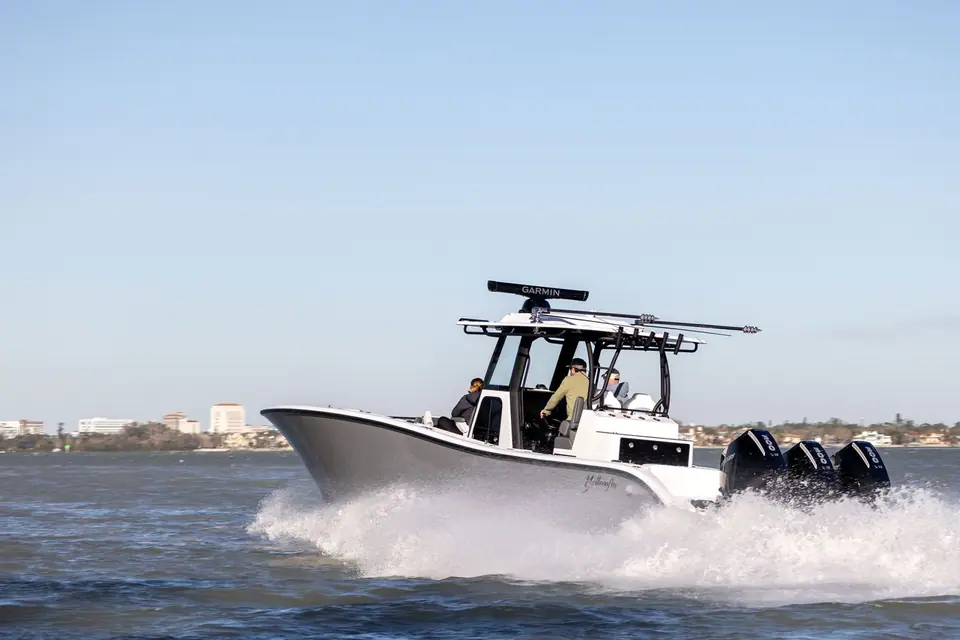
- Length
- 36.7 ft11.18 m
- Beam
- 10 ft3.05 m
- Cruise
- 35 kn
- Cabins
- None
- Used price
- $140K to $780K
On this page
- Overview
- Twenty-plus years as Yellowfin's signature offshore boat
- Twin steps, 24 degrees and a 10-foot beam
- From triple Verado 300s to Mercury V10s
- A fishing layout built for kingfish money
- Dry, light and fast in a beam sea
- Buying a 36 Yellowfin for sale, generation by generation
- What a triple-engine 36 costs to run
- Specifications
- Price and value
- Strengths and weaknesses
- Used buyer checklist
- Rivals
- Our verdict
- FAQ
The Yellowfin 36 Offshore is a 36-foot-8 twin-step center console with a 10-foot beam, 477 gallons of fuel and triple outboards up to 1,275 hp. Built in Florida since 2003, it is a kingfish and sailfish tournament icon.
- Kingfish and sailfish tournament teams
- Offshore anglers who value speed
- Owners who trailer to different fisheries
- Buyers seeking strong resale
Yellowfin 36 Offshore by the numbers
- Speed to length ratio at cruise
- 6.20A planing cruise. Fast passages in exchange for much higher fuel burn per mile.
- Estimated range at cruise
- 557 nmUsing 90 percent of tank capacity at the cruise speed and fuel burn listed on this page.
- Fuel economy at cruise
- 1.30 nmpgNautical miles per gallon at cruise, both engines combined.
- Horsepower per ton
- 207 hpVery high power to weight, built for speed.
- Length to beam ratio
- 3.67 : 1A slim, easily driven hull.
Twenty-plus years as Yellowfin's signature offshore boat
Anyone shopping for a 36 Yellowfin for sale is looking at the boat that defined the brand. Wylie Nagler founded Yellowfin Yachts on Florida's Gulf Coast in the late 1990s, and the 36 Offshore arrived in 2003. Yellowfin itself calls it a perennial flagship model, and it has stayed in the lineup through every evolution of outboard technology since, from early four-strokes to today's Mercury V10s.
The 36 earned its standing on the tournament circuit. On the Southern Kingfish Association trail and in South Florida sailfish events, a 36 Yellowfin with triple outboards became the standard tournament boat for teams who needed to run hard, fish efficiently and come home fast. That reputation is still the main reason used boats sell for strong numbers.
Ownership has changed. In June 2021 Warbird Marine Holdings, formed by EagleTree Capital, bought Yellowfin, making it a sister company to Invincible Boat Company. Nagler stayed on as president, and the Sarasota team remained in place. The company has since expanded factory direct sales in Florida, including a center in St. Augustine.
Twin steps, 24 degrees and a 10-foot beam
The hull is a twin-step deep-V with 24 degrees of deadrise and a beam of just 10 feet. That narrow beam relative to length is the key to the ride. The hull slices through a short chop instead of pounding over it, and Sport Fishing's testers reported it riding with pleasing smoothness in 4 to 5 foot seas and handling 6 foot waves offshore. A 2009 test went further, describing the boat as stable and predictable in 8 to 10 foot seas.
The steps introduce air under the hull, reducing wetted surface and drag, which is where the 36 gets its speed and efficiency. They also give the boat a lively, responsive feel in turns. The trade-off is that stepped hulls reward a skilled driver. Trim needs attention in following seas and in hard turns, and an inexperienced captain can make a stepped boat feel twitchy. Most owners adapt quickly.
Construction uses vinylester resin and Core-Cell composite coring, with titanium cleats and through-hull fittings added during the 2017 refresh. These are tough hulls, but tournament boats are run hard, so survey them carefully.
- Length overall 36 feet 8 inches, beam 10 feet
- Deadrise 24 degrees with two steps
- Draft about 1 foot 6 inches
- Current dry weight about 12,332 lb with power
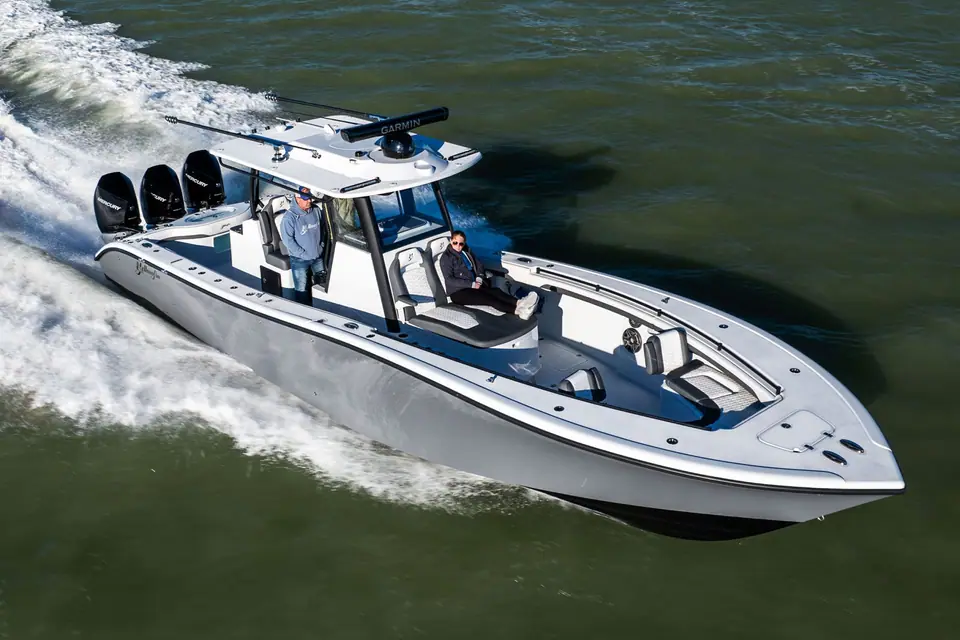
From triple Verado 300s to Mercury V10s
The 36 has been tested across several outboard generations, and the numbers show how the boat has changed. In 2009 Sport Fishing ran a boat with triple 300 hp Mercury Verados to 68.5 mph at 6,100 rpm, burning 84 gallons per hour, and recorded a 40 mph cruise at 27 gallons per hour. That boat listed a weight of just 6,500 lb without engines, much lighter than today's builds.
The 2017 refresh test with triple 350 hp Verados topped out at 62 mph at 6,000 rpm on 79.5 gallons per hour, with a best cruise of 31.4 mph at 3,500 rpm burning 22.4 gallons per hour, or 1.4 mpg. The lower top speed reflects a heavier, more fully equipped boat. In 2024 Sport Fishing tested the 36 with triple 400 hp Mercury V10s and recorded a 70.5 mph top end, a 45 mph cruise and a maximum range of 525 miles.
Yellowfin now rates the 36 for up to 1,275 hp across triple outboards, and it can also be rigged with twins. Twins save weight, cost and maintenance but give up top speed and redundancy. For tournament fishing, triples remain the norm.
A fishing layout built for kingfish money
The 36 cockpit is designed around live bait. The 2017 boat carried a 55-gallon transom livewell and an 80-gallon well in the leaning post, and current boats still feature a plumbed transom livewell and a second plumbed well in the leaning post, with a dedicated livewell pump box. That capacity lets a kingfish team carry enough live bait for a full slow-troll day.
Forward, an insulated fish box drains through a gulper pump, and the console offers optional sub-console head space. The 2017 update moved the console forward to enlarge the aft cockpit, which made the boat noticeably better for four anglers working spreads. Fourteen Gemlux rod holders, a hardtop with five rod holders and spreader lights complete the fishing package.
Current boats also include a dive door, fresh and saltwater washdowns, electric steering and C-Zone digital switching. Options include a coffin box, alternate leaning posts and a Seakeeper 2 gyro, which makes a real difference on the drift for a boat this narrow.
Dry, light and fast in a beam sea
Testers and owners agree the 36 is unusually dry for its size. In beam seas the high, flared bow throws spray away from the cockpit, and the narrow running surface keeps the boat from slamming. Seakeeper Ride 600 is standard on current boats, actively trimming the hull for a smoother ride without the constant tab adjustments of older boats.
At rest, the narrow beam means the 36 rolls more than wider rivals, which is the classic tournament boat compromise. Choosing the Seakeeper 2 gyro largely solves it and adds resale value. Without a gyro, crews quickly learn to set up drifts that keep the bow into the swell.
Buying a 36 Yellowfin for sale, generation by generation
Early boats from 2003 to the late 2000s are the lightest and often the fastest, but most are on their second or third set of engines. They are the most affordable way into a 36 Yellowfin, typically between $140,000 and $250,000 depending on power and condition.
Boats from around 2017 onward carry the forward-moved console, titanium hardware and more refined finish. They usually sell between $295,000 and $500,000. The most recent boats, with Seakeeper Ride, C-Zone digital switching and Mercury V10 power, command $520,000 to nearly $800,000 depending on equipment.
Whatever the year, engines and hull history matter more than cosmetics. Tournament boats may show high hours and hard use, while privately owned boats often have lower hours but may need updated electronics.
What a triple-engine 36 costs to run
At a 40 mph cruise the 36 burns around 27 gallons per hour according to Sport Fishing's 2009 data, and the 2017 boat managed 1.4 mpg at 31.4 mph. Those tested figures work out to roughly 1.4 to 1.5 mpg at cruise, and mixed offshore days with trolling and idling will come in lower. On 477 gallons that is plenty of range for most trips.
Annual service on three outboards, insurance, storage, bottom paint or lift fees and electronics updates add up to roughly $28,000 to $60,000 a year excluding depreciation and fuel spikes. Many owners trailer their 36, but the 10-foot beam requires a wide-load permit and a substantial tow vehicle.
Yellowfin 36 Offshore specifications
| Length overall | 36.7 ft11.18 m |
|---|---|
| Beam | 10 ft3.05 m |
| Draft | 1.5 ft0.46 m |
| Displacement | 12,332 lbs5,594 kg |
| Fuel capacity | 477 gal1,806 L |
| Cabins | None |
| Berths | None |
| Heads | Optional sub-console head |
| Standard engines | Triple outboards up to 1,275 hp total |
| Optional engines | Twin outboard rigs; triple Mercury 400 V10 Verado tested by Sport Fishing |
| Maximum power | 1,275 hp |
| Cruise speed | 35 knots |
| Top speed | 61 knots |
| Range | 456 nm |
| Hull type | Twin-step deep-V monohull, 24 degree deadrise |
| Hull construction | Vinylester resin laminates with Core-Cell foam composite coring |
| Builder | Yellowfin Yachts, United States |
| Naval architect | Yellowfin Yachts in-house design team |
| Other design credits | Wylie Nagler (founder) |
| Production | 2003 to present |
| Status | In production |
Figures come from builder documentation and independent tests where available. Displacement is usually quoted light, so a loaded cruising boat will weigh more. Compare these specs with another model.
Performance data
| Test rig | RPM | Speed (mph) | Fuel (gph) |
|---|---|---|---|
| 3 x Mercury Verado 300 (2009) | 3750 | 40 | 27 |
| 3 x Mercury Verado 300 (2009) | 6100 | 68.5 | 84 |
| 3 x Mercury Verado 350 (2017) | 3500 | 31.4 | 22.4 |
| 3 x Mercury Verado 350 (2017) | 6000 | 62 | 79.5 |
Sport Fishing magazine tests in 2009 and 2017. The 2024 Sport Fishing test with triple Mercury 400 V10s recorded 70.5 mph top speed, a 45 mph cruise and 525 miles maximum range with three people and 100 gallons of fuel.
How much does a Yellowfin 36 Offshore cost?
A 36 Yellowfin spans more than two decades of production, so prices run from early 2000s boats on second-generation engines to nearly new hulls with Mercury V10s. Sport Fishing's 2009 test boat listed at $224,000 with triple Verado 300s, and the 2017 refresh tested at $340,500. The newest boats with Seakeeper Ride, C-Zone switching and V10 power command the top of the market, while proven tournament boats with documented engine service also sell at a premium.
Estimate your yearly cost
A planning estimate using common rules of thumb: insurance near 1.5 percent of value, maintenance near 3 percent, haul out and bottom paint by length. Your marina, region and use will move these numbers. Open the full cost calculator.
Versions and options
- Triple outboard
- The standard tournament configuration, rated up to 1,275 hp across three engines.
- Twin outboard
- Lighter and cheaper to run, suited to buyers who fish closer to shore or prioritize economy over top speed.
Yellowfin 36 Offshore timeline
- 1998Wylie Nagler founds Yellowfin Yachts on Florida's Gulf Coast
- 2003Yellowfin 36 Offshore introduced
- 2009Sport Fishing tests the 36 at 68.5 mph on triple Verado 300s
- 2017Refresh moves the console forward and adds titanium hardware
- 2021Warbird Marine Holdings acquires Yellowfin, Nagler stays as president
- 2024Triple Mercury V10 boat tested at 70.5 mph
Strengths and weaknesses
What owners like
- Proven tournament reputation on the kingfish and sailfish circuits
- Fast and efficient twin-step hull
- Dry ride in rough water
- Large live bait capacity
- Strong resale values across every generation
- Trailerable with permits
What to weigh up
- Narrow beam rolls at rest without a gyro
- Stepped hull requires an attentive driver
- No cabin and only an optional sub-console head
- Triple outboards raise maintenance costs
Used Yellowfin 36 Offshore buyer checklist
Take this list to a viewing. Your ticks are saved in this browser so you can come back to it.
Always commission an independent marine survey and an engine survey before you buy. How a marine survey works.
Rivals to consider
Contender 39 ST
Larger twin-step tournament boat with more fuel and space, at a higher price.
Compare side by sideContender 32 ST
A smaller and cheaper twin-step alternative that still fishes tournaments.
Compare side by sideFreeman 34VH
A twin-engine catamaran with a level ride and strong economy but less top speed.
Compare side by sideSeaVee 340Z
Miami-built custom tournament boat with a similar narrow, fast hull philosophy.
Our verdict on the Yellowfin 36 Offshore
The Yellowfin 36 Offshore is still the reference point for fast tournament center consoles in its size. Its narrow twin-step hull runs fast and dry in rough water, the live bait capacity suits serious fishing, and its tournament heritage keeps resale firm. It asks for an attentive driver and a gyro if you hate roll, but if you want to win fishing tournaments or simply get to the fish first, a 36 Yellowfin remains one of the best choices you can make.
Yellowfin 36 Offshore questions answered
How much is a 36 Yellowfin for sale?
Used Yellowfin 36 Offshore boats range from about $140,000 for early 2000s boats to around $780,000 for recent models. New boats typically cost $700,000 to $900,000 depending on engines and options.
How fast is a Yellowfin 36?
Sport Fishing recorded 70.5 mph with triple Mercury 400 V10s, 68.5 mph with triple Verado 300s on a lighter 2009 boat, and 62 mph with triple Verado 350s in 2017.
What is the fuel capacity of the Yellowfin 36?
Current boats carry 477 gallons. Some earlier boats were listed at 510 gallons.
What are the Yellowfin 36 boat specifications?
The Yellowfin 36 measures 36 feet 8 inches long with a 10-foot beam, a 24 degree twin-step hull, about 12,332 lb dry with power and up to 1,275 hp.
Who builds Yellowfin boats?
Yellowfin Yachts, founded by Wylie Nagler, builds them in Florida. Warbird Marine Holdings acquired the company in 2021.
Yellowfin 36 Offshore photos
More center consoles & offshore boats to explore
Grady-White Express 370
Center Consoles & Offshore Boats, 37 ft
Used $300K to $1.15M
Freeman 37VH
Center Consoles & Offshore Boats, 37 ft
Used $230K to $560K
Midnight Express 37 Open
Center Consoles & Offshore Boats, 37 ft
Used $160K to $850K
Regulator 37
Center Consoles & Offshore Boats, 38 ft
Used $640K to $1M