Yellowfin Yachts Center Consoles & Offshore Boats
Yellowfin 26 Hybrid Review, Bay Boat Draft With Offshore Manners
A 26-foot single-step hybrid that draws about 16 inches, carries 118 gallons and has run 60 mph on twin Yamaha F200s in magazine tests.
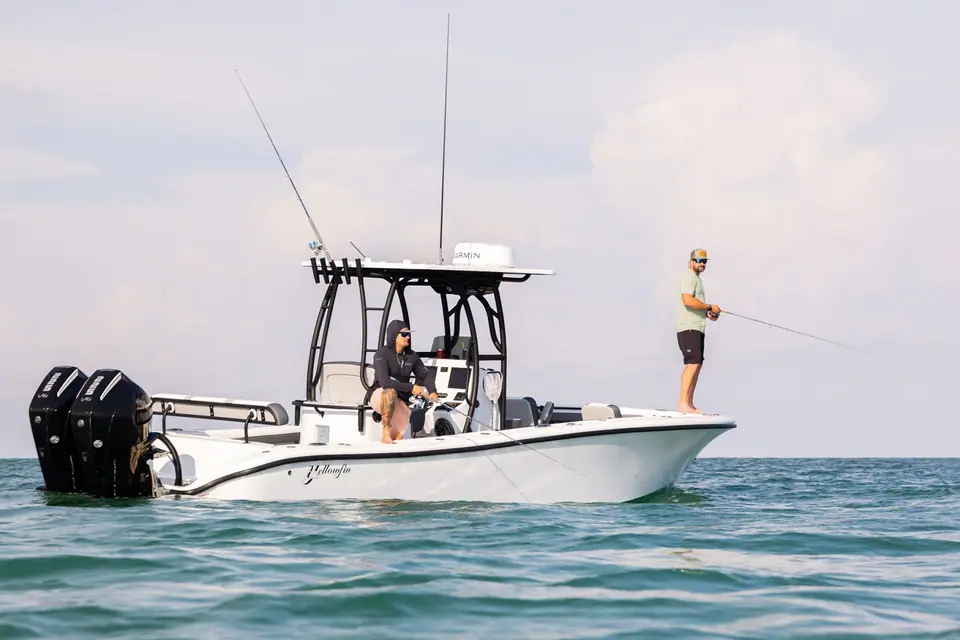
- Length
- 26 ft7.92 m
- Beam
- 8.7 ft2.64 m
- Cruise
- 30.2 kn
- Cabins
- None
- Used price
- $95K to $270K
On this page
- Overview
- The Yellowfin 26 Hybrid and the gap it filled
- One step, a raised pad and 20 degrees at the transom
- What twin F200s delivered in two magazine tests
- A deck plan that works the flats and the wrecks
- Standard equipment versus the options worth paying for
- Where a hybrid gives ground
- Buying a used 26 Hybrid and what it costs to keep
- Specifications
- Price and value
- Strengths and weaknesses
- Used buyer checklist
- Rivals
- Our verdict
- FAQ
The Yellowfin 26 Hybrid is a 26-foot, 8-foot-8 beam center console launched in late 2014 that blends a bay boat's shallow draft with an offshore bow. It takes single or twin outboards up to 500 hp and carries 118 gallons of fuel.
- Gulf Coast anglers who fish flats and nearshore wrecks
- Owners who trailer or keep a boat on a lift
- Small crews that value speed over cabin space
- Florida families who want one boat for most days
Yellowfin 26 Hybrid by the numbers
- Speed to length ratio at cruise
- 6.35A planing cruise. Fast passages in exchange for much higher fuel burn per mile.
- Estimated range at cruise
- 321 nmUsing 90 percent of tank capacity at the cruise speed and fuel burn listed on this page.
- Fuel economy at cruise
- 3.02 nmpgNautical miles per gallon at cruise, both engines combined.
- Horsepower per ton
- 148 hpVery high power to weight, built for speed.
- Length to beam ratio
- 3.00 : 1A beamy hull with lots of volume for its length.
The Yellowfin 26 Hybrid and the gap it filled
The Yellowfin 26 Hybrid exists because Yellowfin owners kept asking for something between the company's flats-capable bay boats and its offshore tournament hulls. When Sport Fishing tested hull number one off Sarasota in November 2014, the 26 slotted between the 24 Bay and the offshore 29 and brought the lineup to 11 models, running from the 17 Skiff up to the 42. Wylie Nagler, the former offshore racer who founded Yellowfin in 1998 and still draws the boats, described the brief simply: a smaller center console an owner could trailer or hoist in a backyard canal without giving up the ride the brand is known for.
More than a decade later, the 26 Hybrid is one of Yellowfin's most popular models, by the builder's own account, and the builder's most direct answer to a question many Gulf Coast anglers ask: do I buy a bay boat or an offshore boat? Capt. Tom Rowland of Saltwater Experience, quoted on Yellowfin's model page, sums up the pitch: run offshore for tuna in the morning and back into the Everglades for snook the same day.
One step, a raised pad and 20 degrees at the transom
Unlike Yellowfin's twin-step offshore boats, the 26 uses a single step amidships. The running surface also stops 19 inches short of the transom, where the bottom rises 5 to 6 inches. That raised pad keeps the propellers in cleaner water and lets the engines be mounted higher for a better bite, which is why engine height on jack plates matters so much on this boat. Sport Fishing's 2015 test boat still carried manual jack plates so Yellowfin could settle the optimum height before production.
The 2015 spec sheet lists 20 degrees of transom deadrise, a compromise between a true bay boat, which usually sits in the mid to high teens, and a deep-V offshore boat in the low to mid 20s. Freeboard follows the same logic. Salt Water Sportsman noted that the 26 has a higher sheer than a bay boat but lower freeboard than Yellowfin's center consoles, and the gunwales measured 24 inches in the bow and 21 inches at the aft coaming.
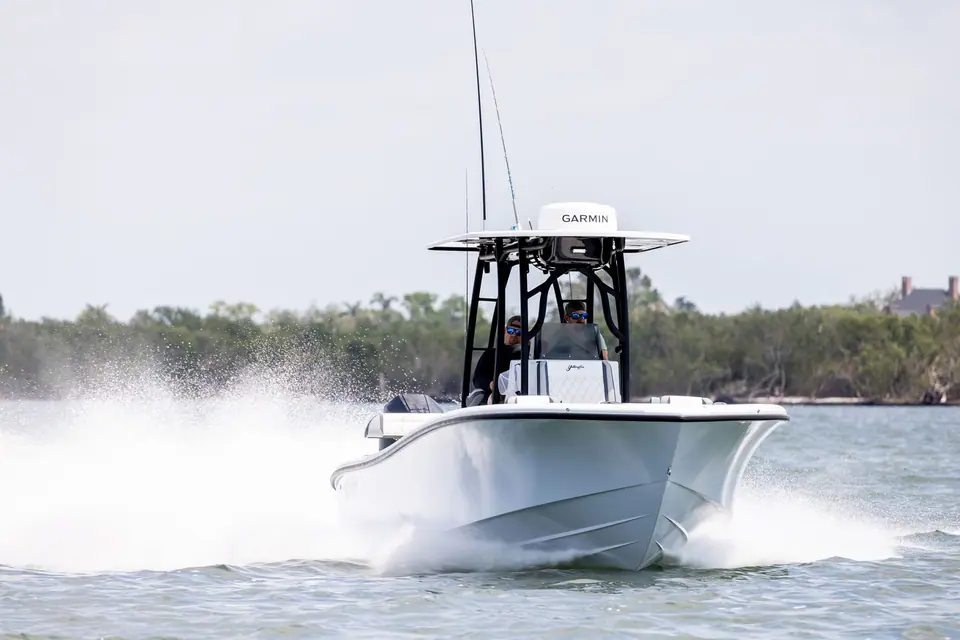
The result in the water is a boat that will drift over a sandbar in less than 2 feet yet still knocks down a Gulf chop. Both magazine testers ran it in gusty winds and steep chop near Sarasota and Tampa Bay and described a soft, dry ride and predictable handling in hard turns, with no tendency to trip or swap ends.
- Length 26 feet, beam 8 feet 8 inches
- Draft about 16 inches on the current spec sheet (18 inches with motors up on the 2015 sheet)
- Approximate weight 6,775 lb with power and a light fuel load on current boats
- Fuel 118 gallons, with optional twin 30-gallon wing tanks
- Maximum power 500 hp from single or twin outboards
What twin F200s delivered in two magazine tests
Two independent tests in early 2015 used the same engines, twin Yamaha F200 four-cylinder outboards. Sport Fishing's Jim Hendricks carried 110 gallons of fuel, two adults and a full livewell. The boat planed in 3.1 seconds, reached 30 mph in 5.8 seconds, and topped out at 59.4 mph at 6,100 rpm while burning 40.2 gallons per hour. The best economy came at 3,500 rpm and 34.8 mph, where the Yamaha displays showed 3.4 mpg, good for a theoretical range of about 400 statute miles on 118 gallons.
Salt Water Sportsman's Karl Anderson ran the same package and recorded 33 mph at 3,500 rpm on 9.2 gph, 45 mph at 4,500 rpm on 17.3 gph, 56 mph at 5,500 rpm on 37.3 gph and 60.8 mph flat out on 40.5 gph.
Those are exceptional numbers for a 26-footer on 400 hp, but keep two things in mind. The 2015 boats were lighter, about 5,200 lb dry with power according to Sport Fishing, while today's spec sheet lists 6,775 lb with power and a light fuel load, partly because of standard equipment like Seakeeper Ride. Expect a current twin-engine boat to run a few mph slower on the same horsepower, and expect a single-engine boat to cruise in the 30s rather than the 40s. Yellowfin now quotes a range of 250 miles or more on standard fuel and about 400 miles with the optional saddle tanks.
A deck plan that works the flats and the wrecks
The layout is a clean single-level deck with three zones. Forward, the standard level foredeck measured 7 feet wide by 7 feet 2 inches long on the test boat, with a fully gelcoated fish locker beneath and an anchor locker that swallowed 300 feet of line. An elevated casting foredeck was a $3,700 option in 2015, and current buyers can choose forward seating instead if the boat will spend more time with family than with a cast net.
Amidships, the console opens upward on gas struts to reveal tidy rigging, a lift-up front seat and five vertical rod holders on each side. The helm in 2015 held a single 15-inch display, and a 19-inch walkway between gunwale and console left room to move around while standing. Behind the helm, the leaning post carried a 50-gallon livewell on the Sport Fishing boat (Salt Water Sportsman's boat had a 45-gallon stand-up well), enough for at least 100 pilchards by the tester's estimate.
Aft, the raised casting platform doubles as a transom-wide bench for about four people, with flip-up seat backs in each corner and insulated boxes outboard that can be plumbed as additional livewells. The aft cockpit measured 7 feet 6 inches across with 3 feet between the livewell and the aft deck.
Standard equipment versus the options worth paying for
Current boats come with more than the early hulls did. Yellowfin's standard list now includes a Seakeeper Ride 450 active trim system, a canvas T-top, an AmeraTrail aluminum trailer with electric-over-hydraulic brakes, C-Zone digital switching, a leaning post, a plumbed livewell, titanium cleats and fixed jack plates.
The options that most affect how the boat fishes and resells are the hydraulic jack plates, single or dual Power-Poles, the twin 30-gallon wing fuel tanks and the hardtop or tower packages. A trolling motor, extra livewells, a livewell pump box and a coffin box are also on the list. In our view, hydraulic jack plates and at least one Power-Pole belong on any 26 that will see shallow water, and the wing tanks are worth it for anyone running offshore from the Gulf Coast, where good bottom can be 40 miles out.
Single versus twin power is the big decision. A single saves weight, cost and fuel and keeps the transom open; twins add redundancy for offshore runs and deliver the 60 mph performance testers recorded.
Where a hybrid gives ground
No 26-foot boat does everything, and the 26 Hybrid's compromises are predictable. The lower freeboard that makes it easy to wade, net bait or lip a redfish also means less security in a big following sea than a dedicated offshore center console of the same length. The 8-foot-8 beam keeps the boat light and easy to tow, but it gives up stability at rest compared with wider 27 and 28-foot hybrid bay boats from Grady-White, Boston Whaler and others.
There is also no enclosed head. The early console had no room for a marine toilet, and Yellowfin's current option list for the 26 does not include one, so families who need a head should look at boats with a larger console. Finally, the price. A Yellowfin costs more than most mass-production hybrids, and the premium buys hull performance, finish and resale, not more space.
Buying a used 26 Hybrid and what it costs to keep
Used 26 Hybrids date from 2015 onward and tend to sell quickly, especially in Florida and along the Gulf. Early twin F200 boats are the most affordable at roughly $95,000 to $135,000 depending on engine hours and electronics, while late-model boats with twin four-strokes, Seakeeper Ride and a hardtop generally ask $220,000 or more. Single-engine boats run noticeably cheaper than twins of the same year.
Running costs are modest for a Yellowfin. At a 30 to 35 mph cruise, twin F200s burned roughly 9 to 10 gph in testing, so a typical season of 100 to 150 hours costs well under $5,000 in fuel. Add outboard service, insurance, trailer maintenance or lift fees, and electronics updates, and most owners spend roughly $9,000 to $22,000 a year excluding depreciation.
Ownership has changed since the early boats. Warbird Marine Holdings bought Yellowfin in 2021, and Yellowfin now says fiberglass components are produced at a large composites plant on Mexico's Yucatan Peninsula while boats are designed, assembled and inspected in Sarasota. Judge any boat, early or late, on its survey.
Yellowfin 26 Hybrid specifications
| Length overall | 26 ft7.92 m |
|---|---|
| Beam | 8.7 ft2.64 m |
| Draft | 1.3 ft0.41 m |
| Displacement | 6,775 lbs3,073 kg |
| Fuel capacity | 118 gal447 L |
| Cabins | None |
| Berths | None |
| Heads | None (early console had no room for a marine toilet) |
| Standard engines | Single or twin outboards, 500 hp maximum |
| Optional engines | Tested with twin Yamaha F200 four-cylinder outboards; early boats were rated for 400 hp |
| Maximum power | 500 hp |
| Cruise speed | 30.2 knots |
| Top speed | 52.8 knots |
| Hull type | Single-step modified-V with a raised aft running pad, 20 degrees transom deadrise (2015 spec) |
| Hull construction | Composite fiberglass laminate; current fiberglass components molded at the Warbird composites plant in Mexico, assembled in Sarasota, Florida |
| Builder | Yellowfin Yachts, United States |
| Naval architect | Yellowfin Yachts in-house design team |
| Other design credits | Wylie Nagler (founder and chief designer) |
| Production | 2014 to present |
| Status | In production |
Figures come from builder documentation and independent tests where available. Displacement is usually quoted light, so a loaded cruising boat will weigh more. Compare these specs with another model.
Performance data
| RPM | Speed (mph) | Fuel (gph) | Source |
|---|---|---|---|
| 3500 | 33 | 9.2 | Salt Water Sportsman 2015 |
| 3500 | 34.8 | 10.2 | Sport Fishing 2015 (3.4 mpg) |
| 4500 | 45 | 17.3 | Salt Water Sportsman 2015 |
| 5500 | 56 | 37.3 | Salt Water Sportsman 2015 |
| 6100 | 59.4 | 40.2 | Sport Fishing 2015 |
Both tests used twin Yamaha F200 outboards on early boats near Sarasota, Florida. Sport Fishing carried 110 gallons of fuel, two adults and a full livewell; its 3,500 rpm fuel figure is derived from the reported 3.4 mpg. Salt Water Sportsman recorded a 60.8 mph top speed at 40.5 gph.
How much does a Yellowfin 26 Hybrid cost?
Sport Fishing's 2015 test boat with twin Yamaha F200s listed at $145,000. Today's boats come with a Seakeeper Ride 450 system, C-Zone switching and an aluminum trailer as standard, and Yellowfin quotes prices on request, so the new range here is our estimate for single and twin outboard builds. On the used market, twin-engine boats with Power-Poles, a hardtop and the optional wing tanks sell at a clear premium over single-engine boats with a canvas top.
Estimate your yearly cost
A planning estimate using common rules of thumb: insurance near 1.5 percent of value, maintenance near 3 percent, haul out and bottom paint by length. Your marina, region and use will move these numbers. Open the full cost calculator.
Versions and options
- Single outboard
- Lighter and simpler, with a cleaner transom for fishing. Best suited to inshore and nearshore use.
- Twin outboards
- The configuration used in the published tests, with twin F200s reaching about 60 mph. Adds redundancy for offshore runs.
Yellowfin 26 Hybrid timeline
- 1998Wylie Nagler founds Yellowfin Yachts in Florida
- 2014Hull number one of the new 26 is tested off Sarasota in November
- 2015Magazine tests record about 60 mph on twin Yamaha F200s; the 26 is rated for 400 hp
- 2021Warbird Marine Holdings acquires Yellowfin
- 2025Seakeeper Ride 450 and a trailer are standard, with ratings up to 500 hp
Strengths and weaknesses
What owners like
- Draws about 16 inches yet handles a Gulf chop
- Exceptional speed and economy for its size in tests
- Single or twin outboards to suit the mission
- Light, easy-towing 8-foot-8 hull with a standard aluminum trailer
- Large leaning-post livewell and convertible aft deck
- Strong Yellowfin resale
What to weigh up
- Lower freeboard than a true offshore center console
- No enclosed head
- Narrower and less stable at rest than 27 to 28-foot hybrids
- Priced well above mainstream hybrid bay boats
Used Yellowfin 26 Hybrid buyer checklist
Take this list to a viewing. Your ticks are saved in this browser so you can come back to it.
Always commission an independent marine survey and an engine survey before you buy. How a marine survey works.
Rivals to consider
SeaVee 270Z
Miami-built hybrid with a similar fish-first focus and a slightly larger hull.
Compare side by sideContender 25 Tournament
A deeper-V offshore boat that runs harder in big seas but gives up shallow-water access.
Compare side by sideBarker Boatworks 26 Open
A custom-feel 26 from North Carolina aimed at nearshore and offshore anglers.
Compare side by sideGrady-White 281 CE
A bigger, more family-focused coastal explorer with a head and more freeboard.
Our verdict on the Yellowfin 26 Hybrid
The Yellowfin 26 Hybrid is the best argument we know for not choosing between a bay boat and an offshore boat. Its single-step hull and raised pad deliver 60 mph and 3 mpg-plus figures on modest power, it floats in water most offshore boats avoid, and the deck works for both a cast net and a kingfish spread. It is not a family cruiser, it has no head and it costs more than mass-market hybrids, but for anglers who split their days between the backcountry and the wrecks, few 26-footers do both jobs this well or hold their value as firmly.
Yellowfin 26 Hybrid questions answered
How fast is the Yellowfin 26 Hybrid?
With twin Yamaha F200s, Sport Fishing recorded 59.4 mph and Salt Water Sportsman 60.8 mph on early, lighter boats. Current boats are heavier, so expect slightly less on the same power.
How much does a Yellowfin 26 Hybrid cost?
The 2015 test boat listed at $145,000 with twin F200s. We estimate new boats at roughly $230,000 to $310,000 today, while used boats range from about $95,000 to $270,000 depending on year and power.
What is the draft of the Yellowfin 26 Hybrid?
Yellowfin lists a draft of about 16 inches, and testers have drifted it over sandbars in less than 2 feet of water.
Can the 26 Hybrid have a single engine?
Yes. It can be rigged with a single or twin outboards, with a maximum rating of 500 hp on current boats.
How far can a Yellowfin 26 Hybrid go?
Yellowfin quotes a range of 250 miles or more on the standard 118-gallon tank and about 400 miles with the optional twin 30-gallon wing tanks.
Is the Yellowfin 26 Hybrid trailerable?
Yes. Current boats include an AmeraTrail aluminum trailer with electric-over-hydraulic brakes. Note that the 8-foot-8 beam is slightly over the standard 8-foot-6 highway width, so check your state's oversize rules.
Yellowfin 26 Hybrid photos
More center consoles & offshore boats to explore
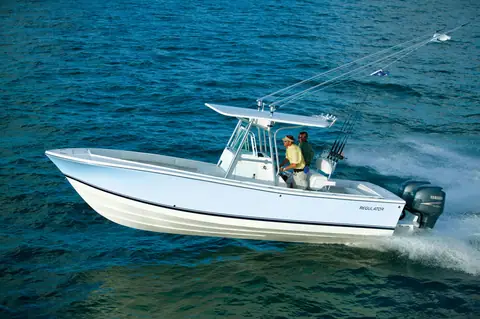
Regulator 26 Classic
Center Consoles & Offshore Boats, 26 ft
Used $30K to $120K
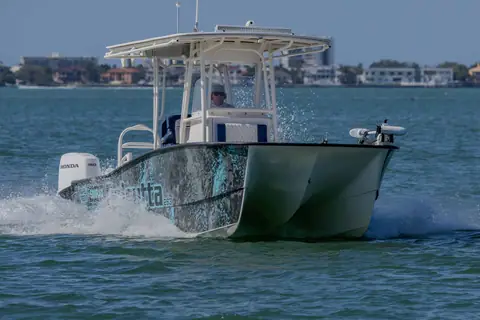
Calcutta 263
Center Consoles & Offshore Boats, 26 ft
Used $65K to $185K
Sea Hunt Gamefish 25
Center Consoles & Offshore Boats, 26 ft
Used $45K to $155K
Barker 26 Open
Center Consoles & Offshore Boats, 26 ft
Used $90K to $215K