Contender Boats Center Consoles & Offshore Boats
Contender 30ST Review, Specs and What to Pay for One
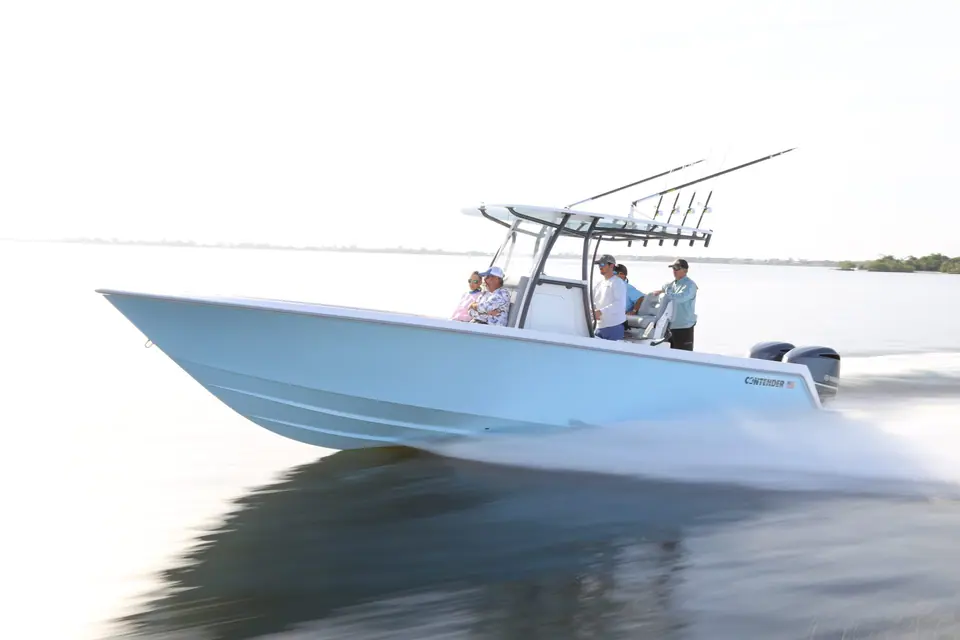
The smallest boat in Contender's stepped-hull family, a 29-foot 8-inch kingfish and sailfish console that runs past 60 mph on twin outboards.
- Length
- 29.7 ft9.04 m
- Beam
- 9.5 ft2.9 m
- Cruise
- 1.7 ft0.51 m
- Cabins
- 0 (walk-in console head compartment)
- Used price
- $90K to $380K
On this page
- Overview
- The 30ST, Contender's front door to the stepped fleet
- Two steps, 24.5 degrees and a 9-foot-6 beam
- What the twin Yamaha F300 test boat actually did
- A deck laid out by people who fish kingfish tournaments
- Who the 30ST suits, and who should look at a 32ST instead
- Running a 30ST for a season
- Reading the used 30ST market
- Specifications
- Price and value
- Strengths and weaknesses
- Used buyer checklist
- Rivals
- Our verdict
- FAQ
The Contender 30ST (Stepped Tournament) is a 29-foot 8-inch semi-custom center console built in Homestead, Florida, since the early 2010s, with a 24.5-degree twin-step hull, 260 gallons of fuel and up to 800 hp of twin outboards.
- Kingfish and sailfish tournament teams
- Offshore anglers who trailer or rack store
- Owners stepping up from a 25 or 28 Contender
- Fast runs to the Gulf Stream or canyon edge
The 30ST, Contender's front door to the stepped fleet
Anyone searching for a 30ST usually already knows the name Contender. The Homestead, Florida, builder was founded in 1984 by Joe Neber, a Miami freediver and spearfisherman, and it built its reputation on deep-V tournament boats that kingfish and sailfish teams trusted in ugly water. The Contender 30ST is where that story meets the company's stepped-hull era. Contender's own site calls it the introduction to its true center console stepped-hull lineup and the smallest boat in the series, sitting below the 32ST, 35ST, 39ST and 44ST.
ST stands for Stepped Tournament. When Salt Water Sportsman reviewed the boat as an all-new model, it described the 30 ST as a stepped design that supplemented the older 27 and 30 Tournament models, and the company claimed an 18 percent gain in efficiency over those conventional hulls. That is the pitch in one sentence: Contender fishability at a size most owners can still trailer, with fuel numbers that make a 60-mile run to the edge less painful.
Contender is a semi-custom builder, so no two 30STs match. The company's option list runs to consoles, tops, seating, livewell plumbing, powder coating, teak, outriggers and additional fuel capacity, which matters when you compare used boats. Two boats of the same year can be very different machines.
Contender 30 ST by the numbers
- Horsepower per ton
- 173 hpVery high power to weight, built for speed.
- Displacement hull speed
- 6.8 knThe efficient cruising speed for a displacement hull of this waterline.
- Length to beam ratio
- 3.12 : 1Moderate proportions.
Two steps, 24.5 degrees and a 9-foot-6 beam
The hull is a deep-V with 24.5 degrees of transom deadrise according to Contender's current spec sheet (Salt Water Sportsman's early review quoted 24 degrees with no running pad at the transom). Reverse chines knock spray down, and the twin steps ventilate the bottom to cut wetted surface at speed. The 9-foot-6-inch beam is narrow by modern standards, which is part of why the boat slices through a short chop rather than pounding on top of it, and part of why it rolls a little more at rest than a beamier family console.
Contender lists the 30ST at 29 feet 8 inches overall with a 20-inch draft, a ready-to-fish weight of 9,250 pounds, 260 gallons of fuel and a maximum rating of 800 hp. Sport Fishing's 2018 buyers guide listed 265 gallons, a 5,450-pound dry weight before power and a 600 hp maximum, so the rating has climbed as outboards got bigger. If you are shopping a used boat, check the capacity plate rather than assuming the current 800 hp figure applies to an older hull.
Construction follows the Contender recipe: hand-laid fiberglass with multidirectional fabrics, a foam-cored stringer system, vinylester resins and foam flotation in the cavities to deaden drumming. Owners in Sport Fishing's Builder Benchmark survey scored the brand near the top for ride, construction and resale.
What the twin Yamaha F300 test boat actually did
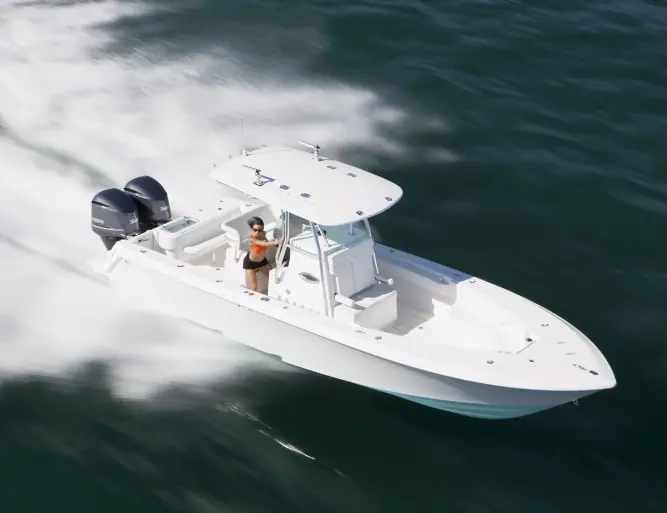
Salt Water Sportsman ran the 30 ST out of Port Everglades with twin Yamaha F300 four-strokes into an 18 to 20 knot southeast wind and a close three- to five-foot swell. The tester settled at 3,500 rpm, where the boat made 38 mph and returned 2.1 miles per gallon, which works out to roughly 18 gallons per hour for both engines. From 3,500 to 5,000 rpm it jumped about 10 mph to nearly 58 mph, and on the run back through the inlet it touched 67 mph before slowing for the no-wake zone.
Those are real figures but not a full certified test, so treat them as one data point. They do line up with what you would expect from a 9,000-pound stepped hull on 600 hp: a comfortable mid-30s mph cruise in a sea and better than 60 mph flat out. With 260 gallons aboard and 2.1 mpg, a theoretical range of more than 500 statute miles at cruise is possible on paper, but a sensible 10 percent reserve and real sea conditions trim that considerably.
The reviewer singled out the quick response of the Uflex steering and the lack of banging when running the tops of windblown swells at a quartering angle. That matches the Contender reputation: dry, predictable and happy to be driven hard.
A deck laid out by people who fish kingfish tournaments
The 30ST has a single-level deck from bow to stern, wide gunwales, pull-up cleats and navigation lights, and a recessed bow handrail so lines never snag. Contender's current standard list includes a 130-gallon forward fish box, a 65-gallon secondary forward box that doubles as dry storage, two 70-gallon aft fish boxes and lockable under-deck rod lockers port and starboard. Twin 40-gallon transom livewells are plumbed with 1,100 gph pumps, and a full transom with an integral dive platform and transom door handles big fish.
Salt Water Sportsman's test boat added an insulated coffin box with electric rams over the forward box, a leaning post with a slide-out Frigid Rigid cooler and tackle storage, and a centerline lazarette giving access to fuel filters, bilge pumps and the livewell sump. Contender is known for gasketed hatches that close quietly and for sump-fed wells that resist air locks, small details that matter on a long tournament day.
Expect to see a range of console choices on used boats. The standard Sport console has a side entry door and cup holders, while the upgraded M-Series console, stand-on console with hardtop and teak console interior are options. An electric head with Y-valve is optional, and the console front seat lifts for walk-in access to the head compartment.
- Fish boxes: 130 gal forward, 65 gal secondary forward, 2 x 70 gal aft
- Livewells: 2 x 40 gal transom wells, 1,100 gph plumbing
- Rod storage: lockable under-deck lockers port and starboard
- Fuel 260 gal, water 21 gal (Contender's spec table), 800 hp max
Who the 30ST suits, and who should look at a 32ST instead
The 30ST makes most sense for a crew of two to four anglers who fish offshore regularly, want twin-engine redundancy, and still want to tow or rack the boat. Salt Water Sportsman noted you will not need a dual-rear-wheel truck to pull it, though a properly fitted trailer matters on any stepped hull.
It is not a family cruiser. There is no cabin, seating is optional, and the narrow beam and deep-V give up stability at rest compared with a 10-foot-beam family console. Buyers who want more bow seating, more fuel or room for a third engine should step up to the 32ST or 35ST. Buyers who want a deep-V without steps should look at Contender's 28T.
Families can still make it work. Contender offers forward seating, rear bench seating, shade tops and upgraded upholstery, and the boat's speed means shorter runs. Just do not expect it to behave like a Boston Whaler or Grady-White at anchor.
Running a 30ST for a season
Fuel is the variable that dominates. At the tested 2.1 mpg, a 60-mile round trip to the canyon edge or the Gulf Stream burns roughly 30 gallons plus trolling time. Owners who fish tournaments and run 150 to 250 hours a year should budget $14,000 to $30,000 annually for fuel, insurance, slip or rack storage, bottom paint if kept in the water, annual outboard service and electronics updates, excluding depreciation.
Twin-engine service is straightforward on outboards: annual service, water pumps every couple of seasons and gearcase oil checks. The stepped bottom needs nothing special, but it does demand a trailer whose bunks are set to support the hull properly, a point Boating has made about Contender's larger stepped models too.
Reading the used 30ST market
Because Contender has built the 30ST for more than a decade with few structural changes, the main price variables are engine generation, hours and options. A repowered early hull with low-hour modern four-strokes can be a better buy than a later boat with tired engines. Tower or stand-on-console boats, Helm Master joystick systems, powder-coated hardtops and Seakeeper-ready rigging push prices up.
Contender's fishing reputation keeps resale strong, which helps the owner who sells but frustrates the bargain hunter. Expect clean examples to move quickly in Florida and the Carolinas. Northern boats that lived on a trailer often show less gelcoat wear and are worth the trip.
Contender 30 ST specifications
| Length overall | 29.7 ft9.04 m |
|---|---|
| Beam | 9.5 ft2.9 m |
| Draft | 1.7 ft0.51 m |
| Displacement | 9,25 lbs4,196 kg |
| Fuel capacity | 26 gal984 L |
| Fresh water | 21 gal79 L |
| Cabins | 0 (walk-in console head compartment) |
| Berths | None |
| Heads | 1 (portable or optional electric head in console) |
| Standard engines | Twin outboards built to order (tested with 2 x Yamaha F300) |
| Optional engines | Twin outboards to the 800 hp rating; earlier boats were offered with twin Yamaha 250 or 300 four-strokes |
| Maximum power | 800 hp |
| Hull type | Twin-step deep-V planing hull, 24.5-degree transom deadrise, reverse chines |
| Hull construction | Hand-laid fiberglass with multidirectional fabrics, foam-cored stringer system, vinylester resins |
| Builder | Contender Boats, United States |
| Naval architect | Contender Boats in-house design team |
| Status | In production |
Figures come from builder documentation and independent tests where available. Displacement is usually quoted light, so a loaded cruising boat will weigh more. Compare these specs with another model.
How much does a Contender 30 ST cost?
Salt Water Sportsman listed the 30ST at a base price of $166,433 with twin Yamaha 300s when it reviewed the then-new boat, and inflation plus today's 800 hp rating have pushed a typical 2026 build well past double that. Engine generation and hours drive the used market more than hull year, because the hull and deck plan barely changed. Hardtop boats with Helm Master, a stand-on console or second station and a full Garmin or Simrad glass dash sit at the top; first-generation boats on original F250s or F300s with high hours sit at the bottom.
Estimate your yearly cost
A planning estimate using common rules of thumb: insurance near 1.5 percent of value, maintenance near 3 percent, haul out and bottom paint by length. Your marina, region and use will move these numbers. Open the full cost calculator.
Versions and options
- Sport console
- Standard console with side entry door, cup holders and a walk-in head compartment.
- M-Series console
- Upgraded, larger console option; often paired with a teak interior package.
- Stand-on console or second station
- Elevated helm options with hardtop or soft top for spotting fish and birds.
Contender 30 ST timeline
- 1984Joe Neber founds Contender Boats in South Florida
- 2012Salt Water Sportsman posts a photo gallery of the new 30 ST; its launch review quotes a $166,433 base price with twin Yamaha F300s
- 2018Sport Fishing buyers guide lists 265 gallons of fuel and a 600 hp maximum rating
- 2026Current Contender spec sheet shows 260 gallons, 9,250 pounds ready to fish and an 800 hp rating
Strengths and weaknesses
What owners like
- Proven twin-step Contender ride in a trailerable size
- Tested 67 mph top end and 2.1 mpg at a 38 mph cruise
- Huge fish box capacity for a 30-footer
- Strong resale and deep Contender dealer network
- Semi-custom build list lets owners tailor the rig
What to weigh up
- Narrow 9-foot-6-inch beam rolls more at rest
- Spartan seating and comfort unless optioned
- Prices have climbed steeply since launch
- Stepped hull needs a carefully fitted trailer
Used Contender 30 ST buyer checklist
Take this list to a viewing. Your ticks are saved in this browser so you can come back to it.
Always commission an independent marine survey and an engine survey before you buy. How a marine survey works.
Rivals to consider
SeaVee 290B
Another Miami-built tournament console with a similar hardcore fishing focus and strong resale.
Compare side by sideRegulator 31
More beam, more comfort and a softer family side, with a conventional deep-V instead of steps.
Compare side by sideContender 32 ST
The next step up in the same family, with more fuel and a bigger cockpit.
Compare side by sideYellowfin 32 Offshore
Florida stepped-hull rival known for speed and a custom build list.
Compare side by sideOur verdict on the Contender 30 ST
The Contender 30ST is the purest expression of what Contender does well, squeezed into a hull most owners can still tow: a dry, fast twin-step ride, enormous fish boxes and a deck with nothing to snag a line. Test numbers of 38 mph at 2.1 mpg and a 67 mph top end tell you it is efficient and quick, and the brand's tournament pedigree keeps resale firm. It is not a family boat and its narrow beam rolls at rest, so buyers who want comfort or room for a crowd should look at a beamier console. For a two- to four-angler offshore team, few 30-footers are better.
Contender 30 ST questions answered
What does ST mean on the Contender 30ST?
ST stands for Stepped Tournament. The 30ST uses a twin-step deep-V bottom, unlike Contender's conventional Tournament models such as the 28T.
How fast is a Contender 30ST?
Salt Water Sportsman reached 67 mph with twin Yamaha F300s and cruised at 38 mph at 3,500 rpm, getting 2.1 mpg.
How much fuel does the Contender 30ST hold?
Contender lists 260 gallons. Earlier buyers guides quoted 265 gallons, and additional fuel capacity is an option.
What is the max horsepower on a Contender 30ST?
The current rating is 800 hp. Sport Fishing's 2018 guide listed 600 hp, so check the capacity plate on older boats.
How much is a 30 foot Contender worth used?
Expect roughly $90,000 for an early boat with high-hour engines up to about $380,000 for a nearly new, well-optioned 30ST in 2026.
Can you trailer a Contender 30ST?
Yes. At 9 feet 6 inches wide and about 9,250 pounds ready to fish it is trailerable without a permit, but use a trailer fitted to the stepped hull.
Contender 30 ST photos
More center consoles & offshore boats to explore
SeaVee 290B
Center Consoles & Offshore Boats, 30 ft
Used $135K to $265K
Wellcraft 290 Coastal
Center Consoles & Offshore Boats, 30 ft
Used $40K to $150K
Egret 290 Offshore
Center Consoles & Offshore Boats, 29 ft
Used $60K to $260K
Freeman 29
Center Consoles & Offshore Boats, 30 ft
Used $90K to $400K