Contender Boats Center Consoles & Offshore Boats
Contender 28T, the Original Contender Hull Grown Up
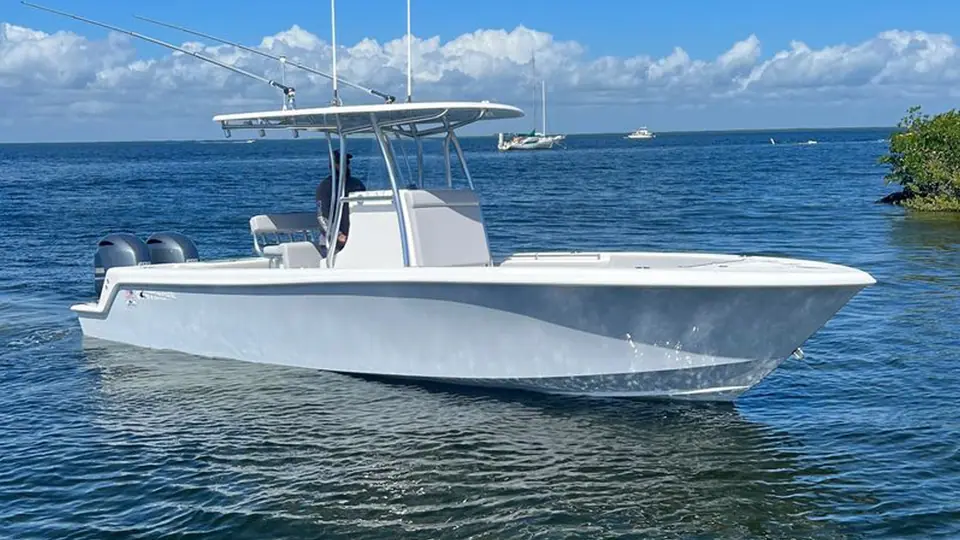
A 28-foot, 8-foot 10-inch beam deep-V with twin-engine power to 600 hp, descended from the 25 Open that built Contender's reputation.
- Length
- 28 ft8.53 m
- Beam
- 8.8 ft2.69 m
- Cruise
- 35.9 kn
- Cabins
- 0
- Used price
- $40K to $260K
On this page
- Overview
- The Contender 28T bloodline, from 25 Open to 28T
- The 2019 relaunch and the rounded cap
- Great white credentials with OCEARCH
- Box space, livewell and rod storage
- Speed and fuel on twin Yamaha 200s
- 28T or 28 Sport, pick your compromise
- Costs of keeping a 28-footer on twins
- Specifications
- Price and value
- Strengths and weaknesses
- Used buyer checklist
- Rivals
- Our verdict
- FAQ
The Contender 28T is a 28-foot tournament center console on a 24.5-degree deep-V, rated to 600 hp with 170 gallons of fuel on current boats, a 140-gallon forward fish box and a long lineage back to the 25 Open.
- Tournament anglers who want twin-engine redundancy
- Offshore runs in rough inlets
- Owners who prefer a lift or dry stack over a trailer
- Buyers seeking a proven older hull to repower
Contender 28T by the numbers
- Speed to length ratio at cruise
- 7.27A planing cruise. Fast passages in exchange for much higher fuel burn per mile.
- Estimated range at cruise
- 291 nmUsing 90 percent of tank capacity at the cruise speed and fuel burn listed on this page.
- Fuel economy at cruise
- 1.90 nmpgNautical miles per gallon at cruise, both engines combined.
- Horsepower per ton
- 162 hpVery high power to weight, built for speed.
- Length to beam ratio
- 3.17 : 1Moderate proportions.
The Contender 28T bloodline, from 25 Open to 28T
Ask a South Florida captain about the Contender 28T and you will usually hear about a different boat first, the 25 Open. Contender's 2011 fleet page described the 28 Tournament as based on the first, the original, and what many still consider the most complete, well-designed 25 in the industry. Archived Contender spec sheets from 2010 show why: the boat then sold as the 25 Open measured 28 feet overall with an 8-foot 10-inch beam, about 4,700 pounds dry, 7,150 pounds ready to fish, 185 gallons of fuel and a 500 hp rating. The name counted the running hull; the overall length included the molded-in transom.
Salt Water Sportsman tested a redesigned 25 Open with what the magazine called Contender's Euro-transom layout and listed it at 28 feet, 8 feet 10 inches, 185 gallons standard and 240 optional, 500 hp maximum. That boat is the direct ancestor of today's 28T. Contender itself, founded in 1984 by Joe Neber, built its early reputation on the 25, and the 28T keeps that hull's narrow, deep personality.
The 2019 relaunch and the rounded cap
Sport Fishing's 2020 buyers guide called the 28T one of the original Contender models and said it returned with a new, more aesthetically pleasing rounded cap and other small modifications to the relaunched classic. The factory pages tell the same story in numbers. In 2016 the 28 Tournament was listed at 4,700 pounds dry, 7,150 pounds loaded, 180 gallons and 500 hp maximum. By 2018 and 2019 the 28T and its 28S sister were listed at 7,400 pounds ready to fish, 180 gallons and a 600 hp rating.
The current boat is 28 feet with an 8-foot 10-inch beam, 20 inches of draft, 7,400 pounds ready to fish, 24.5 degrees of transom deadrise and a 600 hp rating. Contender's current spec table lists 170 gallons of fuel, which matches its published fuel tank guide, even though the model page's intro still mentions 180 gallons. Water is listed as 25 gallons on the web page and 21 gallons in the 2026 brochure. When numbers disagree, the builder's tank guide and brochure are the safer reference.
- 2010 spec sheet (sold as 25 Open): 28 ft, 8 ft 10 in, 4,700 lb dry, 185 gal, 500 hp
- 2016 site (28 Tournament): 4,700 lb dry, 7,150 lb loaded, 180 gal, 500 hp
- 2019 site (28T): 7,400 lb ready to fish, 180 gal, 600 hp
- Current: 7,400 lb ready to fish, 170 gal, 600 hp, Seakeeper Ride standard
Great white credentials with OCEARCH
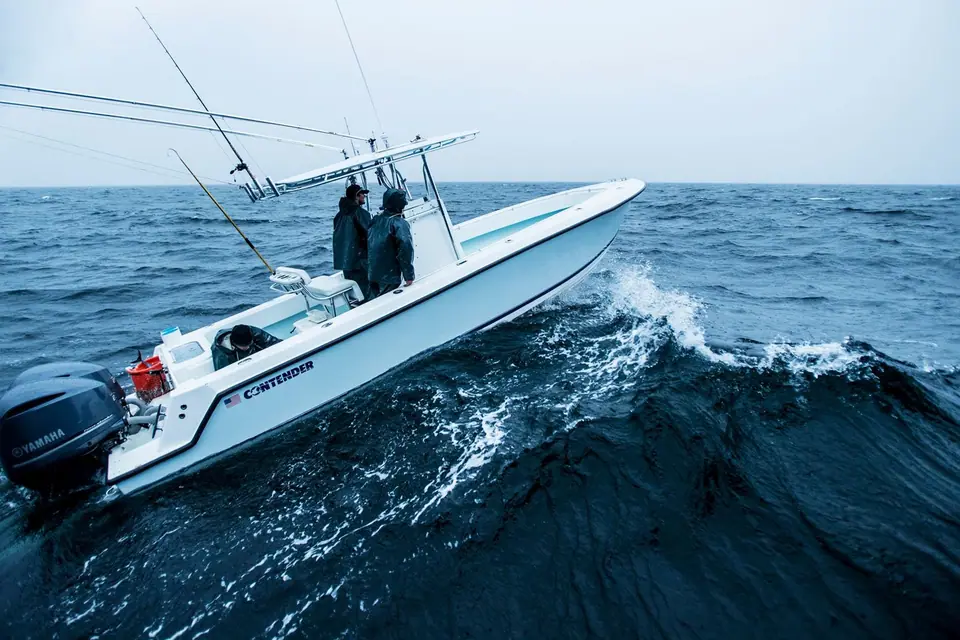
Few small center consoles have a working résumé like the 28T. The shark research group OCEARCH, led by Chris Fischer and Capt. Brett McBride, used a Contender 28T to catch, tag and release great white sharks around the world, and Contender featured Fischer's testimony on its site. He said the team had destroyed the boats it used in the past, both while working and when tied up to the mother ship in the open ocean, and that the Contender endured, describing it as built like a tank.
Marketing aside, that use case says something useful about the hull and structure. A boat that tows alongside a ship offshore and handles 3,000 to 5,000-pound sharks on deck has to have a stout stringer grid and hardware backing, which is exactly where older Contenders tend to impress surveyors.
Box space, livewell and rod storage
The deck is deliberately clean. Up front is a fully lined and insulated 140-gallon fish box, aft are two more 76-gallon boxes to port and starboard, and a 40-gallon transom livewell runs on an 1,100 gph pump according to Sport Fishing. Two under-deck rod lockers sit either side of the console, four flush rod holders line the gunwales and five more ride on the back of the leaning post. The full transom includes a dive door and integral swim platform.
The standard console is Contender's Sport console with a side entry door, two cupholders and room in the oversized panel for multiple displays. Trim tabs, a freshwater system, and a built-in console front seat with cooler are standard. Options include stand-on console second stations with hard or soft tops, Helm Master autopilot and joystick, anchor chute and windlass, welded bow rail, electric head, teak inside the console, outriggers, gulper pumps in the aft boxes, electric reel outlets and multiple leaning posts.
Speed and fuel on twin Yamaha 200s
Contender's archived performance bulletin for the 28 Tournament used twin Yamaha 200 hp HPDI direct-injection two-strokes. The boat ran 29.1 mph at 3,000 rpm on 11.8 gph, about 2.5 mpg, and 41.3 mph at 4,000 rpm on 18.9 gph, about 2.2 mpg. Top speed was 55 mph at 5,500 rpm burning 37.6 gph. Salt Water Sportsman's earlier test of the 25 Open on the same twin 200 HPDI power recorded the identical 41.3 mph at 4,000 rpm and 54.5 mph at 5,300 rpm, which gives the factory figures some independent support.
Modern twin 250 to 300 four-strokes will run faster and quieter, but no current test with published fuel figures was available to us. On the older numbers, a cruise around 35 to 41 mph at roughly 2.2 to 2.5 mpg means 170 gallons is enough for a long canyon or Bahamas day with a reserve, though not for a return trip at full throttle.
28T or 28 Sport, pick your compromise
Contender's 2016 lineup paired the 28 Tournament with a 28 Sport on the same 28-foot by 8-foot 10-inch hull. The Sport added forward seating as standard and pitched itself as a fishing machine built for family fun; the 2018 factory page listed the 28S with the same 140-gallon forward box, twin 76-gallon aft boxes, 40-gallon livewell, three storage compartments under the forward seating and a 600 hp rating.
Today the 28T covers both roles through options such as forward seating, rear benches, stadium seating and upgraded consoles. On the used market, a 28S is often the better family buy, while a stripped 28T with a second station and outriggers is the better tournament tool.
Costs of keeping a 28-footer on twins
At 8 feet 10 inches the 28T exceeds the 8-foot 6-inch trailer limit, so towing generally needs a wide-load permit, and most owners keep the boat on a lift or in dry stack. Twin outboards double routine service, so budget about $12,000 to $26,000 a year excluding depreciation for storage, insurance, engine service, fuel and canvas.
Repowering is common on older boats. A 28 from the late 2000s with fresh twin four-strokes can be a better value than a newer boat with high hours, but confirm the transom and engine mounting area were inspected during the repower.
Contender 28T specifications
| Length overall | 28 ft8.53 m |
|---|---|
| Beam | 8.8 ft2.69 m |
| Draft | 1.7 ft0.51 m |
| Displacement | 7,4 lbs3,357 kg |
| Fuel capacity | 17 gal644 L |
| Fresh water | 21 gal79 L |
| Cabins | 0 |
| Berths | 0 |
| Heads | Optional electric head in console |
| Standard engines | Built to order: twin Yamaha outboards |
| Optional engines | Yamaha Helm Master EX autopilot and joystick packages |
| Maximum power | 600 hp |
| Cruise speed | 35.9 knots |
| Top speed | 47.8 knots |
| Hull type | Deep-V planing hull, 24.5-degree transom deadrise, reverse-radius chines, integrated transom |
| Hull construction | Hand-laid fiberglass, PVC-cored stringer system, foamed-in aluminum fuel tank |
| Builder | Contender Boats, United States |
| Naval architect | Contender Boats in-house design team |
| Status | In production |
Figures come from builder documentation and independent tests where available. Displacement is usually quoted light, so a loaded cruising boat will weigh more. Compare these specs with another model.
Performance data
| RPM | Speed (mph) | Fuel (gph) | mpg |
|---|---|---|---|
| 1000 | 6.6 | 3 | 2.2 |
| 2000 | 11.1 | 7.6 | 1.5 |
| 3000 | 29.1 | 11.8 | 2.5 |
| 4000 | 41.3 | 18.9 | 2.2 |
| 5000 | 52.3 | 28.7 | 1.8 |
| 5500 | 55 | 37.6 | 1.5 |
Contender factory performance bulletin for the 28 Tournament (185-gallon generation), twin Yamaha Z200 HPDI outboards, 1.86 gear ratio. Figures as published by Contender in mph and total gallons per hour.
How much does a Contender 28T cost?
Contender sells through dealers and does not publish retail prices, so the new range is our estimate for twin Yamaha 250 to 300 power with a T-top, electronics and the Seakeeper Ride system now listed as standard. Used values depend heavily on generation. Earlier 28 Tournaments and 25 Opens with older two-stroke or HPDI engines trade at the bottom, while 2019-on boats with the rounded cap and modern twin four-strokes sit near the top.
Estimate your yearly cost
A planning estimate using common rules of thumb: insurance near 1.5 percent of value, maintenance near 3 percent, haul out and bottom paint by length. Your marina, region and use will move these numbers. Open the full cost calculator.
Versions and options
- 25 Open (2000s)
- The 28-foot LOA boat sold under the 25 name, with 185 gallons standard and up to 240 optional, 500 hp maximum.
- 28 Tournament (2011 to 2016)
- Renamed boat on the same hull; 4,700 lb dry, 180 to 185 gallons, 500 to 600 hp ratings depending on year.
- 28 Sport / 28S
- Family-oriented sister with forward seating standard on the same 28-foot hull.
- Current 28T
- Rounded cap from the 2019 relaunch, 170 gallons, 7,400 lb ready to fish, 600 hp maximum, Seakeeper Ride standard.
Contender 28T timeline
- 1984Contender founded by Joe Neber; the original 25 hull sets the template
- 2010Factory spec sheet lists the 28-foot hull as the 25 Open
- 2011Same hull appears in the fleet as the 28 Tournament
- 201628 Tournament and 28 Sport offered side by side
- 201928T relaunched with a rounded cap and 600 hp rating
Strengths and weaknesses
What owners like
- Proven 24.5-degree deep-V with decades of offshore history
- Massive fish storage, 140-gallon forward box plus twin 76-gallon boxes
- Twin-engine redundancy to 600 hp
- Strong structure proven in OCEARCH shark work
- Wide choice of second stations, tops and seating at order
What to weigh up
- 8-foot 10-inch beam needs a permit to trailer
- Narrow deep-V rolls at anchor compared with beamier rivals
- Fuel capacity listed at 170 gallons on current boats, down from 180 to 185
- Minimal comfort features unless optioned
- Twin engines double the service bill
Used Contender 28T buyer checklist
Take this list to a viewing. Your ticks are saved in this browser so you can come back to it.
Always commission an independent marine survey and an engine survey before you buy. How a marine survey works.
Rivals to consider
SeaVee 290B
Another Miami-built tournament favorite, semi-custom with a loyal following.
Compare side by sideContender 30ST
The stepped, larger sibling for buyers who want more beam and fuel.
Compare side by sideBoston Whaler 280 Outrage
Unsinkable construction and more comfort, less pure fishing focus.
Compare side by sideOur verdict on the Contender 28T
The Contender 28T is the boat that best explains Contender's reputation: a narrow, deep, simple tournament center console with enormous box space and a hull pedigree that goes back to the 25 Open. It is not the comfiest 28-footer you can buy, and the current fuel figure is lower than older boats, but it runs hard into a head sea, and its structure has been proven in some of the toughest work any small console has done. Buy a later rounded-cap boat if budget allows, or a well-repowered older 28 if you value the hull more than the cosmetics.
Contender 28T questions answered
What are the Contender 28T specs?
The current 28T is 28 feet long with an 8-foot 10-inch beam, 20-inch draft, 24.5-degree deadrise, 7,400 pounds ready to fish, 170 gallons of fuel and a 600 hp rating.
How fast is a Contender 28T?
Contender's factory bulletin with twin Yamaha 200 HPDI outboards shows 55 mph at 5,500 rpm and a 41.3 mph cruise at 4,000 rpm on 18.9 gph.
What is the difference between the Contender 28T and 28S?
Both use the same 28-foot hull. The 28S added forward seating as standard for family use, while the 28T keeps a cleaner tournament deck.
Is the Contender 28T the old 25 Open?
It descends from it. Contender's 2010 spec sheets list the 25 Open at 28 feet LOA and 8 feet 10 inches of beam, the same dimensions later sold as the 28 Tournament.
What does a Contender 28T cost?
Contender does not publish prices. We estimate new boats at roughly $230,000 to $310,000 with twin Yamahas, while used boats range from about $40,000 to $260,000 depending on age and power.
Contender 28T photos
More center consoles & offshore boats to explore
Bluewater 25T
Center Consoles & Offshore Boats, 28 ft
Used $165K to $215K
Boston Whaler 280 Outrage
Center Consoles & Offshore Boats, 28 ft
Used $65K to $265K
Grady-White Freedom 285
Center Consoles & Offshore Boats, 28 ft
Used $95K to $340K
Parker 2820 XLD Sport Cabin
Center Consoles & Offshore Boats, 28 ft
Used $65K to $265K