Yellowfin Yachts Center Consoles & Offshore Boats
32 Yellowfin for Sale, a Buyer's Guide to the Yellowfin 32 Offshore
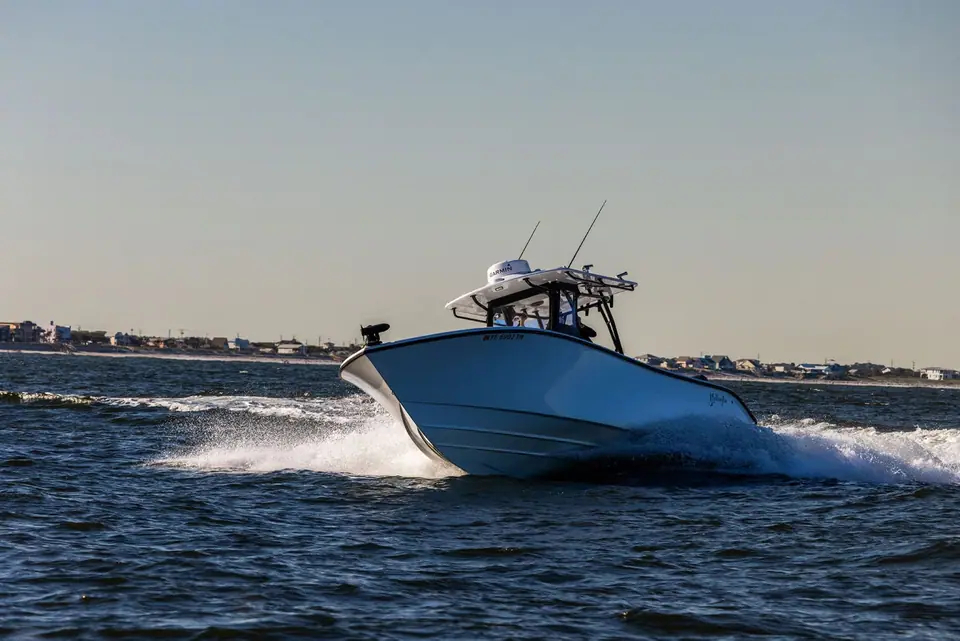
Yellowfin's twin-engine sports car, a 32-foot-6 twin-step center console built since 2008 and rated for up to 900 hp on two outboards.
- Length
- 32.5 ft9.91 m
- Beam
- 9.8 ft2.97 m
- Cruise
- 35.6 kn
- Cabins
- None
- Used price
- $90K to $540K
On this page
- Overview
- Why a 32 Yellowfin for sale gets snapped up
- Twin steps, 22 degrees and a 9-foot-9 beam
- What two Verados and two Yamaha V8s actually did
- Built for live bait, pitch baits and a sailfish spread
- From factory direct to a dealer network
- Picking the right used 32 Yellowfin
- Running costs and the 32 versus the 34
- Specifications
- Price and value
- Strengths and weaknesses
- Used buyer checklist
- Rivals
- Our verdict
- FAQ
The Yellowfin 32 Offshore is a 32-foot-6, 9-foot-9 beam twin-step center console introduced in 2008 to replace the original 31. It is a twin-outboard-only boat, now rated to 900 hp with 332 gallons of fuel.
- Two to four anglers fishing offshore
- Kingfish and sailfish tournament teams on a budget
- Owners who trailer between fisheries
- Buyers stepping up from 25 to 28-foot center consoles
Yellowfin 32 Offshore by the numbers
- Speed to length ratio at cruise
- 6.69A planing cruise. Fast passages in exchange for much higher fuel burn per mile.
- Estimated range at cruise
- 425 nmUsing 90 percent of tank capacity at the cruise speed and fuel burn listed on this page.
- Fuel economy at cruise
- 1.42 nmpgNautical miles per gallon at cruise, both engines combined.
- Horsepower per ton
- 173 hpVery high power to weight, built for speed.
- Length to beam ratio
- 3.33 : 1Moderate proportions.
Why a 32 Yellowfin for sale gets snapped up
Yellowfin calls the 32 Offshore the sports car of its lineup, and that is a fair description. It is the smallest of the builder's dedicated twin-step offshore boats, the only one in the current offshore range designed strictly for two outboards, and the most nimble of the group. Anyone searching for a 32 Yellowfin for sale is usually after the same combination the boat has offered since 2008: tournament-grade speed and ride in a hull that is cheaper to buy, power and run than a 36 or 39.
The 32 replaced Yellowfin's original 31. Salt Water Sportsman reported in late 2008 that Wylie Nagler had retired the 31-foot mold and introduced the 32 as its successor, with a beam nearly 5 inches wider at the stern to carry the weight of modern four-stroke outboards and a slightly lowered bow cap for anglers working the foredeck. It has stayed in the line through every outboard generation since and through the 2021 sale of Yellowfin to Warbird Marine Holdings, the EagleTree Capital-backed group that also owns Invincible.
Twin steps, 22 degrees and a 9-foot-9 beam
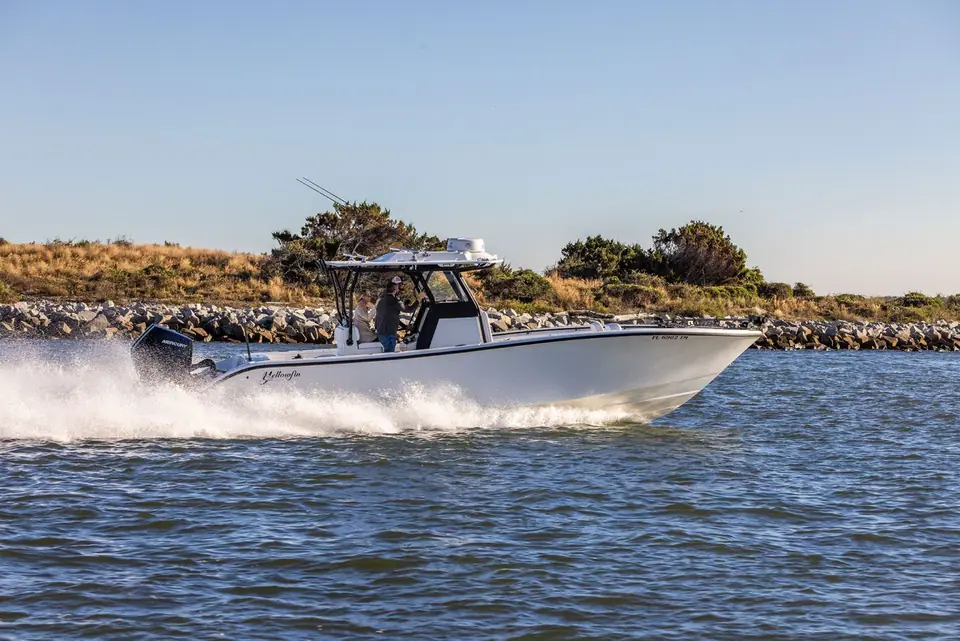
The hull follows the Yellowfin formula. A sharp entry transitions aft into two notched steps that ventilate the running surface, and the transom carries 22 degrees of deadrise. The beam is 9 feet 9 inches on a 32-foot-6 hull, a slender ratio that is a big part of why the boat slices through short chop rather than pounding over it.
Sport Fishing's Dean Travis Clarke tested an early boat out of Hillsborough Inlet and found it nearly impossible to launch. The ventilated hull, he wrote, wanted to hug the surface. Up-sea, down-sea, beam or quartering, he described it as dry, soft, solid, quiet and comfortable with no untenable idiosyncrasies. His only warning was that it turns more sharply than most owners will ever need, so passengers should hold on. At trolling speed, the hull left little surface wash and limited white water astern, which matters for a boat that spends days pulling baits.
Like all stepped hulls, the 32 rewards a driver who trims carefully, especially down-sea, and new owners coming from conventional deep-V boats should take a few runs to learn it. Current boats come with a Seakeeper Ride 600 active trim system, which takes much of that work off the helm.
- LOA 32 feet 6 inches, beam 9 feet 9 inches
- Hull draft about 1 foot 6 to 7 inches (2008 specs)
- Approximate weight 10,421 lb with power and light fuel on current boats
- Fuel 332 gallons on current boats (225 standard plus a 100-gallon option in 2008)
- Twin outboards only, rated to 900 hp today versus 700 hp in 2008
What two Verados and two Yamaha V8s actually did
The early magazine numbers are worth knowing because many of the boats on the used market are from that era. With twin Mercury Verado 300s, Sport Fishing's boat hopped onto plane in just under four seconds, cruised at 40 mph at 4,300 rpm on 24 gph, and hit 57.5 mph at the top on 60 gph. That boat carried an upper control station; Clarke reported that a 32 with a clean T-top runs slightly above 61 mph. Yellowfin's own factory test on twin Verado 300s showed 60.9 mph at 6,050 rpm on 59.8 gph with two people and 175 gallons aboard.
Salt Water Sportsman's Capt. Dave Lear ran a boat with twin Yamaha F350 V8s off Sarasota. The extra 100 hp lifted the top speed to 65.6 mph at 6,100 rpm on 68.4 gph, and an easy 4,000 rpm cruise delivered 41 mph on 24.8 gph. That works out to about 1.65 mpg, which is strong economy for a 32-foot offshore boat.
Today's boats are heavier and better equipped, at roughly 10,400 lb with power versus 8,200 to 8,500 lb in 2008, but they also carry far more horsepower. Twin modern outboards in the 400 to 450 hp class are the natural fit for the 900 hp rating. We have not seen a published independent test of a current-generation 32, so treat the 2008 figures as a floor for speed and a ceiling for economy.
Built for live bait, pitch baits and a sailfish spread
Clarke's test ended with a demonstration: in two hours off Hillsborough Inlet the crew raised, hooked and released five sailfish. The deck is laid out for exactly that kind of day. The 2008 boats came standard with two livewells, a 100-gallon pressurized well in the leaning post and a 50-gallon well in the transom, plus twin in-deck saddle fish boxes of more than 600 quarts each, a coffin box option on the foredeck, tackle centers in the leaning post and a built-in trash can.
The current standard list keeps the same philosophy: a plumbed livewell in the transom with a second plumbed well in the leaning post, a livewell pump box, an insulated fish box with a gulper pump, 14 Gemlux rod holders, a hardtop with five rod holders on the frame, spreader lights, fresh and saltwater washdowns, titanium cleats and through-hulls, electric steering and C-Zone digital switching. Options include forward seating, hardtop and tower choices, a coffin box, more livewells and a sub-console head.
Earlier boats offered five leaning-post configurations, an optional head in the console and an extra 100 gallons of fuel, and Yellowfin built them to order. That means no two used 32s are quite the same, so read the build sheet as carefully as the survey.
From factory direct to a dealer network
In 2008, Sport Fishing noted that Yellowfin had no dealers and buyers dealt directly with the factory. That has changed. Yellowfin now sells through a domestic and international dealer network and has expanded factory-direct sales across most of Florida, including a sales center in St. Augustine, and it runs a demo fleet and a trade-in program.
Construction has evolved too. Early boats were laminated with Core-Cell composite, with Gemlux stainless hardware, tinned wiring and Deutsch connectors called out by testers. Yellowfin now describes a process in which fiberglass components are produced at a large composites plant on Mexico's Yucatan Peninsula, with design, assembly, inspection and delivery prep in Sarasota, Florida.
Picking the right used 32 Yellowfin
The used market splits into three groups. The earliest boats, from 2008 into the early 2010s, often trade between about $90,000 and $175,000. Most are on their second set of engines or will need one soon, so the outboards dominate the value. A boat repowered with modern four-strokes can be a better buy than a newer hull on tired original engines.
Mid-generation boats from roughly 2016 to 2020 typically ask $170,000 to $320,000 and usually carry better electronics, hardtops and more refined rigging. Recent boats with standard Seakeeper Ride, C-Zone and current twin outboards command $330,000 to more than $500,000.
Many 32s live on trailers. The 9-foot-9 beam exceeds the standard 8-foot-6 highway width, so towing usually means an oversize permit and a capable truck, but current boats ship with an aluminum trailer and the 32 is noticeably easier to tow and launch than a 34 or 36, which helps resale for owners who move between fisheries.
Running costs and the 32 versus the 34
Two engines are the 32's quiet advantage. At a 40 mph cruise the tested boats burned roughly 24 to 25 gph, about half of what a triple-engine 36 burns at its top end and far less than a quad-engine boat. Annual service on two outboards, insurance, storage or lift fees, bottom care and electronics updates typically land between $18,000 and $42,000 a year before fuel and depreciation.
The obvious cross-shop is Yellowfin's own 34 Offshore. The 34 adds a 10-foot beam, more fuel and the option of triples, which makes it more stable at rest and faster with three engines. The 32 is lighter, simpler and easier to tow. If you fish with two or three people and do not need triples, the 32 is the better value.
Yellowfin 32 Offshore specifications
| Length overall | 32.5 ft9.91 m |
|---|---|
| Beam | 9.8 ft2.97 m |
| Draft | 1.6 ft0.48 m |
| Displacement | 10,421 lbs4,727 kg |
| Fuel capacity | 332 gal1,257 L |
| Cabins | None |
| Berths | None |
| Heads | Optional sub-console head |
| Standard engines | Twin outboards, 900 hp maximum |
| Optional engines | Tested with twin Mercury Verado 300s and twin Yamaha F350 V8s on 2008 boats |
| Maximum power | 900 hp |
| Cruise speed | 35.6 knots |
| Top speed | 57 knots |
| Hull type | Twin-step deep-V monohull, 22 degrees transom deadrise |
| Hull construction | Vinylester and Core-Cell composite construction on early boats; current fiberglass components molded at the Warbird composites plant in Mexico and assembled in Sarasota |
| Builder | Yellowfin Yachts, United States |
| Naval architect | Yellowfin Yachts in-house design team |
| Other design credits | Wylie Nagler (founder) |
| Production | 2008 to present |
| Status | In production |
Figures come from builder documentation and independent tests where available. Displacement is usually quoted light, so a loaded cruising boat will weigh more. Compare these specs with another model.
Performance data
| Test rig | RPM | Speed (mph) | Fuel (gph) |
|---|---|---|---|
| 2 x Mercury Verado 300 (Sport Fishing) | 4300 | 40 | 24 |
| 2 x Mercury Verado 300 (Sport Fishing) | WOT | 57.5 | 60 |
| 2 x Mercury Verado 300 (factory test) | 6050 | 60.9 | 59.8 |
| 2 x Yamaha F350 (Salt Water Sportsman) | 4000 | 41 | 24.8 |
| 2 x Yamaha F350 (Salt Water Sportsman) | 6100 | 65.6 | 68.4 |
2008 tests of early 32s. The Sport Fishing boat carried an upper control station; the factory figure was reported by Salt Water Sportsman with two people and 175 gallons of fuel aboard.
How much does a Yellowfin 32 Offshore cost?
In 2008 a 32 with twin Mercury Verado 300s and a trailer listed at $157,000. Current boats carry a hardtop, Seakeeper Ride 600, C-Zone, electric steering and an aluminum trailer as standard and are priced on request, so our new range is an estimate for typical twin-engine builds. Used values hinge on engine generation and hours, whether the boat has been repowered, and on electronics and top configuration more than on hull year alone.
Estimate your yearly cost
A planning estimate using common rules of thumb: insurance near 1.5 percent of value, maintenance near 3 percent, haul out and bottom paint by length. Your marina, region and use will move these numbers. Open the full cost calculator.
Versions and options
- Original 31 (predecessor)
- Yellowfin's first offshore model in this size; its mold was retired when the 32 arrived in 2008.
- 32 Offshore, 2008 onward
- Twin-step, twin-outboard hull with a wider stern than the 31. Fuel and horsepower ratings have grown over time, from 225 gallons and 700 hp to 332 gallons and 900 hp.
Yellowfin 32 Offshore timeline
- 1998Wylie Nagler founds Yellowfin Yachts in Florida
- 2008The 32 replaces the original 31; tests show about 61 mph on twin Verado 300s and 65.6 mph on twin F350s
- 2021Warbird Marine Holdings acquires Yellowfin
- 2025Current 32 lists 332 gallons, 10,421 lb with power and a 900 hp twin-engine rating with Seakeeper Ride 600 standard
Strengths and weaknesses
What owners like
- Fast, dry twin-step ride for its size
- Twin-engine running costs with tournament-class speed
- Generous live bait capacity
- Lighter and easier to tow than the 34 and 36
- Strong resale and a large owner community
What to weigh up
- Narrow beam rolls more at rest than wider 32s
- No triple-engine option
- Stepped hull asks for an attentive driver
- No cabin, only an optional console head
Used Yellowfin 32 Offshore buyer checklist
Take this list to a viewing. Your ticks are saved in this browser so you can come back to it.
Always commission an independent marine survey and an engine survey before you buy. How a marine survey works.
Rivals to consider
Contender 32 ST
Another twin-step tournament 32 with a strong kingfish following.
Compare side by sideSeaVee 340Z
Miami-built custom tournament boat with a similarly narrow, fast hull.
Regulator 31
A heavier, wider Carolina-style boat that trades top speed for comfort and finish.
Compare side by sideYellowfin 34 Offshore
The in-house step up, with a 10-foot beam and the option of triple outboards.
Compare side by sideOur verdict on the Yellowfin 32 Offshore
The Yellowfin 32 Offshore is the purest expression of what made the brand famous: a narrow, twin-step hull that runs fast and dry, fishes well and costs less to feed than the bigger tournament boats. It is not the most stable boat at rest and it will never take triples, but for small crews who want 60-plus mph capability on two engines and a resale story few 32s can match, it is still one of the smartest buys in the class.
Yellowfin 32 Offshore questions answered
How much is a 32 Yellowfin for sale?
Used Yellowfin 32 Offshores range from roughly $90,000 for early boats to about $540,000 for nearly new examples. New boats are priced on request; we estimate $480,000 to $620,000 for typical twin-engine builds.
How fast is a Yellowfin 32?
Salt Water Sportsman recorded 65.6 mph with twin Yamaha F350s in 2008, and Yellowfin's factory test showed 60.9 mph on twin Verado 300s. Current boats are rated for up to 900 hp.
Can a Yellowfin 32 take triple engines?
No. The 32 is designed for twin outboards only. The 34 Offshore is Yellowfin's smallest boat that accepts triples.
What is the fuel capacity of the Yellowfin 32?
Current boats carry 332 gallons. Early boats had 225 gallons standard with an optional extra 100-gallon tank.
When did Yellowfin start building the 32?
The 32 was introduced in 2008 as the replacement for Yellowfin's original 31-foot model.
Yellowfin 32 Offshore photos
More center consoles & offshore boats to explore
Contender 31 Tournament
Center Consoles & Offshore Boats, 33 ft
Used $45K to $125K
Contender 32 ST
Center Consoles & Offshore Boats, 33 ft
Used $115K to $430K
Onslow Bay 33 Tournament Edition
Center Consoles & Offshore Boats, 33 ft
Used $180K to $450K
Boston Whaler 305 Conquest
Center Consoles & Offshore Boats, 32 ft
Used $55K to $115K