Grady-White Center Consoles & Offshore Boats
Grady-White Canyon 456 Review, Price, Performance and Buyer's Guide
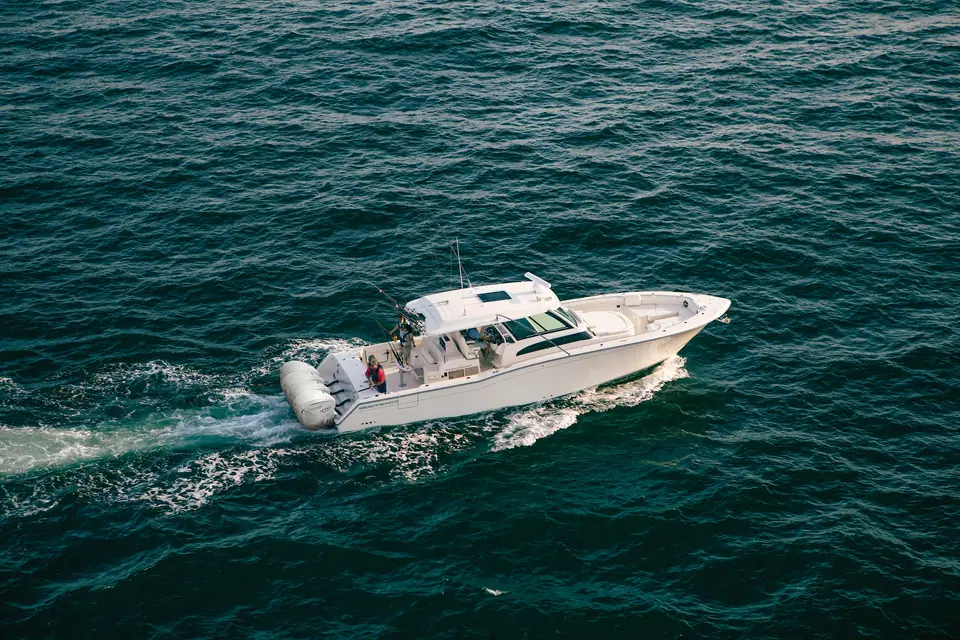
Grady-White's 45-foot flagship, a quad-Yamaha center console that packs a Seakeeper, a 12 kW diesel generator and a real cabin onto the Hunt SeaV2 hull.
- Length
- 45 ft13.72 m
- Beam
- 14 ft4.27 m
- Cruise
- 26 kn
- Cabins
- 1 (convertible dinette)
- Used price
- $1.05M to $2M
On this page
- Overview
- Grady-White Canyon 456, the flagship nobody expected
- The SeaV2 hull at 45 feet
- Quad Yamaha speed and fuel numbers
- Sea Command Center helm and the aft-facing trolling seats
- Livewells, fish boxes and the sea chest
- Cabin, galley and bow lounges for the family
- Grady-White Canyon 456 price, running costs and resale
- Specifications
- Price and value
- Strengths and weaknesses
- Used buyer checklist
- Rivals
- Our verdict
- FAQ
The Grady-White Canyon 456 is a 45-foot center console launched in 2019 with a 14-foot beam, 616 gallons of fuel, quad Yamaha outboards and more standard equipment than any Grady before it.
- Owners moving up from smaller Grady-Whites
- Offshore fishing families
- Owner-operators replacing a convertible
- Canyon runs in the mid-Atlantic
Grady-White Canyon 456 by the numbers
- Speed to length ratio at cruise
- 4.16A planing cruise. Fast passages in exchange for much higher fuel burn per mile.
- Estimated range at cruise
- 328 nmUsing 90 percent of tank capacity at the cruise speed and fuel burn listed on this page.
- Fuel economy at cruise
- 0.59 nmpgNautical miles per gallon at cruise, both engines combined.
- Horsepower per ton
- 147 hpVery high power to weight, built for speed.
- Length to beam ratio
- 3.21 : 1Moderate proportions.
Grady-White Canyon 456, the flagship nobody expected
For most of its history Grady-White, the family-owned builder in Greenville, North Carolina, built sensible 20- to 30-foot boats for people who fish and take their kids along. So when the Grady-White Canyon 456 debuted at the 2019 Miami show, it surprised a lot of people. Here was a 45-foot, 1,800 hp center console with a Seakeeper, a diesel generator and an air-conditioned helm, built by a company better known for the Fisherman 180.
BoatTest called it the best boat Grady had ever built, and the logic behind it is clear. The 456 was created for owners who would otherwise buy a traditional sportfishing convertible, with a seven-figure price, a paid captain and maintenance bills that can reach six figures, and who would rather run their own boat. It also gives Grady's loyal owners, many of whom have worked up through three or four models, somewhere to go next.
The result is a boat that feels very Grady-White in its priorities: comfortable seats, a soft ride, thoughtful storage and a long list of standard equipment that rivals charge extra for.
The SeaV2 hull at 45 feet
Grady-White's SeaV2 hulls are drawn in collaboration with C. Raymond Hunt & Associates, the firm founded by the man who pioneered the modern deep-V around 1960. Grady calls its version SeaV2, a continuously variable V in which deadrise sharpens progressively from the transom to the bow. On the Canyon 456 the transom deadrise is 21 degrees, and the forward sections get much finer so the boat cleaves through a head sea instead of slamming.
It is a conventional, non-stepped hull, and that is a deliberate choice. Stepped bottoms dominate the big-console market because they are fast and efficient, but a well-designed variable deadrise hull tracks predictably in following seas and does not need to be driven at high speed to ride well. Grady prioritizes the soft, dry ride its owners expect over a headline top speed.
The 14-foot beam adds stability at rest, which matters when trolling or drifting with a family aboard, and Grady fits a Seakeeper 6 gyro as standard to take out most of the roll at anchor or on the troll. Zipwake dynamic trim, also standard, auto-levels the boat in turns and during acceleration.
Quad Yamaha speed and fuel numbers
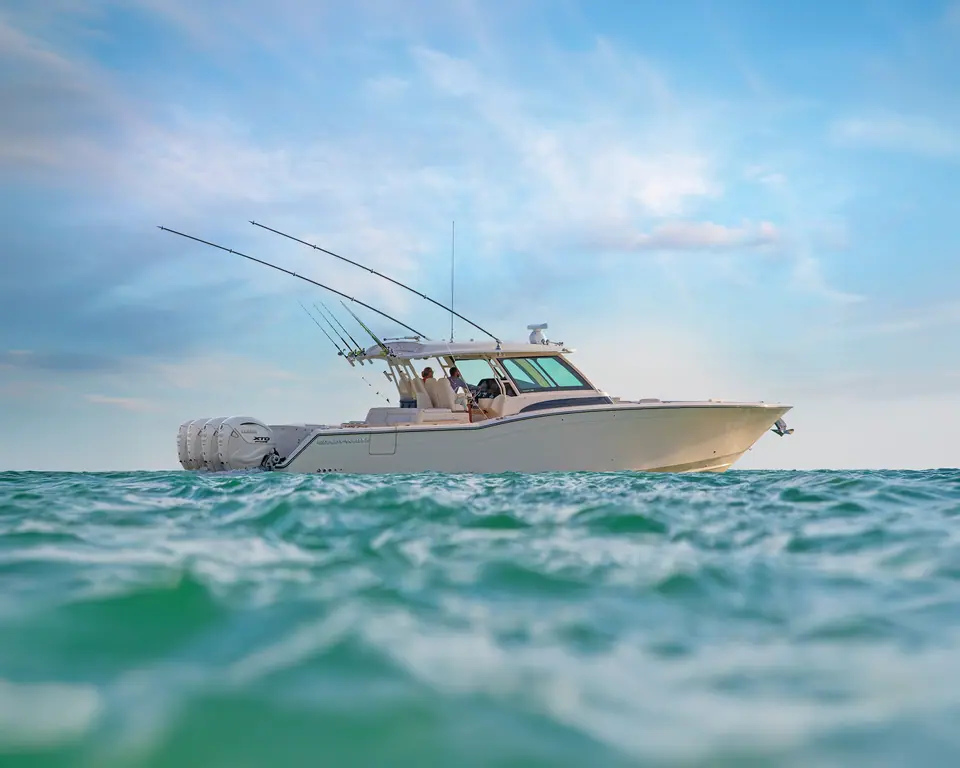
Power has always been four Yamaha XTO Offshore V8s. Launch boats carried quad 425s; current boats use the XTO 450, keeping the 1,800 hp maximum. Grady-White and Yamaha tested the quad rig turning 16 3/8 x 21 propellers at a test weight of 31,650 pounds, which includes fuel, water, gear, engines and people, against a dry weight of about 24,500 pounds. BoatTest reported the figures on the launch 425s, and Grady now publishes the same numbers for the XTO 450 package.
They recorded a top speed of 58 mph (about 50 knots) at 6,000 rpm, burning fuel at 0.4 mpg. Optimum cruise came at 3,500 rpm, 30.1 mph (about 26 knots) at 44 gallons per hour, or 0.68 mpg. With 616 gallons on board, that gives a practical range of roughly 375 statute miles at cruise while holding back a 10 percent reserve.
Those numbers are honest rather than spectacular. A stepped 45-footer on similar power will usually run several knots faster and slightly more efficiently. What you get in exchange is a heavy, solid-feeling boat that stays comfortable at 30 mph in conditions where lighter boats slow down. Yamaha Helm Master with Set Point is standard, giving Stay Point, Fish Point and Drift Point station keeping.
- Top speed: 58 mph (about 50 knots) at 6,000 rpm, 146.6 gph
- Optimum cruise: 30.1 mph at 3,500 rpm, 44 gph, 0.68 mpg
- Fuel 616 gallons, water 80 gallons, separate 30-gallon diesel tank for the generator
- Maximum power 1,800 hp; current package quad Yamaha XTO 450
Sea Command Center helm and the aft-facing trolling seats
Grady trademarked the name Sea Command Center for the helm, and it earns the label. Four individual forward-facing seats with power adjustment, flip-up bolsters and flip-down armrests sit behind a one-piece curved windshield with slim mullions. The wheel and controls are offset to starboard where they belong. The helm is enclosed on three sides, has 16,000 BTU of reverse-cycle air conditioning, an electric sunroof and side windows that slide open on good days. CZone digital switching controls nearly every system, including seacocks, from the dash or a smartphone.
The back of the console is where the 456 really stands apart. Three raised, cushioned aft-facing seats with air conditioning vents behind them give the crew a comfortable perch to watch the spread, with a SureShade awning overhead and space on the transom bulkhead for a 24-inch display showing sonar and the last strike position. Tackle storage holds six Plano boxes plus drawers, and a mini galley with sink, refrigerator and grill flanks the seats.
For anglers this is more practical than a traditional mezzanine. A strike is one step away, and nobody spends six hours sitting on a cooler.
Livewells, fish boxes and the sea chest
Grady fitted a sea chest, a raw-water reservoir that feeds the livewells, generator, air conditioning and washdowns from a single intake, an unusual system in this class. The two transom livewells hold 35 gallons each with 1,500 gph pumps and full-column distribution, and a 459-quart refrigerated and freezer fish box sits in the center of the transom with partitions to split the catch.
Port and starboard cockpit side doors serve for landing fish, boarding from a dock and recovering divers. Rod storage is everywhere: ten holders across the hardtop, six under the gunwales, four more lockable, and twelve lockable rods inside the cabin using Grady's integrated rod storage slides and the shower stall. Optional Gemlux carbon outriggers complete the tournament spec.
Cabin, galley and bow lounges for the family
Below decks, the cabin uses Sapele and teak joinery, Corian counters and its own 12,000 BTU reverse-cycle air conditioning. The galley has a two-burner glass cooktop, sink, refrigerator, microwave drawer and a six-bottle wine cooler. Forward, an electrically actuated table drops to turn the dinette into a double berth for two, with a 32-inch television on the bulkhead. The stand-up head is genuinely large thanks to the beam, with a VacuFlush toilet, a 20-gallon holding tank and a separate shower stall.
It is a cabin for a couple, not for a crew. Four anglers can nap in shifts, but the 456 is a day boat with overnight capability rather than a cruiser. On deck, the bow is set up for family use with two electrically raised semicircular tables surrounded by deep seating, a trunk-cabin sun pad with chaise backrests, and insulated boxes of 43, 123 and 210 quarts under the seats that work equally well as fish boxes or drink coolers.
Grady-White Canyon 456 price, running costs and resale
Expect a new Canyon 456 to cost roughly $1.9 million to $2.4 million in 2026, depending on electronics and options. Because the Seakeeper, 12 kW diesel generator, bow thruster, joystick, Zipwake and air conditioning are standard, the option list is shorter than on many rivals, and that makes comparison shopping easier.
Used boats from 2019 onward have generally traded between about $1.05 million and $2 million. Grady-White resale has traditionally been among the strongest in the industry, and the 456 benefits from a deep pool of Grady owners looking to move up.
Annual running costs of $75,000 to $140,000 are realistic once you include insurance, a 45-foot slip, quad outboard service, generator and Seakeeper maintenance, bottom paint and about 300 to 500 engine hours of fuel. Ten batteries and three chargers also mean periodic battery replacement is a real line item.
Grady-White Canyon 456 specifications
| Length overall | 45 ft13.72 m |
|---|---|
| Beam | 14 ft4.27 m |
| Draft | 2.5 ft0.76 m |
| Air draft | 10.4 ft3.18 m |
| Displacement | 24,5 lbs11,113 kg |
| Fuel capacity | 616 gal2,332 L |
| Fresh water | 8 gal303 L |
| Cabins | 1 (convertible dinette) |
| Berths | 2 |
| Heads | 1 with separate shower |
| Standard engines | 4 x Yamaha XTO Offshore 450 hp outboards |
| Optional engines | Launch boats used 4 x Yamaha XF425 XTO Offshore |
| Maximum power | 1,800 hp |
| Cruise speed | 26 knots |
| Top speed | 50 knots |
| Hull type | SeaV2 continuously variable deep-V, 21-degree transom deadrise |
| Hull construction | Hand-laid fiberglass |
| Builder | Grady-White Boats, United States |
| Naval architect | C. Raymond Hunt & Associates |
| Production | 2019 to present |
| Status | In production |
Figures come from builder documentation and independent tests where available. Displacement is usually quoted light, so a loaded cruising boat will weigh more. Compare these specs with another model.
Performance data
| RPM | Speed (mph) | Fuel (gph) | MPG |
|---|---|---|---|
| 1000 | 7 | 7.8 | 0.89 |
| 1500 | 9.4 | 10.4 | 0.91 |
| 2000 | 11.4 | 16 | 0.71 |
| 2500 | 16.1 | 24.7 | 0.65 |
| 3000 | 23.8 | 33.7 | 0.7 |
| 3500 | 30.1 | 44 | 0.68 |
| 4000 | 36.8 | 57.2 | 0.64 |
| 4500 | 43.4 | 76 | 0.57 |
| 5000 | 48.7 | 93.3 | 0.52 |
| 5500 | 53.4 | 120.2 | 0.44 |
| 6000 | 58 | 146.6 | 0.4 |
Grady-White and Yamaha test data, quad Yamaha XTO Offshore, 16 3/8 x 21 props, 31,650 lb test weight including fuel, people and gear. Speeds in statute mph.
How much does a Grady-White Canyon 456 cost?
Grady-White fits most of the expensive equipment as standard, including the Seakeeper 6, diesel generator, Zipwake trim, bow thruster and Helm Master joystick, so used boats vary less in specification than rival brands. Price spreads come mainly from engine hours, the 425 versus 450 Yamaha generation, electronics upgrades such as a 24-inch cockpit display or Starlink, and cosmetic condition of teak and upholstery.
Estimate your yearly cost
A planning estimate using common rules of thumb: insurance near 1.5 percent of value, maintenance near 3 percent, haul out and bottom paint by length. Your marina, region and use will move these numbers. Open the full cost calculator.
Grady-White Canyon 456 timeline
- 1959Grady-White Boats founded in Greenville, North Carolina
- 2019Canyon 456 debuts at the Miami show as Grady's largest boat, on quad Yamaha 425s
- 2020sYamaha XTO 450 replaces the 425 as the standard quad package
- 2026Canyon 456 remains the flagship above the Canyon 386
Strengths and weaknesses
What owners like
- Soft, dry SeaV2 ride from a proven Hunt-designed hull
- Seakeeper 6, diesel generator, joystick and Zipwake all standard
- Air-conditioned helm and clever aft-facing trolling seats
- Large, well-finished head with separate shower
- Strong Grady-White resale and dealer support
- Sea chest and 459-quart refrigerated fish box
What to weigh up
- Slower than stepped-hull rivals on similar power
- Cabin sleeps only two in comfort
- Fuel economy of about 0.68 mpg at best cruise
- Complex systems require diligent maintenance
- Heavy for trailering or lift storage
Used Grady-White Canyon 456 buyer checklist
Take this list to a viewing. Your ticks are saved in this browser so you can come back to it.
Always commission an independent marine survey and an engine survey before you buy. How a marine survey works.
Rivals to consider
Boston Whaler 420 Outrage
A little shorter with an unsinkable foam-filled hull and triple V12 option, slightly less fishing focus.
Compare side by sideYellowfin 42 Offshore
A faster stepped tournament boat with less cabin luxury and a more hardcore fishing deck.
Compare side by sideValhalla V-46
Viking-built stepped center console with a machinery room and more speed, at a higher price.
Pursuit S 428 Sport
A plush triple-outboard alternative with a more social layout and lower price.
Our verdict on the Grady-White Canyon 456
The Grady-White Canyon 456 is the big center console for buyers who care more about ride, comfort and completeness than about a 60-mph top speed. Its Hunt-designed SeaV2 hull is soft and predictable, the standard equipment list removes most option-sheet anxiety, and features such as the air-conditioned aft-facing trolling seats show real thought about how people fish. Faster stepped boats exist, but few 45-footers are as easy to live with or as easy to resell.
Grady-White Canyon 456 questions answered
How much does a Grady-White Canyon 456 cost?
A new Canyon 456 typically costs about $1.9 million to $2.4 million in 2026. Used boats from 2019 onward have generally sold between about $1.05 million and $2 million.
How fast is the Grady-White Canyon 456?
Builder testing with quad Yamaha XTOs recorded 58 mph (about 50 knots) at 6,000 rpm. Best cruise is about 30 mph at 3,500 rpm.
What is the fuel burn of the Canyon 456?
At optimum cruise of 30.1 mph the quad Yamahas burn about 44 gallons per hour, or 0.68 mpg. At wide open throttle economy drops to about 0.4 mpg.
Does the Canyon 456 have a cabin?
Yes. It has a cabin with galley, a convertible dinette that sleeps two and a large head with a separate shower, all air-conditioned.
What engines does the Grady-White 456 use?
It runs four Yamaha XTO Offshore outboards, originally 425 hp and now 450 hp, for a maximum of 1,800 hp.
Is a Seakeeper standard on the Canyon 456?
Yes. A Seakeeper 6 gyro stabilizer is standard, powered by a standard 12 kW diesel generator.
Grady-White Canyon 456 photos
More center consoles & offshore boats to explore
Regal 43 SAV
Center Consoles & Offshore Boats, 44 ft
Used $1.15M to $1.55M
Contender 44 ST
Center Consoles & Offshore Boats, 44 ft
Used $550K to $1.15M
Freeman 43
Center Consoles & Offshore Boats, 43 ft
Used $950K to $1.4M
Midnight Express 43 Open
Center Consoles & Offshore Boats, 43 ft
Used $380K to $1.5M
Other Grady-White models
- Grady-White Canyon 336
- Grady-White Express 330
- Grady-White Express 340
- Grady-White Express 370
- Grady-White Fisherman 216
- Grady-White Fisherman 236
- Grady-White Fisherman 257
- Grady-White Freedom 235
- Grady-White Freedom 275
- Grady-White Freedom 285
- Grady-White Gulfstream 232
- Grady-White Marlin 300
- Grady-White Seafarer 22
- All Grady-White models