Barker Boatworks Center Consoles & Offshore Boats
Barker Boats 26 Open, the Twin-Step Hybrid Bay Boat Reviewed
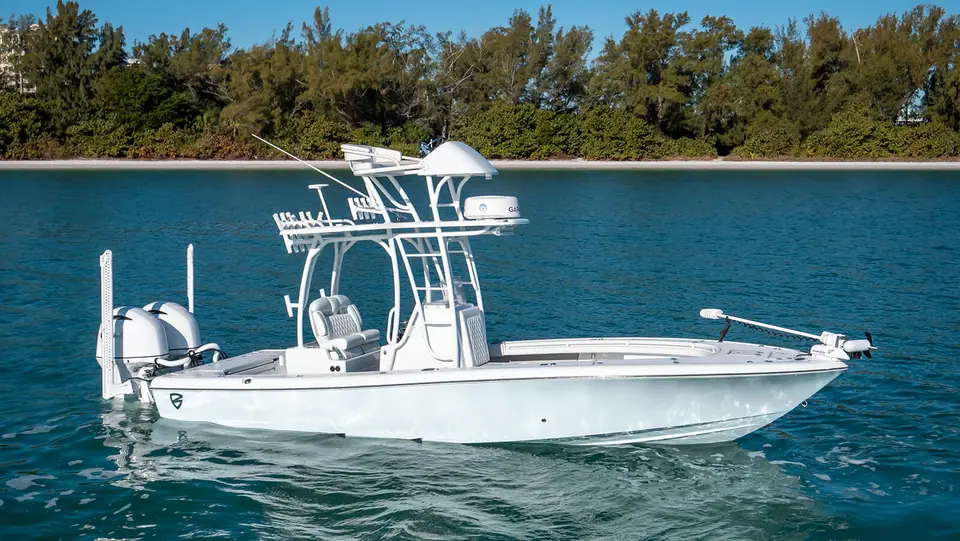
A custom-built 25-foot 6-inch hybrid on a patented Michael Peters stepped hull, built to order in Sarasota and rigged like a small yacht.
- Length
- 25.5 ft7.77 m
- Beam
- 9.3 ft2.82 m
- Cruise
- 32.2 kn
- Cabins
- None (open center console)
- Used price
- $90K to $215K
On this page
- Overview
- Who builds Barker boats, and why the 26 Open matters
- The Michael Peters ventilated-tunnel bottom under a 25-foot boat
- A deep cockpit plan built around bait and big fish boxes
- What a single Verado delivers: the Biscayne Bay numbers
- Helm, digital switching and the optional half tower
- Owning a custom-built 26: costs, service and trailering
- Finding a used Barker 26 Open for sale
- Specifications
- Price and value
- Strengths and weaknesses
- Used buyer checklist
- Rivals
- Our verdict
- FAQ
The Barker 26 Open is a 25-foot 6-inch hybrid bay and offshore center console on a Michael Peters twin-step hull. Built to order in Sarasota, it tested at 57 mph and 3.4 mpg on one Mercury Verado 350.
- Florida anglers who split time between flats and nearshore reefs
- Owners who want one engine and low fuel bills
- Buyers who value custom build quality over brand recognition
- Tarpon and snook fishermen who also chase mahi
Barker 26 Open by the numbers
- Speed to length ratio at cruise
- 6.84A planing cruise. Fast passages in exchange for much higher fuel burn per mile.
- Estimated range at cruise
- 319 nmUsing 90 percent of tank capacity at the cruise speed and fuel burn listed on this page.
- Fuel economy at cruise
- 2.95 nmpgNautical miles per gallon at cruise, both engines combined.
- Horsepower per ton
- 208 hpVery high power to weight, built for speed.
- Length to beam ratio
- 2.76 : 1A beamy hull with lots of volume for its length.
Who builds Barker boats, and why the 26 Open matters
Barker boats come from a small, build-to-order shop in Sarasota, Florida, and the 26 Open is the model that turned the brand from a cult bay-boat builder into a name offshore anglers recognize. Kevin Barker founded Barker Boatworks in the summer of 2014 after roughly a decade in the boatbuilding trade. His first boat, the 26 Calibogue Bay, was named for the South Carolina waters he fished as a kid, and it was conceived as an ultimate bay boat for tarpon, snook and redfish.
The 26 Open followed within about a year. Barker kept the Calibogue's hull, cut away its fly-fishing casting decks and raised the cap to create a deeper cockpit, producing what the fishing press calls a hybrid: a boat you fish in rather than on. Barker himself framed it as a boat for an angler who wants to chase redfish in the bays in the afternoon and still feel comfortable running out for dolphin and sailfish in the morning.
Every hull is built to the owner's specification, so no two are identical. Barker later folded into Strike Force 7, a group that also includes Canyon Bay BoatWorks and Perry Composite Manufacturing, and support still runs through the Sarasota factory rather than a national dealer network.
The Michael Peters ventilated-tunnel bottom under a 25-foot boat
Barker commissioned Michael Peters, whose Michael Peters Yacht Design has drawn hulls for Edgewater, Invincible and Viking, to develop the running surface. The result is Peters' patented Stepped-Vee Ventilated Tunnel design, a twin-step bottom that feeds air under the hull to reduce wetted surface. Barker claims it has one of the lowest drag coefficients of any monohull, and the test numbers back up the efficiency claim even if the marketing language is ambitious.
The geometry is modest by offshore standards: 18 degrees of deadrise at the transom, a 9-foot-3-inch beam and a draft of about 14 inches. That is bay-boat territory, which is the point. The steps let a fairly flat, shallow hull run fast and dry in a chop without the slamming you would expect from 18 degrees, and the boat floats in water most 25-foot offshore boats cannot reach.
Construction is a differentiator. Every hull is vacuum-bagged and resin-infused with 100 percent vinylester resin and composite coring. Earlier buyers guides also describe glass, carbon and Kevlar ratios tuned per model, closed-cell foam gaskets across the full face of hatches rather than a thin edge seal, and a set-back engine bracket so the outboard bites clean water. Molds for the original Calibogue Bay were built by Marine Concepts.
A deep cockpit plan built around bait and big fish boxes
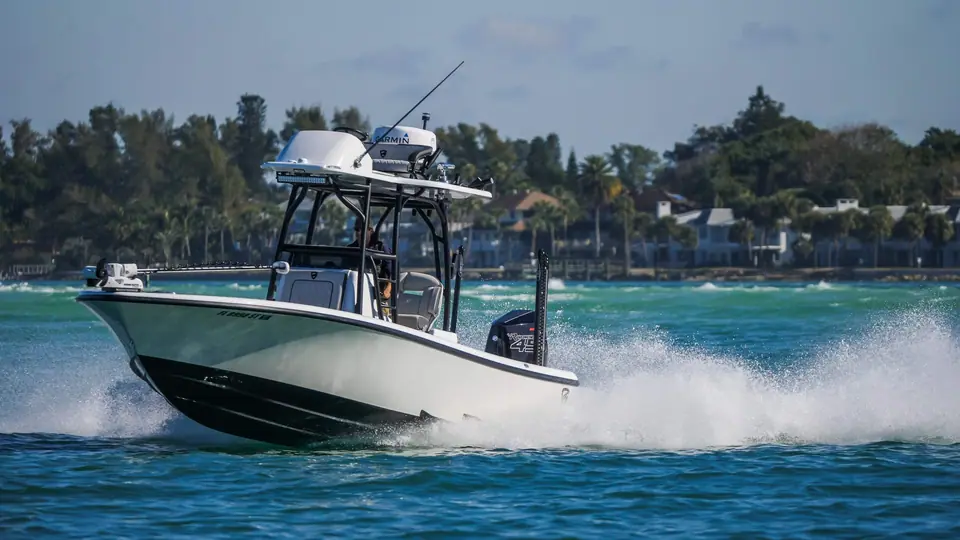
The 26 Open is laid out as a fishing tool first. A 45-gallon baitwell with a viewing window lives in the leaning post (early boats had a 40-gallon pressurized tank there), backed by a 15-gallon pitch-bait well in the bow, a 15-gallon well in the transom and a 15-gallon transom cooler. Barker's spec sheet lists 1,100 gph baitwell pumps fed from a custom sea chest with three pumps and a 1.5-inch stainless high-speed pickup, the kind of plumbing that keeps pilchards alive on a long run.
Fish storage is generous for the length: a 140-gallon macerated, insulated box under the forward deck plus a 50-gallon macerated box. Sport Fishing's tester iced eight mahi in the forward locker on a single morning without filling it. Twin locking compartments in the forward gunwales hold rods up to 10 feet, and the boat carries a dozen or more rod holders between the gunwales, console and the Key West-style hardtop, which brings 11 rocket launchers as standard.
There is no splashwell, which frees floor space aft, and abbreviated casting decks at bow and stern give height for sight fishing in calm water while the deep center section keeps crew secure offshore. A standard 8-foot Power-Pole holds the boat on a flat; earlier test boats carried two.
- Baitwells: 45-gallon leaning post well with window, 15-gallon bow well, 15-gallon transom well
- Fish boxes: 140-gallon and 50-gallon, both macerated and insulated
- Standard: Garmin 8616 XSV display, C-Zone/MDI digital switching, JL Audio, Odyssey AGM batteries, dual fuel fills
- Options: second-station half tower, sunroof, forward seating, Seakeeper 1 gyro
What a single Verado delivers: the Biscayne Bay numbers
The most complete data set comes from Sport Fishing magazine's 2016 fish trial on Biscayne Bay. With a Mercury Verado 350 turning a 19-inch Mirage Plus prop, two crew and 69 gallons of fuel, the 26 Open planed in 5.7 seconds with almost no bow rise, reached 30 mph in 9.5 seconds and topped out at 57 mph at 6,200 rpm while burning 30 gph. The sweet spot was 4,000 rpm and 37 mph, where the engine drank 10.9 gph for 3.4 mpg.
That economy is the headline. At 3.4 mpg the standard 90-gallon tank works out to about 306 statute miles, and boats fitted with the optional larger tank (Barker now quotes 120 gallons maximum) stretch that further. Very few 26-foot offshore-capable boats run that far on one engine.
Salt Water Sportsman's 2025 buyers guide tested a newer boat with a Mercury 400 V10 Verado and a heavier 6,800-pound test load, recording 56 mph and a maximum range of 180 miles at 40 mph. Testers on both occasions described a dry ride through 2-foot chop and confident, predictable turns, with none of the skittish behavior older stepped hulls were known for.
Helm, digital switching and the optional half tower
Barker dispensed with analog gauges early. The test boats ran fully networked Garmin multifunction displays that also show engine data, and the current standard package pairs a Garmin 8616 XSV with Mercury VesselView 4. Switching is digital, through C-Zone and an MDI custom panel with battery monitors. The 31-inch-wide helm sits behind a leaning post with a guide-style helm seat; twin teak-back helm chairs are optional.
The upgrade most often seen on the used market is the half tower. A sliding pilot hatch in the hardtop lets the skipper climb to a second station with its own Garmin display, standing on a SeaDek pad or sitting on a small bench. For sight casting to tarpon or running weed lines it is a genuine advantage, but it adds weight and windage, and it raises the boat's height for storage and trailering.
Owning a custom-built 26: costs, service and trailering
Running costs are reasonable because there is only one engine to feed and service. At a 37 mph cruise the boat burns roughly 11 gph, so 100 hours a year costs well under the fuel bill of a twin-engine 26-footer. We budget $9,000 to $17,000 a year for a trailered or dry-stacked boat, covering insurance on a high-value hull, annual Verado service, bottom or hull care, Power-Pole and electronics upkeep, and storage. Owners keeping the boat in a wet slip in South Florida should add slip fees on top.
The 26 Open ships on a custom Amera Trail aluminum C-channel trailer as standard, and at 9 feet 3 inches it tows without wide-load permits. With a hardtop and half tower, check your garage and bridge heights before ordering.
Finding a used Barker 26 Open for sale
Searches for Barker boats for sale return few results at any given time, because production is measured in dozens of hulls rather than hundreds. Expect most listings to come through Florida brokers and owner networks, often with a price that surprises buyers used to big-brand bay boats. Our estimate puts early 2016 to 2018 boats around $90,000 to $140,000 and late-model boats with V10 power and a tower near or above $200,000, but each boat's spec moves the number more than its year.
Because every Barker is custom, read the build sheet rather than the model name. Engine (Verado 350 inline six versus the newer V10 350 or 400), tank size, tower, trolling motor, Power-Poles and electronics vary widely. A boat with the half tower, the larger fuel tank and the V10 sits at the top of the market.
Barker 26 Open specifications
| Length overall | 25.5 ft7.77 m |
|---|---|
| Beam | 9.3 ft2.82 m |
| Draft | 1.2 ft0.36 m |
| Displacement | 4,8 lbs2,177 kg |
| Fuel capacity | 12 gal454 L |
| Fresh water | 2 gal76 L |
| Cabins | None (open center console) |
| Berths | None |
| Heads | Room for a portable head inside the console |
| Standard engines | 1 x Mercury 350 hp V10 Verado on a Bob's Machine Shop jack plate |
| Optional engines | Mercury 400 V10 Verado; twin-engine rigs available to order |
| Maximum power | 500 hp |
| Cruise speed | 32.2 knots |
| Top speed | 49.5 knots |
| Range | 266 nm |
| Hull type | Patented Michael Peters Stepped-Vee Ventilated Tunnel twin-step hull, 18-degree transom deadrise |
| Hull construction | Vacuum-bagged, resin-infused fiberglass with 100 percent vinylester resin and composite coring |
| Builder | Barker Boatworks, United States |
| Naval architect | Michael Peters Yacht Design |
| Other design credits | Kevin Barker (founder, layout and fishing features) |
| Production | 2015 to present |
| Status | In production |
Figures come from builder documentation and independent tests where available. Displacement is usually quoted light, so a loaded cruising boat will weigh more. Compare these specs with another model.
Performance data
| RPM | Speed (mph) | Fuel (gph) | MPG |
|---|---|---|---|
| 4000 | 37 | 10.9 | 3.4 |
| 6200 | 57 | 30 | 1.9 |
Sport Fishing magazine fish trial, Biscayne Bay, Mercury Verado 350 with 19-inch Mirage Plus prop, two crew, 69 gallons of fuel. Time to plane 5.7 seconds, 0 to 30 mph in 9.5 seconds. Only the published cruise and top-speed points are shown.
How much does a Barker 26 Open cost?
Salt Water Sportsman priced the 26 Open at $131,500 with a Verado 350 in 2016. Barker builds every boat to order, so 2026 prices depend heavily on the electronics, tower, Seakeeper 1 and engine choice; our new-boat band is an estimate scaled from that 2016 figure and current Mercury V10 pricing, not a published list price. Few hulls exist, so clean used boats change hands quietly and well above mass-production bay boats of the same length.
Estimate your yearly cost
A planning estimate using common rules of thumb: insurance near 1.5 percent of value, maintenance near 3 percent, haul out and bottom paint by length. Your marina, region and use will move these numbers. Open the full cost calculator.
Versions and options
- 26 Calibogue Bay
- The original 2014 Barker on the same hull, with full casting decks for fly and sight fishing and a lower cap; the dedicated bay-boat sibling.
- 26 Open
- Deeper cockpit, abbreviated casting decks, no splashwell and more bait and fish-box volume for nearshore and offshore work.
- 26 Open Tower
- Announced in 2017 buyers guides as a tower-equipped version; in practice the half tower with second station became a popular option on the 26 Open.
Barker 26 Open timeline
- 2014Kevin Barker founds Barker Boatworks and launches the 26 Calibogue Bay on a Michael Peters hull
- 2015The 26 Open is introduced as a hybrid bay and offshore model on the same twin-step hull
- 2016Sport Fishing and Salt Water Sportsman test the 26 Open at 57 mph and 3.4 mpg with a Verado 350
- 2017Buyers guides announce a 26 Open Tower variant as the line expands
- 2024Barker is described as part of Strike Force 7 with Canyon Bay BoatWorks and Perry Composite Manufacturing
- 2025Salt Water Sportsman tests a 26 Open with a Mercury 400 V10 at 56 mph
Strengths and weaknesses
What owners like
- Exceptional single-engine efficiency, 3.4 mpg at 37 mph in testing
- Twin-step hull runs dry and fast with about 14 inches of draft
- Vacuum-infused vinylester construction and yacht-grade fit and finish
- Large fish boxes and serious bait capacity for a 25-foot boat
- Built to order, so the boat can be specified exactly
- Strong resale thanks to scarcity
What to weigh up
- Expensive for its length, close to the price of larger offshore boats
- No national dealer network for service
- 18-degree deadrise limits comfort in big head seas
- Used examples are rare and every boat is different
- Half tower adds height that complicates storage
Used Barker 26 Open buyer checklist
Take this list to a viewing. Your ticks are saved in this browser so you can come back to it.
Always commission an independent marine survey and an engine survey before you buy. How a marine survey works.
Rivals to consider
Yellowfin 26 Hybrid
The best-known premium hybrid bay boat, also stepped and also expensive, with a stronger dealer network.
Compare side by sideBlackJack 256 Coastal
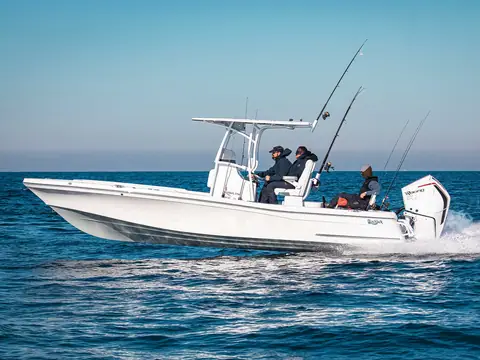
Same length and hybrid concept from Arkansas, lighter and far cheaper, with a Carolina-flare hull instead of steps.
Compare side by sideContender 25 Tournament
A deeper-V offshore boat that rides harder seas better but cannot reach the same skinny water.
Compare side by sideCanyon Bay 24H
A Strike Force 7 stablemate, smaller and simpler, for buyers who want the group's build quality at a lower price.
Compare side by sideOur verdict on the Barker 26 Open
The Barker 26 Open earns its reputation. A Michael Peters twin-step hull, vinylester infusion and a fishing layout drawn by a lifelong angler produce a 25-footer that ran 57 mph on one engine and returned 3.4 mpg at a 37 mph cruise, numbers few boats its size can match. It is not cheap, service is factory-centric and the moderate deadrise means it is a fair-weather offshore boat rather than a canyon runner. For a Florida angler who wants to fish the flats and the weed line from the same boat, and who would rather own something hand built than mass produced, it is one of the most convincing hybrids available.
Barker 26 Open questions answered
Where are Barker boats built?
Barker Boatworks builds its boats to order in Sarasota, Florida. The company is now part of Strike Force 7, which also includes Canyon Bay BoatWorks and Perry Composite Manufacturing.
How fast is the Barker 26 Open?
Sport Fishing recorded 57 mph at 6,200 rpm with a Mercury Verado 350, and Salt Water Sportsman saw 56 mph with a Mercury 400 V10 and a heavier test load.
What is the fuel economy of the Barker 26 Open?
Best economy in testing was 3.4 mpg at 37 mph and 4,000 rpm, burning 10.9 gph with a Verado 350. That gives about 306 miles of range on the standard 90-gallon tank.
Who designed the Barker 26 Open hull?
Michael Peters Yacht Design. The boat uses Peters' patented Stepped-Vee Ventilated Tunnel twin-step hull with 18 degrees of deadrise at the transom.
What is the difference between the Barker 26 Open and 26 Calibogue Bay?
Both share the same 25-foot 6-inch hull. The Calibogue Bay is a true bay boat with full casting decks, while the 26 Open has a deeper cockpit, smaller decks and more bait and fish capacity for offshore trips.
How much does a Barker 26 Open cost?
It was priced at $131,500 with a Verado 350 in 2016. Today's custom builds cost substantially more, and used boats typically ask between about $90,000 and $215,000 depending on year and options.
Barker 26 Open photos
More center consoles & offshore boats to explore
BlackJack 256 Coastal
Center Consoles & Offshore Boats, 26 ft
Used $85K to $150K
Boston Whaler 250 Outrage
Center Consoles & Offshore Boats, 25 ft
Used $55K to $200K
Parker 2520 XLD Sport Cabin
Center Consoles & Offshore Boats, 25 ft
Used $50K to $200K
Sea Hunt Gamefish 25
Center Consoles & Offshore Boats, 26 ft
Used $45K to $155K