Conch Boats Center Consoles & Offshore Boats
Conch 33, the Key West Guide Boat Built Bigger
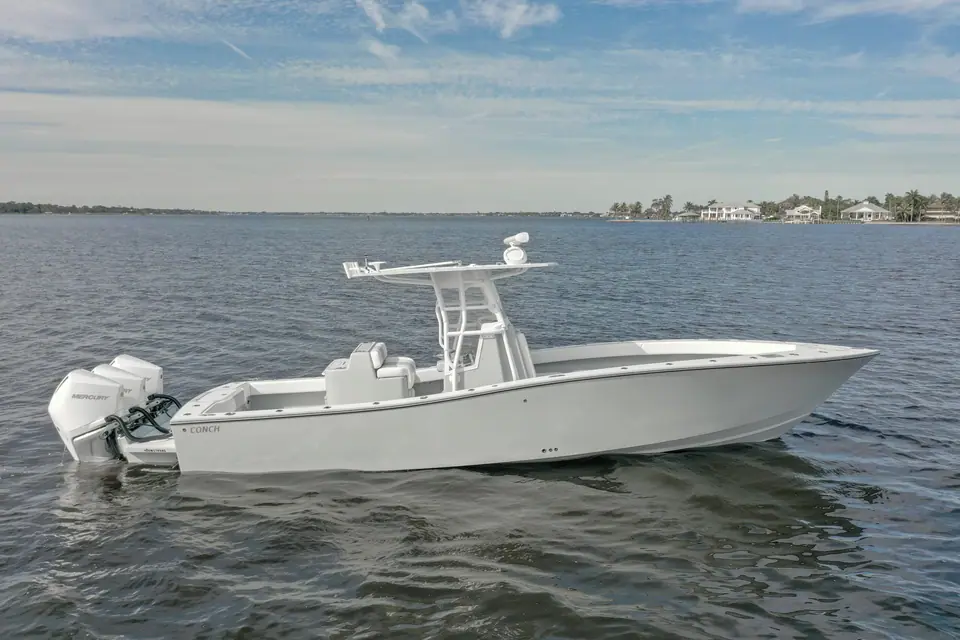
A 33-foot, 9-foot 10-inch beam offshore fishing console from Stuart, Florida, grown from the legendary Conch 27 and rated for twins or triples to 1,350 hp.
- Length
- 33 ft10.06 m
- Beam
- 9.8 ft3 m
- Cabins
- 0
- Used price
- $85K to $280K
On this page
- Overview
- Conch boats for sale, and why the 33 gets the calls
- From Edey and Duff to R&R Boatworks
- Dimensions, hull and construction
- Three livewells and a seachest
- Twin or triple power
- Who owns a Conch 33
- Buying a used Conch 33
- Specifications
- Price and value
- Strengths and weaknesses
- Used buyer checklist
- Rivals
- Our verdict
- FAQ
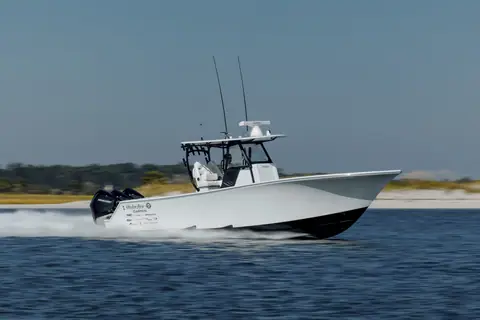
The Conch 33 is a 33-foot (35-foot 6-inch with bracket) offshore center console built by R&R Boatworks in Stuart, Florida since about 2006, with a 9-foot 10-inch beam, 425 gallons of fuel and three livewells.
- Live-bait tournament anglers
- Charter captains in the Keys and Florida's east coast
- Long-range offshore runs
- Owners who prize function over amenities
Conch 33 by the numbers
- Horsepower per ton
- 415 hpVery high power to weight, built for speed.
- Displacement hull speed
- 7.2 knThe efficient cruising speed for a displacement hull of this waterline.
- Length to beam ratio
- 3.36 : 1Moderate proportions.
Conch boats for sale, and why the 33 gets the calls
Conch boats for sale do not come up often, and when a 33 appears serious offshore anglers pay attention. The Conch name carries real weight in the Florida Keys because the original Conch 27 was designed with Key West fishing guides, and the 33 was built to give that same no-nonsense formula more room, more fuel and more engines. The builder describes it simply as a boat for the serious offshore angler and the ultimate fisherman.
This is not a family day boat with a fishing option. It is a tournament and charter tool with three livewells, a huge fuel load and a cockpit laid out for people who fish for a living or fish like they do. Buyers who want a cabin, a big head and lounges should look elsewhere; buyers who want to run 60 miles offshore with a crew and a full well of bait should keep reading.
From Edey and Duff to R&R Boatworks
The story starts in Massachusetts. According to Conch's own history, roughly 30 years ago the Mattapoisett sailboat builder Edey and Duff brought together a group of professional Key West fishing guides and a naval architect to design the ultimate offshore outboard fishing boat. The brief called for great seakeeping, stability at rest, ample livewell and fish box capacity, and a structure strong enough to survive constant commercial use. The result was the Conch 27, introduced in the late 1980s.
Salt Water Sportsman later tested a diesel inboard version of the 27, owned by Key West Capt. John Stark, and noted that Key West guides helped design the boat and that serious anglers had long admired the layout. R&R Boatworks, owners of their own Conch 27, acquired the assets of Edey and Duff in 2005 and began designing a larger version. Less than a year later the Conch 33 made its debut. R&R also retooled the 27 molds with new hatches, consoles, decks, leaning posts and hardtops, added the Conch 30 in 2015, the 25 bay boat in 2021 and the Conch 18 and Conch 41 in 2022.
Dimensions, hull and construction
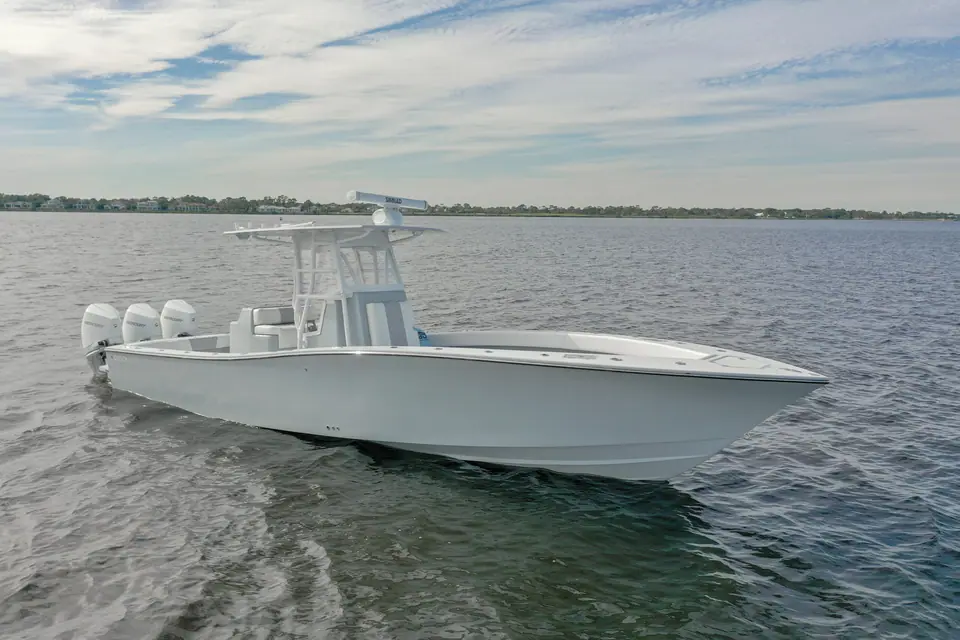
Conch lists the 33 at 33 feet without its bracket and 35 feet 6 inches with it, a 9-foot 10-inch beam, about 6,500 pounds, 35 gallons of water and 425 gallons of fuel, with twin or triple outboards up to 1,350 hp. An archived 2016 version of the company site added a 22.5-degree deadrise at the transom and described construction as 100 percent composite and vacuum-bagged with no wood, a high-density double-ply transom with extra-heavy lamination, and aluminum saddle fuel tanks.
That 2016 page listed fuel as 300 to 600 gallons depending on configuration, with 300 gallons in saddle tanks as standard, while the current site quotes 425 gallons. Treat tankage as a build-specific number and confirm it on any used boat. Through-hulls below the waterline were bronze with shutoff valves, and stainless above, which is the kind of detail that matters on a boat expected to work hard for decades.
Three livewells and a seachest
If one feature defines the 33, it is bait capacity. Current standard equipment includes two in-deck 85-gallon livewells forward plus a 45-gallon transom livewell with plumbing, fed by a Conch seachest. The 2016 spec sheet offered either a single 180-gallon or twin 85-gallon forward wells, a 125-gallon aft in-deck livewell, the 45-gallon transom well and 900 to 1,500 quarts of insulated fish box and storage space.
For kite fishing for sailfish, slow-trolling live bait for kingfish or carrying a day's worth of pilchards to the wrecks, that capacity is extraordinary for a 33-footer. The rest of the deck is equally businesslike: 10 console rod holders, five stainless pop-up cleats, an anchor locker with built-in chute, Lenco trim tabs, a custom fiberglass leaning post, four marine batteries, push-button switching on a custom dash and saltwater and freshwater washdowns. A custom hardtop with three Lumitec spreader lights is standard.
- Two 85-gallon in-deck forward livewells
- 45-gallon transom livewell with seachest supply
- Ten console rod holders and five pop-up cleats
- Custom hardtop with Lumitec spreader lights
- Saltwater and freshwater washdowns
Twin or triple power
Conch rates the 33 for twin or triple outboards up to 1,350 hp, and the 2016 site described power options as twin or triple V6 outboards. An archived Conch classified listed a 2015 Conch 33 with Suzuki 300s, so owners have not been tied to a single engine brand. We could not find a published speed and fuel curve from Conch or an independent magazine test, so we do not quote speeds here.
Practically, twins suit owners who prioritize economy and simpler maintenance, while triples add top-end speed, bigger loads and a get-home margin offshore. On a narrow hull with 425 gallons of fuel, range on twins should be excellent, but confirm real numbers with a sea trial and an engine data display.
Who owns a Conch 33
The typical owner is a tournament angler, a Keys or Treasure Coast charter captain, or a private owner who fishes like one. The boat's appeal is functional rather than flashy, and that shapes resale: buyers know the brand, and good boats tend to sell to people who have fished on one.
Expect annual costs, excluding depreciation, of roughly $15,000 to $35,000 for a slip or dry stack, insurance, twin or triple outboard service, bottom work and fuel. The large fuel capacity is a blessing on long runs, but filling it is a four-figure bill.
Buying a used Conch 33
Because R&R built the 33 continuously from about 2006 and kept upgrading materials and fittings, later boats generally have better hardware, hardtops and switching. Earlier boats can still be excellent if they were maintained, but check the bracket, transom and saddle tanks carefully.
Our estimated used range runs from about $85,000 for early boats needing updates to about $280,000 for recent triple-engine examples. The factory is still in Stuart, Florida, which is a real advantage for parts and advice, and the company offers demo rides and factory tours by appointment.
Conch 33 specifications
| Length overall | 33 ft10.06 m |
|---|---|
| Beam | 9.8 ft3 m |
| Displacement | 6,5 lbs2,948 kg |
| Fuel capacity | 425 gal1,609 L |
| Fresh water | 35 gal132 L |
| Cabins | 0 |
| Berths | 0 |
| Heads | Not specified |
| Standard engines | Twin or triple outboards, built to order |
| Maximum power | 1,350 hp |
| Hull type | Deep-V planing hull, 22.5-degree transom deadrise, outboard bracket |
| Hull construction | 100 percent composite, vacuum-bagged construction with no wood |
| Builder | R&R Boatworks (Conch Boats), United States |
| Other design credits | Evolved from the Conch 27, developed by Edey & Duff with Key West fishing guides |
| Production | 2006 to present |
| Status | In production |
Figures come from builder documentation and independent tests where available. Displacement is usually quoted light, so a loaded cruising boat will weigh more. Compare these specs with another model.
How much does a Conch 33 cost?
Conch does not publish prices, and boats are built to order with widely varying power and electronics, so we do not quote a new range. Used values are our estimates. The low end covers early boats with original twin outboards and dated electronics; the top covers recent triple-engine boats with a hardtop and modern displays. Engine hours and fuel tank configuration matter more than model year.
Estimate your yearly cost
A planning estimate using common rules of thumb: insurance near 1.5 percent of value, maintenance near 3 percent, haul out and bottom paint by length. Your marina, region and use will move these numbers. Open the full cost calculator.
Versions and options
- Twin-engine Conch 33
- The economical configuration with lower maintenance and long range on 425 gallons.
- Triple-engine Conch 33
- Up to 1,350 hp total for tournament speed and heavy loads.
- Fuel options
- 2016 literature listed 300 to 600 gallons with 300 in saddle tanks standard; current site lists 425 gallons.
Conch 33 timeline
- Late 1980sEdey and Duff introduces the Conch 27, designed with Key West guides
- 2005R&R Boatworks acquires the assets of Edey and Duff
- 2006Conch 33 debuts less than a year after the acquisition
- 2015Conch 30 introduced on the 27 hull with an integrated bracket
- 2022Conch 41 and Conch 18 Pistol enter production
Strengths and weaknesses
What owners like
- Huge bait capacity with three livewells and a seachest
- 425 gallons of fuel for long offshore runs
- No-wood, vacuum-bagged composite construction
- Twin or triple power to 1,350 hp
- Respected Key West guide-boat heritage
- Factory still building and supporting the model
What to weigh up
- Narrow 9-foot 10-inch beam rolls at anchor
- Few family comforts
- No published performance data
- No public pricing, so values are harder to benchmark
- Rarely listed, which limits choice
Used Conch 33 buyer checklist
Take this list to a viewing. Your ticks are saved in this browser so you can come back to it.
Always commission an independent marine survey and an engine survey before you buy. How a marine survey works.
Rivals to consider
Contender 33 Tournament
Another narrow, deep Florida tournament hull with a bigger brand footprint.
Compare side by sideOnslow Bay 33 Tournament Edition
Carolina-built fishing machine with a similar no-frills philosophy.
Compare side by sideOur verdict on the Conch 33
The Conch 33 is a specialist's boat, a narrow, fuel-heavy, livewell-packed offshore console that grew out of one of the Keys' most respected guide boats. It gives up comfort and stability at rest to beamier family consoles, and buyers have to do their own homework because Conch publishes no prices and no performance curves. For anglers who fish live bait hard and run long distances, a well-maintained 33 is a rare and very capable find.
Conch 33 questions answered
Who builds Conch boats?
R&R Boatworks builds Conch boats in Stuart, Florida, after acquiring the assets of original builder Edey and Duff in 2005.
How long is the Conch 33?
It is 33 feet without the bracket and 35 feet 6 inches with it, on a 9-foot 10-inch beam.
How much fuel does a Conch 33 hold?
The current site lists 425 gallons. Older literature listed 300 to 600 gallons depending on tank configuration.
What engines can a Conch 33 carry?
Twin or triple outboards up to 1,350 hp total.
When was the Conch 33 introduced?
It debuted less than a year after R&R Boatworks acquired Edey and Duff in 2005, so around 2006.
Is the Conch 33 related to the Conch 27?
Yes. Conch says the 33 evolved from the Conch 27, offering more space, more features and twin or triple engines.
Conch 33 photos
More center consoles & offshore boats to explore
Boston Whaler 330 Outrage
Center Consoles & Offshore Boats, 33 ft
Used $175K to $560K
Blackfin 332 CC
Center Consoles & Offshore Boats, 33 ft
Used $225K to $450K
Onslow Bay 33 Tournament Edition
Center Consoles & Offshore Boats, 33 ft
Used $180K to $450K
Front Runner 33 CC
Center Consoles & Offshore Boats, 33 ft
Used $280K to $440K