Contender Boats Center Consoles & Offshore Boats
Contender 32ST for Sale, Specs, Performance and Used Buying Guide
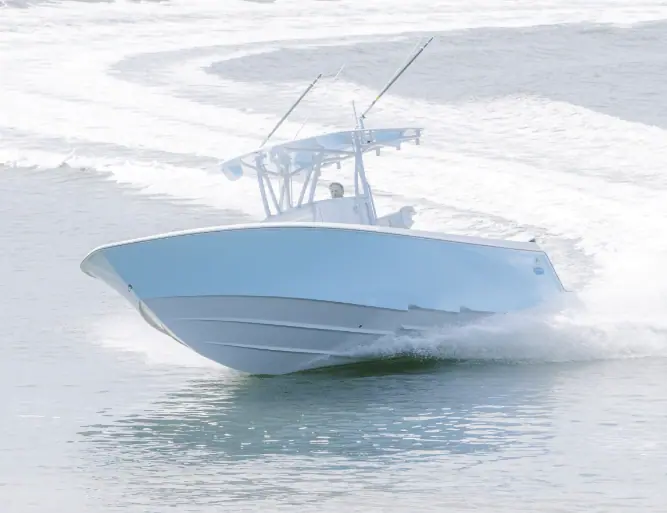
A twin-step, 24.5-degree tournament hull from Homestead that cruises past 40 mph on twin 300s and still drifts flat enough to fish.
- Length
- 32.6 ft9.93 m
- Beam
- 9.7 ft2.95 m
- Cruise
- 35 kn
- Cabins
- None (console head compartment)
- Used price
- $115K to $430K
On this page
- Overview
- Why anglers keep hunting for a Contender 32ST for sale
- The 24.5-degree twin-step bottom explained
- Real speed and fuel numbers on twin Yamaha 300s
- A deck built around livewells, fish boxes and rod storage
- Family use, the console head and the 32LS sister ship
- What to pay on the new and used market
- Who should buy one and who should not
- Specifications
- Price and value
- Strengths and weaknesses
- Used buyer checklist
- Rivals
- Our verdict
- FAQ
The Contender 32ST is a 32-foot 7-inch twin-step center console built since 2010, rated to 850 hp, carrying 290 gallons of fuel and prized by kite fishermen and tournament crews.
- Tournament and kite fishermen
- Offshore anglers running 40 to 80 miles
- Bahamas crossings
- Owners who value ride and speed over comfort
Why anglers keep hunting for a Contender 32ST for sale
Search the brokerage market for a Contender 32ST for sale and you will notice something unusual: there are never many, and the good ones disappear fast. That scarcity says a lot about the boat. Contender, founded by Joe Neber in 1984 and building in Homestead, Florida, built its reputation on conventional deep-V open and tournament models that dominated South Florida kingfish and sailfish events for two decades. The 32ST, dated to about 2010 by PowerBoat Guide data and reviewed as a new step-hull model by Salt Water Sportsman in 2014, put that proven fishing layout on a twin-step running surface, and it quickly became the default 32-foot tournament boat on the east coast of Florida.
The boat was originally conceived as a kite-fishing platform for South Florida sailfish, a style of fishing that rewards a boat that idles cleanly, drifts predictably and can sprint to the next bait pod or the next weed line in a hurry. That DNA is still visible today. The 32ST is not a family dayboat dressed up with rod holders. It is a fishing machine first, and every inch of the deck plan reflects that priority.
It is also a semi-custom boat. Contender lets owners spec livewell plumbing, leaning posts, hardtop pipework, electronics and console details, so it is rare to find two identical 32STs. For a buyer, that means reading each listing carefully rather than assuming one boat equals another.
Contender 32 ST by the numbers
- Speed to length ratio at cruise
- 6.57A planing cruise. Fast passages in exchange for much higher fuel burn per mile.
- Estimated range at cruise
- 381 nmUsing 90 percent of tank capacity at the cruise speed and fuel burn listed on this page.
- Fuel economy at cruise
- 1.46 nmpgNautical miles per gallon at cruise, both engines combined.
- Horsepower per ton
- 147 hpVery high power to weight, built for speed.
- Length to beam ratio
- 3.37 : 1Moderate proportions.
The 24.5-degree twin-step bottom explained
The heart of the 32ST is its running surface. Contender pairs a sharp 24.5-degree transom deadrise with two ventilated steps and a pair of lifting strakes that run the full length of the bottom. The steps introduce air under the hull, the strakes generate lift, and together they cut wetted surface so the boat goes faster on less fuel than the non-stepped Tournament hull it shares a deck with. Contender's own sales team has said that stepped hulls account for about nine of every ten boats ordered in the models where both bottoms are offered.
Testers consistently note the flat running attitude. Power up gently and bow rise is modest; push the throttles and the boat jumps on plane in seconds and settles into a level attitude that rarely needs trim tabs except to correct a lopsided load. In a chop the steps trap air and the hull rides over the top rather than slamming through.
There is a learning curve, as with any step hull. In following seas, testers found the boat could climb the back of a wave and drop into the trough at moderate speeds around 35 mph, and the fix was counterintuitive: more speed, not less. Owners who come from conventional deep-Vs should spend a few calm days learning how the hull wants to be trimmed and driven before running an inlet on an ebb tide.
Real speed and fuel numbers on twin Yamaha 300s
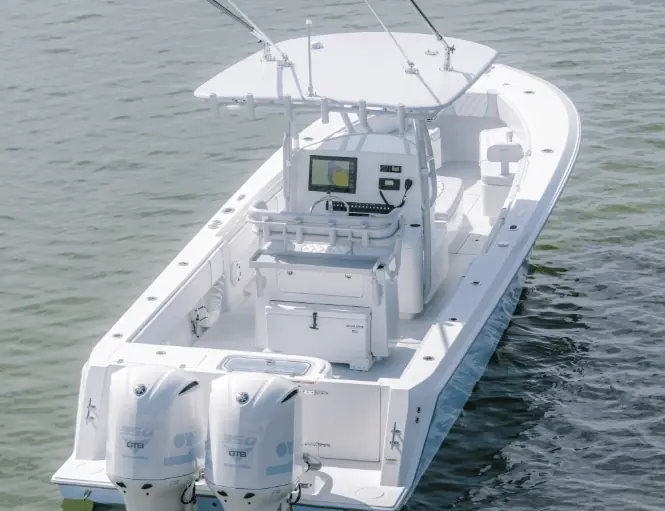
The 32ST is a fast boat even on what is now considered middle-of-the-road power. In a Salt Water Sportsman test with twin Yamaha F300s, the boat touched 60 mph at 5,800 rpm and, at a brisk 41 mph cruise, returned about 1.7 miles per gallon, which works out to roughly 24 gallons per hour for both engines. The magazine's later buyer's guide entry listed 68.8 mph at 6,100 rpm with dual Yamaha 300s and close to 2 mpg at a 40 mph cruise, a reflection of how much load and propeller choice matter on a step hull.
Current boats carry 290 gallons (earlier boats were listed at 310), and at 1.7 mpg that works out to roughly 440 statute miles on paper while holding back a 10 percent reserve; real trips with trolling and rough water come in lower. For Florida anglers that means running from Jupiter to the Bahamas banks and back with fuel to spare, or making a 70-mile canyon run in the mid-Atlantic without sweating the gauge.
Contender rates the hull for up to 850 hp today, up from 700 hp in 2014 and 800 hp in 2019, which opens the door to bigger twin Yamaha packages. More horsepower buys acceleration and a higher top end, but the twin 300 package is the sweet spot for efficiency and weight. If you mostly fish within 40 miles of the inlet, there is no need to chase a bigger rig on the used market.
- Twin F300 tested top speed: about 60 mph (52 knots) at 5,800 rpm
- Best cruise on twin F300s: about 41 mph at 1.7 mpg, roughly 24 gph total
- Fuel capacity: 290 gallons on current boats (310 on earlier boats), roughly 440 statute miles on paper at cruise
- Maximum rated power: 850 hp
A deck built around livewells, fish boxes and rod storage
Walk the 32ST and the fishing intent is obvious. Twin 40-gallon transom livewells plumbed at 1,100 gph sit aft, with sea-chest plumbing available for tournament crews who need to keep goggle-eyes and threadfins lively all day. Forward, a 130-gallon insulated fish box and a 90-gallon secondary box live under the deck, and two 70-gallon fish boxes sit aft on either side of the bilge access hatch on current boats (the 2014 test boat listed 96-gallon aft boxes). That is enough insulated volume for a full day of wahoo, tuna or a cooler of dolphin, with room left for ice and drinks.
The console is lower and wider than on the old Contenders, which improves sightlines in every direction and leaves room for two 15-inch or larger displays. Side decks stay wide enough to walk forward even with outfits stowed in the five vertical rod holders on each side of the console. Two full-length lockable rod lockers sit in the forward deck, and the leaning post can be ordered with a pull-out cooler or an additional livewell.
Kite fishermen will appreciate the clean bow and recessed rails, and the cockpit coaming is at a comfortable height for leaning into a fish. Hardware is heavy stainless throughout, including pop-up cleats that will not snag a line during a fight.
Family use, the console head and the 32LS sister ship
Be realistic about what this boat is. The 32ST has a walk-in console with a fully lined head compartment, an electrical panel with breakers and battery switches, and lockable rod storage, but there is no cabin and no overnight accommodation. Seating is limited to the leaning post, the console front seat and whatever forward cushions are fitted.
Families who want more comfort should look at the 32LS, which shares the same twin-step bottom but adds plush forward seating and aft seating aimed at a mixed crew. On the used market, a 32ST with optional bow cushions and a removable rear seat can serve both roles, but it remains a fishing boat that tolerates guests rather than a social boat that tolerates fishing.
For a couple or a family with teenagers who fish, that is often the right trade. The boat is dry, fast and stable at rest, and fast boats mean shorter runs and more time on the water with people who get bored on long transits.
What to pay on the new and used market
A new 32ST in 2026 typically lands between about $420,000 and $540,000 depending on power, electronics and hardtop specification, and Contender's order books tend to stretch for months. That gap between new price and availability is a big reason used boats hold their value so well.
Used prices run from roughly $115,000 for an early boat with original F300s and tired electronics up to about $430,000 for a nearly new hull with current-generation Yamaha power. The largest single variable is engines. A 2014 boat repowered with new F300s three years ago can be a better buy than a 2018 boat with 1,800 hours on the original engines, and it will cost less to own over the next five years.
Expect annual running costs in the $18,000 to $34,000 range for an actively fished boat, covering insurance, dry storage or a slip, engine service, bottom paint if kept wet, and fuel. Fuel is the variable that moves the most: a tournament season can easily burn 2,500 gallons.
Who should buy one and who should not
The 32ST is ideal for the serious angler who fishes offshore 40 or more days a year, wants tournament-level fishability and values ride and speed over cabin space. It suits South Florida kite fishing, Gulf of Mexico snapper and grouper trips, mid-Atlantic tuna runs and Bahamas crossings equally well.
It is a poor fit for buyers who need overnight accommodations, a lot of social seating or a boat that will mostly anchor at a sandbar. For those owners, a Boston Whaler 330 Outrage or a Pursuit OS 325 will be more comfortable, and a step up to the Contender 39 ST brings more range and seakeeping for longer runs.
Contender 32 ST specifications
| Length overall | 32.6 ft9.93 m |
|---|---|
| Beam | 9.7 ft2.95 m |
| Draft | 1.7 ft0.51 m |
| Displacement | 11,56 lbs5,243 kg |
| Fuel capacity | 29 gal1,098 L |
| Fresh water | 26 gal98 L |
| Cabins | None (console head compartment) |
| Berths | None |
| Heads | 1 (in console) |
| Standard engines | 2 x Yamaha F300 outboards (most common rig) |
| Optional engines | Larger twin Yamaha or Mercury packages up to 850 hp total on current boats (700 hp rating in 2014, 800 hp in 2019) |
| Maximum power | 850 hp |
| Cruise speed | 35 knots |
| Top speed | 52 knots |
| Hull type | Twin-step deep-V with 24.5-degree transom deadrise and full-length lifting strakes |
| Hull construction | Hand-laid fiberglass with composite coring, semi-custom finish |
| Builder | Contender Boats, United States |
| Naval architect | Contender Boats in-house design team |
| Production | 2010 to present |
| Status | In production |
Figures come from builder documentation and independent tests where available. Displacement is usually quoted light, so a loaded cruising boat will weigh more. Compare these specs with another model.
Performance data
| Condition | Speed (mph) | Fuel economy (mpg) | Note |
|---|---|---|---|
| Top speed, 5,800 rpm | 60 | n/a | Twin Yamaha F300, Salt Water Sportsman 2014 test |
| Fast cruise | 41 | 1.7 | Twin Yamaha F300, about 24 gph total |
| Following sea cruise, 3,500 rpm | 35 | n/a | Tester increased to 4,500 rpm for a better ride |
| Top speed, 6,100 rpm | 68.8 | n/a | Twin Yamaha 300, Salt Water Sportsman buyer's guide listing |
Figures from Salt Water Sportsman's 2014 review and buyer's guide entry for the 32ST. Speeds vary widely with load, propeller choice and hardtop or tower configuration.
How much does a Contender 32 ST cost?
Engine hours and the generation of Yamaha power drive the 32ST market more than the hull year, because the hull itself barely changed. Early boats on original F300s with 1,500 or more hours trade at the bottom of the range, while late boats on twin F350 or XF425 power with a full Garmin or Simrad glass dash, sea-chest livewells and a factory hardtop sit near the top. Repowered older hulls are often the best value per dollar.
Estimate your yearly cost
A planning estimate using common rules of thumb: insurance near 1.5 percent of value, maintenance near 3 percent, haul out and bottom paint by length. Your marina, region and use will move these numbers. Open the full cost calculator.
Versions and options
- 32ST (Sport Tournament)
- The fishing-first version with a twin-step bottom, twin 40-gallon transom livewells and four insulated fish boxes.
- 32LS
- The family-oriented sister ship on the same stepped hull, with plush forward and aft seating replacing some of the fishing hardware.
- 32 Tournament
- The earlier non-stepped deep-V version of the same deck, slower but favored by some owners for its traditional handling.
Contender 32 ST timeline
- 1984Joe Neber founds Contender Boats in South Florida
- 2000sConventional deep-V Contender tournament models build the brand's kingfish and sailfish reputation
- 201032ST appears on a twin-step hull with full-length lifting strakes, per PowerBoat Guide dating
- 2014Salt Water Sportsman tests the 32ST at 60 mph on twin F300s; rated power 700 hp, fuel 310 gallons
- 2026Current 32ST listed at 290 gallons and 850 hp, with sport and M-Series console options
Strengths and weaknesses
What owners like
- Twin-step 24.5-degree hull combines speed with a sharp head-sea entry
- Excellent fuel economy, close to 2 mpg at 40 mph on twin 300s
- Huge insulated fish box capacity and twin 40-gallon livewells
- Wide side decks and clean bow for kite and bow fishing
- Strong resale and constant demand from tournament anglers
- Semi-custom options let owners tailor plumbing and electronics
What to weigh up
- No cabin and limited guest seating for families
- Step hull needs learning in following seas
- Only 26 gallons of fresh water
- Used boats often carry heavy tournament hours
- Narrow 9-foot 8-inch beam limits cockpit socializing
Used Contender 32 ST buyer checklist
Take this list to a viewing. Your ticks are saved in this browser so you can come back to it.
Always commission an independent marine survey and an engine survey before you buy. How a marine survey works.
Rivals to consider
Boston Whaler 330 Outrage
More family seating and the unsinkable foam-filled hull, but a softer fishing focus and a heavier boat.
Compare side by sideYellowfin 32 Offshore
The closest stepped-hull rival in spirit, equally fast and fishy, with a slightly more custom feel.
Compare side by sideSeaVee 32B
A tournament favorite from Miami with a conventional deep-V, prized for build quality and resale.
Freeman 34VH
A catamaran alternative with a stable drift and shallow draft, but a very different ride in head seas.
Compare side by sideOur verdict on the Contender 32 ST
The Contender 32ST is one of the best 32-foot fishing boats ever built and still one of the smartest buys on the brokerage market. Its twin-step deep-V delivers 60 mph speed and near 2 mpg cruise economy on modest power, while the deck carries more livewell and fish box capacity than most 35-footers. It is not a family cruiser, and buyers need to respect the hull in following seas, but for an angler who fishes hard offshore, a well-maintained 32ST, ideally on fresh Yamaha power, is very hard to beat.
Contender 32 ST questions answered
How fast is a Contender 32ST?
With twin Yamaha F300s, testers recorded about 60 mph at 5,800 rpm, and lightly loaded boats have reached close to 69 mph. Bigger 350 or 425 hp packages add top-end speed.
How much does a Contender 32ST cost?
A new 32ST typically costs about $420,000 to $540,000 depending on power and options. Used boats range from roughly $115,000 for early hulls to around $430,000 for nearly new ones.
What is the fuel burn of a Contender 32ST?
At a fast cruise around 41 mph on twin F300s, the boat burns roughly 24 gallons per hour, about 1.7 miles per gallon. On paper that gives roughly 440 statute miles from 290 gallons with a 10 percent reserve.
Does the Contender 32ST have a cabin?
No. It has a walk-in console with a head compartment and storage, but no berths. The 32LS sister ship adds more seating, not a cabin.
What is the difference between the 32ST and the 32 Tournament?
The 32ST uses a twin-step bottom with lifting strakes, while the Tournament has a conventional deep-V. The ST is faster and more efficient on the same power.
What is the maximum horsepower on a Contender 32ST?
Contender rates the current 32ST for up to 850 hp. Earlier boats were rated at 700 hp (2014) and 800 hp (2019), so check the capacity plate.
Contender 32 ST photos
More center consoles & offshore boats to explore
Contender 31 Tournament
Center Consoles & Offshore Boats, 33 ft
Used $45K to $125K
Yellowfin 32 Offshore
Center Consoles & Offshore Boats, 33 ft
Used $90K to $540K
Onslow Bay 33 Tournament Edition
Center Consoles & Offshore Boats, 33 ft
Used $180K to $450K
Boston Whaler 330 Outrage
Center Consoles & Offshore Boats, 33 ft
Used $175K to $560K