Contender Boats Center Consoles & Offshore Boats
Contender 33 T Tournament, the Deep-V Bridge to the Stepped Era
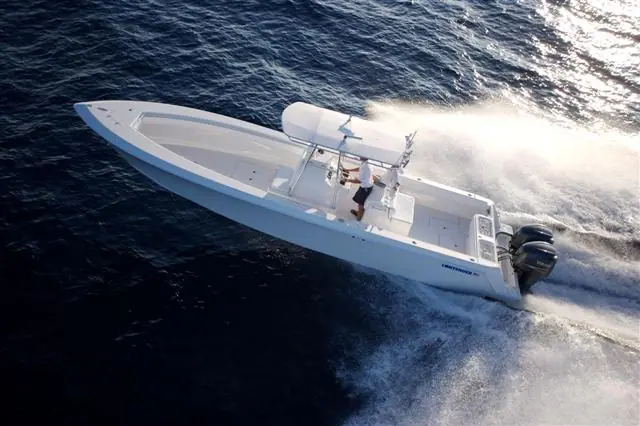
A 34-foot 5-inch deep-V tournament console with 400 gallons of fuel and twin or triple outboards, and the deck plan Contender carried into its stepped 33 ST and 35 ST.
- Length
- 34.4 ft10.49 m
- Beam
- 9.7 ft2.95 m
- Cruise
- 2 ft0.61 m
- Cabins
- 0 (extra-large walk-in console with head compartment)
- Used price
- $70K to $165K
On this page
- Overview
- What the 33 T actually is
- A spec sheet you will see again on the 35 ST
- The bigger console that set the template
- Four livewells and room for a tournament weigh-in
- Performance, and the 33 ST numbers that frame it
- Owning a 33T in 2026
- Specifications
- Price and value
- Strengths and weaknesses
- Used buyer checklist
- Rivals
- Our verdict
- FAQ
The Contender 33 Tournament (33T) is a 34-foot 5-inch deep-V center console with a 9-foot-8-inch beam, a 24.5-degree bottom, 400 gallons of fuel and a 1,050 hp rating for twin or triple outboards. It was current around 2009 to 2011 and is now sold only on the used market.
- Value-minded tournament anglers
- Bahamas and canyon runs
- Owners who prefer a traditional deep-V
- Repower and refit buyers
What the 33 T actually is
Search for a 33 T or a Contender 33T for sale and you will find a boat that sits at an important hinge in Contender's history. The Contender 33 Tournament is a 34-foot 5-inch deep-V center console that Contender's own website, around 2009, described as built on a brand-new high-performance hull able to handle either twin or triple outboards. It sat in the upper half of a lineup that then ran 21, 23, 23-T, 25, 25-S, 27-T, the 31 family, 33-T, 35, the 36 family and the 38 Express.
It is also the boat Contender used as the starting point for its first stepped hull. When Salt Water Sportsman tested the new 33 ST in 2009, it reported that Contender already had a successful deep-V, non-stepped 33 in production, and that the company kept that deck layout and changed only the hull below the waterline and the stringer system to accommodate the steps. In other words, the 33T and 33 ST share the same deck, and the 33T is the conventional-bottom version.
That makes the 33T an interesting used buy: you get the deck and fishing systems of the boats that followed, on a solid deep-V that predates Contender's stepped era.
Contender 33 Tournament by the numbers
- Horsepower per ton
- 156 hpVery high power to weight, built for speed.
- Displacement hull speed
- 7.3 knThe efficient cruising speed for a displacement hull of this waterline.
- Length to beam ratio
- 3.56 : 1Moderate proportions.
A spec sheet you will see again on the 35 ST
Contender's archived 33 Tournament page lists 34 feet 5 inches overall, a 9-foot-8-inch beam, a 24-inch draft, a dry weight of about 6,600 pounds, 13,500 pounds ready to fish, a 24.5-degree deep-V, 400 gallons of fuel and a 1,050 hp maximum. The standard deck carries a 208-gallon and a 115-gallon insulated fish box forward, two 85-gallon insulated boxes aft and two 40-gallon round livewells above deck at the transom.
Those numbers are worth memorizing, because they reappear. Sport Fishing's 2016 buyers guide for the Contender 35 ST quoted 34 feet 5 inches, 400 gallons, a 6,600-pound dry weight and a 1,050 hp rating, with the same 208- and 115-gallon forward boxes and 85-gallon aft boxes. Contender's current 35ST page still lists 13,500 pounds ready to fish and 400 gallons. The obvious reading is that the 33's deck, and the dimensions of its family, carried forward into the stepped 33 ST and then the 35 ST, though Contender has never published a formal lineage, so treat that as our inference from the spec sheets.
For a buyer, the practical point is simple. A used 33T, 33 ST and early 35 ST can look nearly identical on a trailer. The difference is under the boat: the 33T has an unbroken deep-V, the ST models have two ventilated steps.
The bigger console that set the template
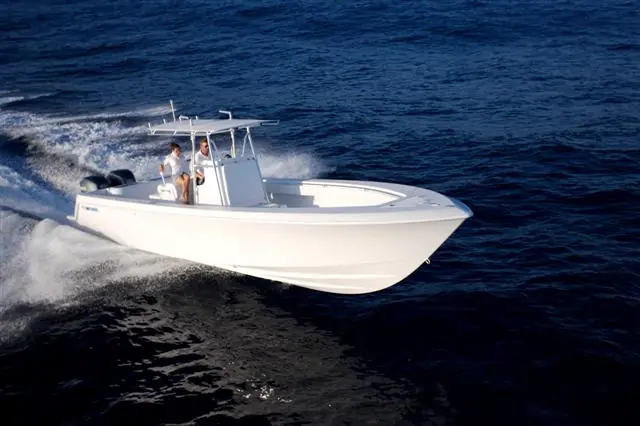
Contender's overview made a point of the 33T's larger, wider console, with an integrated seat molded into its front and an oversized electronics panel. Standard equipment included an extra-large walk-in console with head compartment, lockable storage, a custom helm pod, dual hydraulic steering with a custom wheel, recessed trim tabs, waterproof switches and breakers and a 2,000 gph bilge pump.
Salt Water Sportsman's description of the 33 ST, which used this deck, adds useful detail: a center-mounted helm on a pod with knee room underneath for anglers using the leaning post, a finished console interior that hides wiring while leaving access to the back of the electronics and the battery switches, and room for the large multifunction displays then coming to market. Contender offered a T-top and two leaning post options.
Contender also highlighted a trend-setting combination of leaning post and livewell, plus finished hatches made in two-part molds with gelcoat on both faces, a small detail that makes the deck look and wear better than single-sided hatch lids.
Four livewells and room for a tournament weigh-in
The 33T came standard with Contender's signature twin above-deck transom livewells, and optional below-deck wells made it possible to carry four wells in total. That combination suits kite fishing for sailfish and slow-trolling for kingfish, where you want a lot of healthy bait, and the in-deck well doubles as an easy target when you dump a cast net.
Fish storage is generous for a 34-footer. Two forward boxes of 208 and 115 gallons and two 85-gallon aft boxes give well over 400 gallons of insulated capacity, and outboard of the aft forward box sit long lockers that Salt Water Sportsman noted can store rods up to eight feet. A transom door to starboard, a pop-up bow light and a molded anchor locker with a proper anchor keeper round out the layout.
Hardware was Contender standard: chrome-on-bronze or stainless fittings, a recessed bow lifting ring with pop-up cleat, 10-inch stern cleats, 8-inch spring cleats with hawse pipes and four Lee's flush-mount gunwale rod holders as delivered.
Performance, and the 33 ST numbers that frame it
We could not find an independent test of the non-stepped 33T. The closest data comes from its stepped sister. Salt Water Sportsman's 33 ST, on twin Yamaha F350s, found a sweet spot around 4,500 rpm at almost 54 mph burning 38 gph, and topped out at more than 67 mph. The tester also praised the stepped boat's handling in sharp turns and its quick planing.
A deep-V 33T on the same power would be expected to be somewhat slower and thirstier at high cruise, since Contender's case for the steps was efficiency. It also trades a little speed for a traditional feel in turns and when backing down. With 400 gallons aboard, either version has the legs for the Bahamas or a long canyon run, and triple-engine boats add redundancy far offshore.
Without a published test, we leave cruise speed and fuel burn blank in our specifications rather than guess.
Owning a 33T in 2026
Every 33T is now at least a decade and a half old, and most have been fished hard. A good one with sound stringers, a dry deck and late-model power is a strong value, often priced between $70,000 and $165,000. Budget $12,000 to $28,000 a year for insurance, storage, routine service on two or three outboards and fuel for a typical season, more if you run tournaments.
Big-ticket items to watch are repowers, fuel tanks and wiring. A triple-engine repower can cost more than the boat is worth, so a recently repowered hull is usually the smarter purchase than a cheap one with tired engines. If you want the same deck with a warranty and a stepped hull, the current Contender 35ST is the modern descendant.
Contender 33 Tournament specifications
| Length overall | 34.4 ft10.49 m |
|---|---|
| Beam | 9.7 ft2.95 m |
| Draft | 2 ft0.61 m |
| Displacement | 13,5 lbs6,124 kg |
| Fuel capacity | 4 gal1,514 L |
| Cabins | 0 (extra-large walk-in console with head compartment) |
| Berths | None |
| Heads | 1 (console head compartment) |
| Standard engines | Twin outboards to customer order |
| Optional engines | Triple outboards up to the 1,050 hp rating |
| Maximum power | 1,050 hp |
| Hull type | Conventional (non-stepped) deep-V planing hull, 24.5-degree deadrise |
| Hull construction | Hand-laid fiberglass with multidirectional fabric, foam-cored solid glass stringer system, foam flotation |
| Builder | Contender Boats, United States |
| Naval architect | Contender Boats in-house design (Joe Neber) |
| Status | Discontinued |
Figures come from builder documentation and independent tests where available. Displacement is usually quoted light, so a loaded cruising boat will weigh more. Compare these specs with another model.
How much does a Contender 33 Tournament cost?
The 33T is no longer built, so all pricing is brokerage. Triple-engine boats and those repowered with modern 300 to 350 hp four-strokes command the top of the range; original twin-engine boats with high hours sit at the bottom. Because the 33T looks almost identical to the stepped 33 ST and early 35 ST from the waterline up, confirm the hull type before comparing prices. These are our 2026 estimates.
Estimate your yearly cost
A planning estimate using common rules of thumb: insurance near 1.5 percent of value, maintenance near 3 percent, haul out and bottom paint by length. Your marina, region and use will move these numbers. Open the full cost calculator.
Versions and options
- 33 Tournament (33T)
- Deep-V, non-stepped hull; twin or triple outboards to 1,050 hp; 400 gallons.
- 33 ST
- Stepped version introduced around 2009 with the same deck and a revised bottom and stringer system.
Contender 33 Tournament timeline
- 1984Joe Neber founds Contender Boats in South Florida
- 2009Contender's site lists the 33-T as built on a brand-new high-performance hull, and the company celebrates 25 years since its first completed boat
- 2009Salt Water Sportsman tests the new stepped 33 ST, which reuses the 33's deck
- 2011The 33 Tournament still appears on Contender's archived model pages
- 2016Sport Fishing lists the 35 ST at 34 ft 5 in, 400 gallons and 1,050 hp, the same figures as the 33T
Strengths and weaknesses
What owners like
- 400 gallons of fuel for long offshore runs
- Twin or triple outboard capability
- Huge insulated fish box capacity
- Up to four livewells
- Conventional deep-V handling and backing down
- Shares a deck with later stepped Contenders
What to weigh up
- No independent performance test available
- Less efficient at speed than stepped successors
- All examples are now well over a decade old
- Easily confused with the 33 ST and 35 ST in listings
Used Contender 33 Tournament buyer checklist
Take this list to a viewing. Your ticks are saved in this browser so you can come back to it.
Always commission an independent marine survey and an engine survey before you buy. How a marine survey works.
Rivals to consider
Contender 35 ST
The modern stepped descendant with the same fuel capacity and box layout, at several times the price.
Compare side by sideRegulator 34SS
Carolina-built rival with more comfort, a softer family side and a conventional deep-V.
Compare side by sideSeaHunter 33 Tournament
Another Miami-area tournament console with a similar no-frills fishing focus.
Compare side by sideContender 31 Tournament
Smaller, cheaper deep-V sibling with 310 gallons and a 700 hp rating.
Compare side by sideOur verdict on the Contender 33 Tournament
The Contender 33 Tournament is the overlooked middle child of Contender's history: a capable 34-foot deep-V with 400 gallons, up to four livewells and room for three outboards, and the deck that carried straight into the stepped 33 ST and 35 ST. It lacks a published independent test and every example is now well used, so buy on survey and engine condition rather than reputation alone. Find one with sound structure and recent power and you get a genuine tournament platform for the price of a new bay boat.
Contender 33 Tournament questions answered
What does 33 T mean on a Contender?
T stands for Tournament. The 33T is Contender's 33-foot class deep-V tournament center console, as opposed to the stepped 33 ST.
How long is a Contender 33 Tournament?
Contender lists it at 34 feet 5 inches overall with a 9-foot-8-inch beam.
How much fuel does a Contender 33T carry?
400 gallons, according to Contender's specifications.
Is the Contender 33T the same as the 35 ST?
Not exactly. The 33T is a non-stepped deep-V, while the 35 ST has two steps, but the 2016 35 ST specs and fish box sizes match the 33T, suggesting a shared deck lineage.
Can the Contender 33T take triple engines?
Yes. Contender said it handles twin or triple-engine applications, with a 1,050 hp maximum rating.
Contender 33 Tournament photos
More center consoles & offshore boats to explore
Pursuit OS 325 Offshore
Center Consoles & Offshore Boats, 35 ft
Used $200K to $600K
Contender 35 ST
Center Consoles & Offshore Boats, 35 ft
Used $130K to $600K
Yellowfin 34 Offshore
Center Consoles & Offshore Boats, 35 ft
Used $85K to $620K
Regulator 34SS
Center Consoles & Offshore Boats, 34 ft
Used $105K to $195K