Regulator Marine Center Consoles & Offshore Boats
Regulator 23 for Sale, a Buyer's Guide to Every Generation
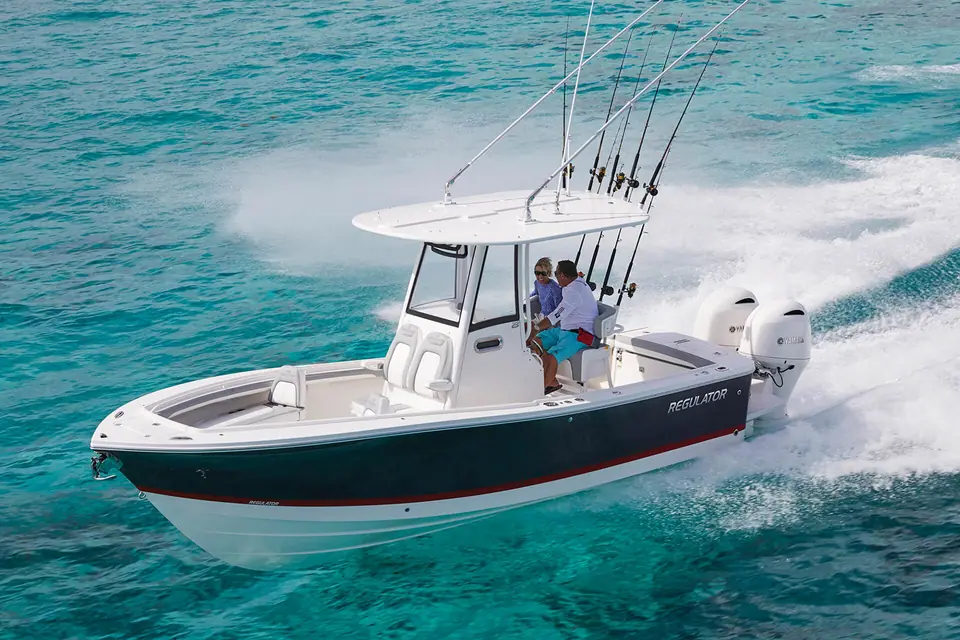
The smallest Regulator rides a Lou Codega 24-degree hull, weighs like a bigger boat and has run in three distinct generations since the 2000s.
- Length
- 23.4 ft7.14 m
- Beam
- 8.5 ft2.59 m
- Cruise
- 25.1 kn
- Cabins
- 0 (console head compartment)
- Used price
- $40K to $200K
On this page
- Overview
- Regulator 23 for sale, know which generation you are looking at
- The notched-transom years
- The bracket boat arrives in 2014
- Twin F150 numbers from Yamaha and Boating
- Deck plan and storage on the current boat
- Costs for a trailerable offshore boat
- Picking the right used 23
- Specifications
- Price and value
- Strengths and weaknesses
- Used buyer checklist
- Rivals
- Our verdict
- FAQ
The Regulator 23 is a Lou Codega-designed 24-degree deep-V center console built in Edenton, North Carolina. The current bracket version, launched in 2014, is 23 ft 5 in with 149 gallons of fuel and twin Yamaha F150s standard.
- Nearshore and offshore anglers on a trailer
- Kingfish and dolphin tournament teams
- Owners who prioritize ride over speed
- Buyers stepping into the Regulator brand
Regulator 23 by the numbers
- Speed to length ratio at cruise
- 5.56A planing cruise. Fast passages in exchange for much higher fuel burn per mile.
- Estimated range at cruise
- 244 nmUsing 90 percent of tank capacity at the cruise speed and fuel burn listed on this page.
- Fuel economy at cruise
- 1.82 nmpgNautical miles per gallon at cruise, both engines combined.
- Horsepower per ton
- 84 hpStrong power to weight for a planing hull.
- Length to beam ratio
- 2.76 : 1A beamy hull with lots of volume for its length.
Regulator 23 for sale, know which generation you are looking at
A search for a Regulator 23 for sale turns up boats that share a name and a hull philosophy but differ in almost everything else. Lou Codega has drawn the 23, like every Regulator, on a 24-degree deep-V, but there have been three broad versions: the original notched-transom 23, updated in 2005 and joined by the 23 FS forward-seating model around 2007; and the bracket-mounted 23 launched in 2014, which Power and Motoryacht described as replacing a notched-transom hull. Since about 2019 the bracket boat has been rated for twin outboards, and twin Yamaha F150s are now standard.
The difference matters for price and for how the boat behaves. A 2005 boat with a 300 hp two-stroke is a $50,000 conversation. A late-model twin-engine 23 with the full option sheet can approach $200,000. Both are genuine Regulators, but they are not the same boat.
The notched-transom years
Sport Fishing's 2005 review covered the evolutionary new 23 built on the Codega hull of the original. The trial boat had a 300 hp Yamaha HPDI two-stroke and cruised at 32 mph at 4,000 rpm on 13.4 gph, topping out at 46.9 mph at 5,700 rpm on 29.2 gph. The hull alone weighed about 3,800 pounds, heavy for a 23-footer, and the reviewer drove it in near 6-foot seas without slamming or rattles. Specs were 23 ft 4 in long, 8 ft 4 in wide, with a $62,500 price including the Yamaha.
The 2005 changes included a new stringer system, liner and cap, a fiberglass engine well molded into the cap rather than the liner, batteries relocated under the console, twin fuel fills and a large lazarette hatch for bilge pump access. Power options ran from single F225 or F250 four-strokes to twin F150s or twin 200 HPDIs.
The 23 FS added family-friendly forward seating over twin 140-quart boxes and a 685-quart centerline fish box that doubles as locking rod storage for eight rods. Saltwater Sportsman listed a 160-gallon tank and a 400 hp maximum.
The bracket boat arrives in 2014
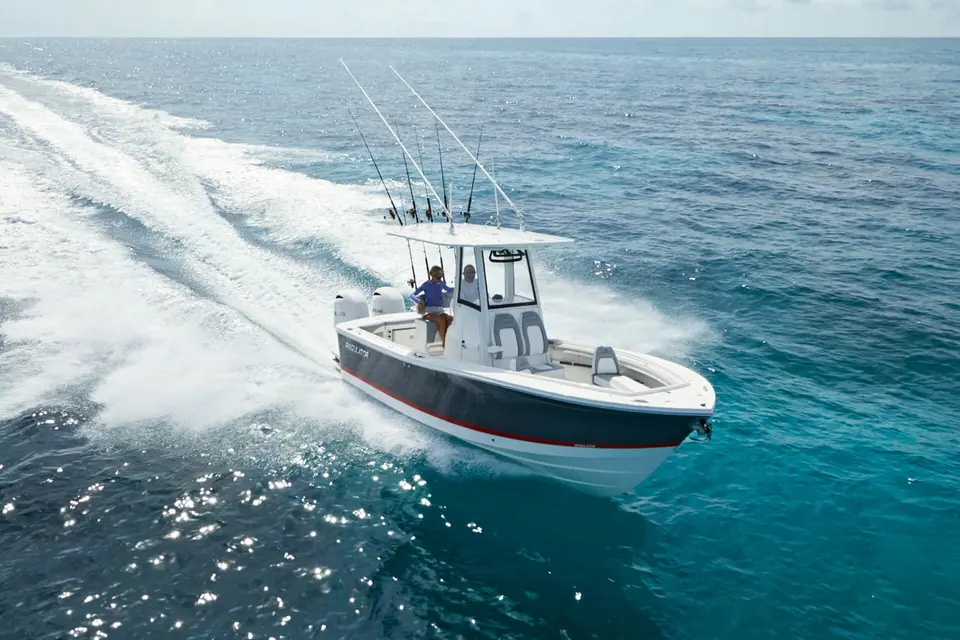
The current 23 measures 23 ft 5 in on the hull but 27 ft 6 in with its full-width Armstrong bracket and engines, and Jim Hendricks of Sport Fishing thought it looked more like a 28-footer at the dock. The bracket puts the outboards more than 3 feet behind the transom, frees the cockpit and gives the boat the footprint of a 25- or 26-footer. Beam grew to 8 ft 6 in, still trailerable without a wide-load permit.
Early bracket boats carried a single Yamaha F300 and weighed about 6,200 pounds dry. Saltwater Sportsman's 2015 test planed in 7.5 seconds, cruised at 29.5 mph and 4,200 rpm burning about 14 gph, hit 37 mph at 5,000 rpm and ran past 45 mph flat out, with a $92,395 price. Hendricks ran his test boat into 3- to 4-foot nor'easter seas off St. Lucie Inlet at about 25 mph and found it soft and remarkably dry thanks to the Carolina flare.
Regulator's grillage, a molded fiberglass stringer grid bonded to the hull with polybond adhesive, secured with biaxial glass and then foam-injected, is a big part of why these boats feel solid and quiet.
Twin F150 numbers from Yamaha and Boating
Yamaha's 2019 performance bulletin for the twin-F150 23, tested at 8,104 pounds with 100 gallons of fuel and two people, shows the boat at its best economy around 4,000 rpm and 28.9 mph, burning 13.8 gph for 2.09 mpg. Wide open, it reached 46.8 mph at 5,900 rpm on 30.2 gph. Zero to 30 mph took 10.5 seconds, slower than the single F300 boat because twin 150s add weight without adding much power.
Boating's 2019 test saw more than 48 mph with twin 150s and a 29 mph cruise under 13 gph, which it translated into about 310 miles of range. It priced that boat at $114,995 and called it an ideal kingfish tournament boat.
Deck plan and storage on the current boat
Regulator's current spec sheet lists two 240-quart forward dry storage boxes, a 350-quart rod storage compartment, a 69-quart console cooler seat, a 46-gallon transom livewell or fish box, 20 gallons of fresh water and an optional head with a 9-gallon holding tank in a stand-up console compartment with 71 inches of headroom. Earlier bracket boats had a 23-gallon livewell and an identical 120-quart fish box side by side in the transom, with a fold-away transom bench.
The T-top attaches to the side of the console rather than the deck, keeping walkways clear, and Boating noted hawse pipes for the cleats, uncommon at this size. Seakeeper Ride is now standard, along with Yamaha digital controls.
- Bridge height 104 inches, height from keel 127 inches
- Draft 21 inches engines up, 33 inches engines down
- Dry weight 7,120 pounds with twin F150s (current spec sheet)
- Fuel 149 gallons
Costs for a trailerable offshore boat
At about 14 gph at cruise and roughly 2 mpg, the 23 is economical to run. Budget about $8,000 to $16,000 a year for insurance, storage or a lift slip, Yamaha service, trailer maintenance and incidentals, plus fuel. Twin-engine boats cost more to service than single-engine ones but add redundancy offshore.
At more than 7,000 pounds dry before fuel and gear, a 23 on a trailer is a job for a full-size truck and a tandem-axle trailer, so check the tow rating before you buy.
Picking the right used 23
Regulator's price history explains used values. The 2005 boat listed at $62,500, the 2015 bracket boat at $92,395 and the 2019 twin-150 boat at $114,995. In 2026 the online configurator starts at $218,295. Expect roughly $40,000 to $72,000 for notched-transom and 23 FS boats, about $75,000 to $120,000 for single-F300 bracket boats from 2015 to 2018, and $115,000 to $200,000 for twin-engine boats from 2019 on.
If you fish mostly inshore and nearshore and want to keep costs low, an older single-engine 23 is hard to beat for the money. If you run 30 miles offshore regularly, the twin-engine bracket boat is the one to buy.
Regulator 23 specifications
| Length overall | 23.4 ft7.14 m |
|---|---|
| Beam | 8.5 ft2.59 m |
| Draft | 2.8 ft0.84 m |
| Air draft | 8.7 ft2.64 m |
| Displacement | 7,12 lbs3,23 kg |
| Fuel capacity | 149 gal564 L |
| Fresh water | 2 gal76 L |
| Cabins | 0 (console head compartment) |
| Berths | 0 |
| Heads | 1 in console (portable toilet standard, marine head optional) |
| Maximum persons | 10 |
| Standard engines | 2 x Yamaha F150 outboards on Armstrong bracket |
| Optional engines | Single Yamaha F300 on earlier bracket boats |
| Maximum power | 300 hp |
| Cruise speed | 25.1 knots |
| Top speed | 40.7 knots |
| Hull type | Deep-V planing hull, 24 degrees transom deadrise, Carolina flare bow |
| Hull construction | Solid hand-laid fiberglass with fiberglass grillage stringer system |
| Builder | Regulator Marine, United States |
| Naval architect | Lou Codega |
| Production | 2014 to present |
| Status | In production |
Figures come from builder documentation and independent tests where available. Displacement is usually quoted light, so a loaded cruising boat will weigh more. Compare these specs with another model.
Performance data
| RPM | Speed (mph) | Fuel (gph) | MPG |
|---|---|---|---|
| 1000 | 5.2 | 1.7 | 3.15 |
| 2000 | 8.5 | 4.7 | 1.83 |
| 3000 | 10.9 | 10.5 | 1.04 |
| 3500 | 17.9 | 12.7 | 1.41 |
| 4000 | 28.9 | 13.8 | 2.09 |
| 4500 | 34.5 | 17.3 | 1.99 |
| 5000 | 39.2 | 21 | 1.86 |
| 5500 | 43.6 | 26.3 | 1.66 |
| 5900 | 46.8 | 30.2 | 1.55 |
Yamaha performance bulletin for the Regulator 23CC with twin F150XCA, July 2019, test weight 8,104 lb with 100 gallons of fuel and two people. Fuel is the total for both engines.
How much does a Regulator 23 cost?
Regulator's online builder starts the current 23 at $218,295, up from $92,395 with a single F300 in 2015 and $114,995 with twin F150s in 2019. Used prices split sharply by generation: notched-transom boats from the 2000s are budget buys, while twin-engine bracket boats hold value close to new. Engine hours and the T-top, electronics and powder-coat options make the rest of the difference.
Estimate your yearly cost
A planning estimate using common rules of thumb: insurance near 1.5 percent of value, maintenance near 3 percent, haul out and bottom paint by length. Your marina, region and use will move these numbers. Open the full cost calculator.
Versions and options
- 23 (notched transom, 2005 update)
- 23 ft 4 in, 8 ft 4 in beam, single outboards up to 300 hp or twin 150 to 200 hp, 35-gallon in-deck livewell.
- 23 FS
- Forward seating version with insulated bow boxes and a 685-quart centerline fish box, about 2007.
- 23 bracket, single F300
- Launched 2014 with an Armstrong bracket, 8 ft 6 in beam and 149 gallons of fuel.
- 23 bracket, twin F150
- Twin-engine rating by 2019; twin F150s and Seakeeper Ride are standard today.
Regulator 23 timeline
- 1988Joan and Owen Maxwell found Regulator Marine in Edenton, North Carolina
- 2005Updated 23 with new stringers, liner and cap is reviewed by Sport Fishing
- 200723 FS forward-seating model offered
- 2014New bracket-mounted 23 replaces the notched-transom hull
- 2019Twin Yamaha F150 package tested at more than 48 mph by Boating
Strengths and weaknesses
What owners like
- Codega 24-degree hull rides far bigger than 23 feet
- Heavy, solid build with fiberglass grillage
- Bracket adds cockpit room and performance
- Around 2 mpg at cruise with twin F150s
- Trailerable 8 ft 6 in beam
- Strong resale and brand following
What to weigh up
- Heavy to tow for its length
- New price has more than doubled since 2015
- Twin F150s are slower to 30 mph than a single F300
- Small console head for family use
- Generations are easy to confuse in listings
Used Regulator 23 buyer checklist
Take this list to a viewing. Your ticks are saved in this browser so you can come back to it.
Always commission an independent marine survey and an engine survey before you buy. How a marine survey works.
Rivals to consider
Contender 23 Open
Lighter and faster, with a stepped-up performance focus over ride.
Compare side by sideGrady-White Fisherman 236
Hunt-designed family center console with a softer, more refined finish.
Compare side by sideCobia 240 Center Console
A value-priced alternative with a larger single outboard.
Compare side by sideOur verdict on the Regulator 23
The Regulator 23 is the right boat for anglers who want a small center console that rides like a big one. Codega's 24-degree hull and Regulator's heavy grillage construction make every generation tough and dry, and the bracket boat introduced in 2014 adds cockpit space and better performance. New prices are steep, so the smart money often goes to a well-kept single-F300 bracket boat or, for maximum value, a clean older 23 FS. Just know which generation you are buying.
Regulator 23 questions answered
How fast is a Regulator 23?
Yamaha's bulletin shows 46.8 mph with twin F150s, and Boating saw more than 48 mph. A single F300 bracket boat ran past 45 mph in Saltwater Sportsman's test.
How much fuel does the Regulator 23 hold?
The current bracket boat holds 149 gallons. The 23 FS listed 160 gallons.
What is the difference between the Regulator 23 and 23 FS?
The 23 FS was a forward-seating version of the notched-transom 23 with insulated bow boxes and a large centerline fish box. The current 23 uses a bracket and has forward seating built in.
What does a new Regulator 23 cost?
Regulator's online builder starts the 23 at $218,295 with twin Yamaha F150s.
Is the Regulator 23 trailerable?
Yes, the 8 ft 6 in beam is trailerable without a permit, but the boat weighs over 7,000 pounds dry with engines, so you need a capable tow vehicle.
What is a used Regulator 23 worth?
Roughly $40,000 to $72,000 for older notched-transom boats and up to about $200,000 for late twin-engine bracket boats.
Regulator 23 photos
More center consoles & offshore boats to explore
Grady-White Gulfstream 232
Center Consoles & Offshore Boats, 23 ft
Used $25K to $175K
Cobia 240 CC
Center Consoles & Offshore Boats, 24 ft
Used $70K to $125K
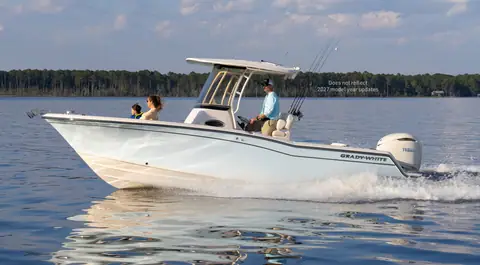
Grady-White Fisherman 236
Center Consoles & Offshore Boats, 24 ft
Used $75K to $152K
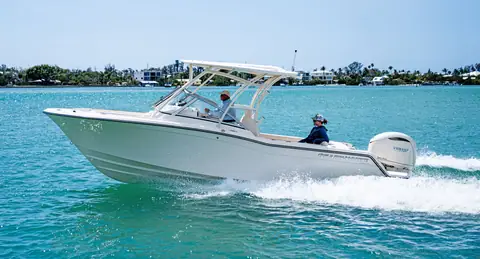
Grady-White Freedom 235
Center Consoles & Offshore Boats, 24 ft
Used $85K to $178K