Grady-White Center Consoles & Offshore Boats
Grady White Fisherman 216 Review, Specs and Used Buying Guide
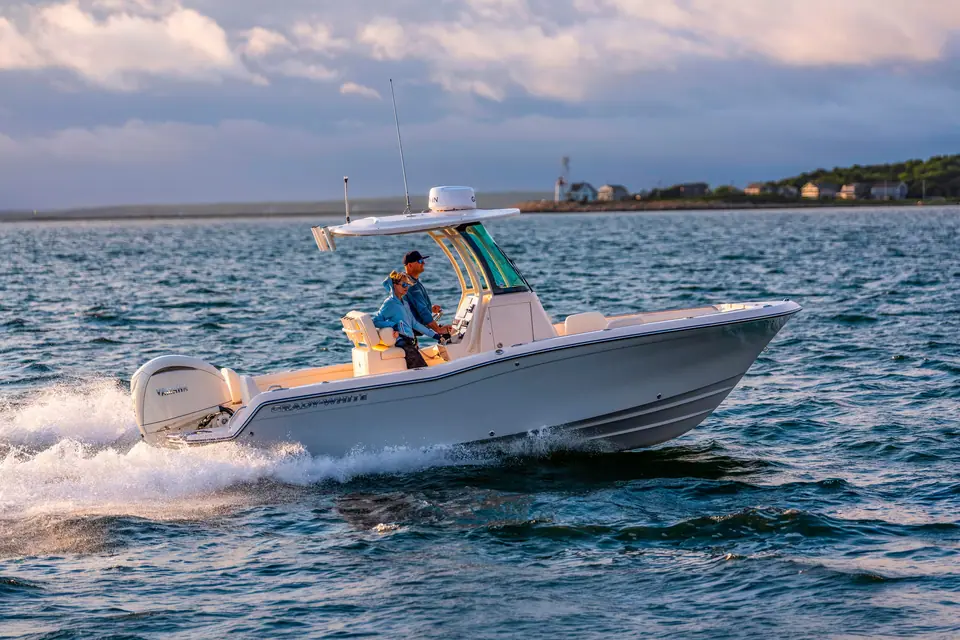
The smallest Grady-White with a stand-up console head and dual boarding platforms, a 21-foot SeaV2 center console for families who fish.
- Length
- 21.3 ft6.47 m
- Beam
- 8.5 ft2.59 m
- Cruise
- 27 kn
- Cabins
- None (lockable console head compartment)
- Used price
- $60K to $118K
On this page
- Overview
- What the Grady White Fisherman 216 is, and who it suits
- Twenty-one feet of SeaV2 with a 19-degree transom
- The swing-away jump seats and the twin boarding platforms
- A console head that is genuinely usable
- Choosing between the F200, F250 and F300
- How the 216 has evolved since its 2018 debut
- Living with a 216 on a trailer, a lift or a rack
- Buying a used Fisherman 216
- Specifications
- Price and value
- Strengths and weaknesses
- Used buyer checklist
- Rivals
- Our verdict
- FAQ
The Grady-White Fisherman 216 is a 21-foot 3-inch, 8-foot 6-inch beam center console built since the 2018 model year in Greenville, North Carolina, on a single Yamaha outboard of 200 to 300 hp with 80 gallons of fuel.
- First saltwater boat for a family
- Inshore and nearshore fishing
- Island or lake-house commuting
- Owners downsizing from a cruiser
Grady-White Fisherman 216 by the numbers
- Speed to length ratio at cruise
- 6.28A planing cruise. Fast passages in exchange for much higher fuel burn per mile.
- Estimated range at cruise
- 196 nmUsing 90 percent of tank capacity at the cruise speed and fuel burn listed on this page.
- Fuel economy at cruise
- 2.73 nmpgNautical miles per gallon at cruise, both engines combined.
- Horsepower per ton
- 179 hpVery high power to weight, built for speed.
- Length to beam ratio
- 2.50 : 1A beamy hull with lots of volume for its length.
What the Grady White Fisherman 216 is, and who it suits
The Grady White Fisherman 216 is the company's 21-foot center console, the first rung of the ladder for buyers who want the SeaV2 ride and Grady-White build quality without a twin-engine budget. It measures 21 feet 3 inches on the centerline, 23 feet 3 inches including the molded swim platforms, with an 8-foot 6-inch beam and a single Yamaha outboard of 200 to 300 hp. It joined the lineup for the 2018 model year and remains in the 2027 range alongside the smaller Fisherman 180.
The people who buy it fall into three camps. Young families get their first saltwater boat with a head the spouse will actually use. Downsizers leaving a cruiser or sailboat want something easy to launch that still looks salty. And a surprising number use it for transport: one owner review on the Grady-White site describes the 216 as a mainland to island commuter before the family stepped up to a Canyon 271. BoatTEST's review named the same groups, hard-core anglers, casual anglers with watersports kids, and people transitioning from sportboats or cruisers.
If you mainly fish offshore beyond 20 miles, the 216 is the wrong tool and the Fisherman 257 or a Canyon is the right one. For bays, sounds, inlets on decent days and nearshore wrecks, it is one of the best-mannered boats of its size.
Twenty-one feet of SeaV2 with a 19-degree transom
Every Grady-White rides on the SeaV2 bottom, a continuously variable deep-V developed with C. Raymond Hunt Associates in which no two points on the keel share the same deadrise. On the 216 the transom figure is 19 degrees, sharpening steadily toward the bow so the forefoot cuts chop while the flatter aft sections add stability at rest and help the boat plane with a single engine. Hard chines and strakes knock spray down, and BoatTEST noted that the hull shows the flared bow typical of North Carolina boats, built for Outer Banks inlets.
Draft with the engine up is just 16 inches, shallow enough for redfish flats and creek mouths, and cockpit depth is 25 inches aft, rising to about 34 inches forward according to BoatTEST. That aft figure puts the bolsters at mid-thigh, low enough for kids to see over and high enough with toe rails to brace while gaffing.
Construction follows the Grady formula. Hull and deck are 100 percent hand-laid, stringers and transom are water-impervious composite with no wood, deck hardware is through-bolted 316 stainless, and every box, cup holder and rod holder drains overboard rather than into the bilge. Basic flotation is standard.
The swing-away jump seats and the twin boarding platforms
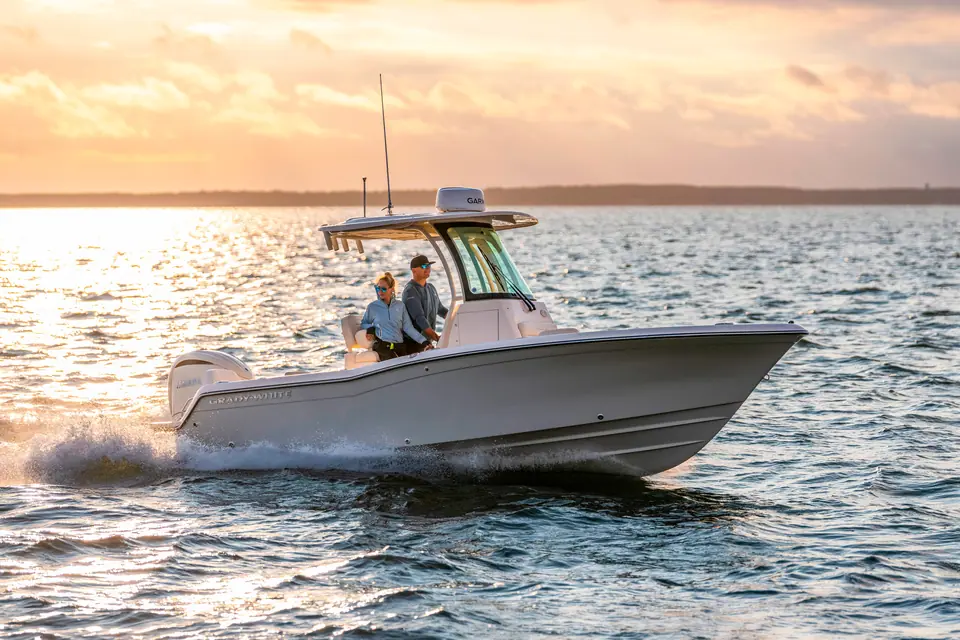
The feature that defined the 216 at launch sits at the stern. Two aft jump seats, each more than two feet wide according to Grady-White, have backrests that swing inboard to open a walkway on each side of the outboard. Flip the cushion and its base over and the top becomes a nonskid tread, so you can walk from the cockpit to either swim platform without climbing over upholstery. Grady-White called it an industry first in its launch material.
BoatTEST measured each platform at 28 inches fore and aft by 24 inches wide, with a four-step ladder reaching 22 inches below the surface. Those platforms are longer than on earlier Grady designs and serve as dockside boarding steps, swim decks and a launch point for tubes. An optional ski pylon stows inside the transom.
The trade-off is that the 216 has no full-width transom fish box or standard livewell aft. Fish go in two 81-quart insulated boxes under the bow seats, and live bait means paying for the deluxe lean bar, which carries a 25-gallon livewell underneath.
A console head that is genuinely usable
Grady-White's marketing chief said at launch that a roomy head is a rare commodity in a 21-foot boat, and she was right. The lockable console compartment holds a portable head, LED lighting, storage and a composite cherry and holly sole, with about 4 feet 8 inches of headroom measured by BoatTEST. Upgrades include a portable head with deck pump-out or one with an in-line macerator and overboard discharge for offshore use.
Ahead of the console is a cushioned seat with a 29-quart insulated box below. The helm takes flush-mounted displays up to 12 inches, and the standard lean bar has a backrest, flip-up bolster, tackle trays, lockable storage and four rod holders. Steering is hydraulic tilt as standard. The fiberglass T-top is optional and brings an integrated tempered glass windshield, LED spreader lights, four more rod holders and a radar flat; without it you get a console windshield only, which is how a lot of trailer boats are ordered.
Choosing between the F200, F250 and F300
Grady-White publishes its own performance data for three single Yamaha four-strokes on a hardtop-equipped 216. With the 2.8-liter F200 the boat topped out at 42.2 mph and cruised most efficiently at 27.3 mph and 4,000 rpm on 7.3 gph, or 3.73 mpg. The F250 lifted top speed to 48.9 mph with a best cruise of 31.1 mph on 9.9 gph. The F300, tested at the same 5,139-pound loaded weight, reached 51.1 mph and cruised at 29.6 mph on 8.7 gph.
Our advice is to buy the F250 or F300 if you carry a full family or run open water often. The F200 is the frugal choice and the most common in older used boats, but it has less in reserve with eight people aboard. Note that the launch spec sheet capped the boat at 250 hp; the current rating is 300 hp, so check the capacity plate on a 2018 or 2019 boat before planning a repower.
- F200: 42.2 mph top at 5,900 rpm, 27.3 mph cruise on 7.3 gph
- F250: 48.9 mph top at 5,900 rpm, 31.1 mph cruise on 9.9 gph
- F300: 51.1 mph top at 6,000 rpm, 29.6 mph cruise on 8.7 gph
How the 216 has evolved since its 2018 debut
Grady-White updates boats every model year rather than in big generational jumps. Comparing the 2018 specification with today's shows the main drift. Maximum horsepower rose from 250 to 300. Published weight without engine went from 3,125 pounds in Sport Fishing's launch preview to 3,360 pounds now. Bridge clearance with the T-top is listed at 7 feet 11 inches. Current boats ship with a waterproof touchscreen stereo with Bluetooth and Wi-Fi, four LED-lit speakers and a choice of four colored gelcoats in place of the older palette.
Late-model boats therefore carry more equipment and a little more weight; a 2018 with the F200 will run at the lower end of the figures above.
Living with a 216 on a trailer, a lift or a rack
At 8 feet 6 inches of beam the 216 tows without a wide-load permit, and Grady-White's own loaded test weight of about 5,100 pounds with engine, fuel, people and gear suggests a road package in the 5,500 to 6,500 pound range once you add a tandem trailer. A full-size half-ton pickup or large SUV handles it comfortably. It also fits most dry-stack racks and four-post lifts, which keeps bottom paint out of the budget.
Running costs are modest by Grady standards. A season of 100 to 150 engine hours, Yamaha annual service, insurance, registration and storage typically runs $6,000 to $11,000, more if you keep it in a wet slip in a high-cost marina. Fuel at cruise is close to 10 gph with the F250.
Buying a used Fisherman 216
Supply is steady because Grady-White builds the 216 every year, and demand is strong because few rivals combine a 21-foot hull, a stand-up console head and this build quality. Boston Whaler's 220 Outrage costs more, Robalo's R222 costs less and rides harder, and Regulator does not build a direct equivalent at this length.
Prioritize boats with the T-top, the deluxe lean bar livewell and the F250 or F300. Ask for Yamaha service records and the factory hour reading, and confirm whether the boat has the optional freshwater shower with its 10-gallon tank. Grady-White's fact-of-build request service lets you confirm original equipment, which is useful when a seller's listing is vague.
Grady-White Fisherman 216 specifications
| Length overall | 21.3 ft6.47 m |
|---|---|
| Beam | 8.5 ft2.59 m |
| Draft | 1.3 ft0.41 m |
| Air draft | 7.9 ft2.41 m |
| Displacement | 3,36 lbs1,524 kg |
| Fuel capacity | 8 gal303 L |
| Cabins | None (lockable console head compartment) |
| Berths | None |
| Heads | 1 portable head in the console (macerator and pump-out versions optional) |
| Maximum persons | 8 |
| Standard engines | Single Yamaha four-stroke outboard, F200 to F300 |
| Optional engines | Yamaha Helm Master EX digital electric steering (listed with the F250), Yamaha autopilot |
| Maximum power | 300 hp |
| Cruise speed | 27 knots |
| Top speed | 42.5 knots |
| Range | 196 nm |
| Hull type | SeaV2 continuously variable deep-V, 19 degrees deadrise at the transom |
| Hull construction | Hand-laid fiberglass with composite stringers and transom |
| Builder | Grady-White Boats, United States |
| Naval architect | C. Raymond Hunt Associates (SeaV2 hull concept) |
| Other design credits | Grady-White in-house engineering team (design engineer Christian Carraway) |
| Production | 2018 to present |
| Status | In production |
Figures come from builder documentation and independent tests where available. Displacement is usually quoted light, so a loaded cruising boat will weigh more. Compare these specs with another model.
Performance data
| RPM | Speed (mph) | Fuel (gph) | MPG |
|---|---|---|---|
| 1000 | 5.2 | 1.3 | 3.96 |
| 1500 | 6.9 | 2.1 | 3.29 |
| 2000 | 8.3 | 3.6 | 2.34 |
| 2500 | 9.4 | 5.5 | 1.71 |
| 3000 | 22.4 | 6.4 | 3.52 |
| 3500 | 28.6 | 8.4 | 3.4 |
| 3800 | 31.1 | 9.9 | 3.14 |
| 4000 | 32.9 | 11.5 | 2.86 |
| 4500 | 37 | 14.2 | 2.61 |
| 5000 | 41.8 | 19 | 2.2 |
| 5500 | 45.6 | 22.4 | 2.04 |
| 5900 | 48.9 | 24.3 | 2.01 |
Grady-White factory test, June 2017, single Yamaha F250 (4.2L) with 15.5 x 17 SWS II prop, hardtop, 5,139 lb loaded weight including people, fuel, water and gear.
How much does a Grady-White Fisherman 216 cost?
Sport Fishing listed the launch MSRP at $74,950 with a Yamaha F200, and Grady-White prices have climbed steadily since, so a 2026 boat with an F250 or F300, the T-top and the deluxe livewell lean bar lands well into six figures. Engine size, the fiberglass T-top and the factory livewell lean bar are the options that move resale most. Clean 2018 and 2019 boats with low Yamaha hours sell quickly because the 216 is one of the few premium 21-footers with a real console head.
Estimate your yearly cost
A planning estimate using common rules of thumb: insurance near 1.5 percent of value, maintenance near 3 percent, haul out and bottom paint by length. Your marina, region and use will move these numbers. Open the full cost calculator.
Versions and options
- Single Yamaha F200
- The entry package and the lightest rig, 42 mph top speed and the best fuel economy in Grady-White's tests.
- Single Yamaha F250
- The balanced choice, 48.9 mph top and a 31 mph cruise, and the engine listed with the optional Helm Master EX steering.
- Single Yamaha F300
- Allowed under the current 300 hp rating; 51 mph top speed and a strong hole shot with a full crew.
- T-top or console windshield
- The fiberglass T-top adds an integrated glass windshield, spreader lights, rod holders and a radar flat; boats without it keep a lower profile for garages and racks.
Grady-White Fisherman 216 timeline
- 2017Grady-White completes factory performance testing of the new 21-foot center console with F200, F250 and F300 Yamahas
- 2018Fisherman 216 debuts as a 2018 model with a 250 hp rating and a $74,950 MSRP with a Yamaha F200
- 2022FishTalk magazine reviews the 216, by now a staple of Grady's Fisherman series
- 2027Still in the lineup for the 2027 model year with a 300 hp rating and an updated equipment list
Strengths and weaknesses
What owners like
- SeaV2 ride and Grady-White build quality at the lowest price in the center console range
- Swing-away jump seat backrests open walkways to both swim platforms
- Console head with about 4 feet 8 inches of headroom
- 16-inch draft reaches skinny water
- Trailerable 8-foot 6-inch beam and modest towing weight
- Strong resale and steady buyer demand
What to weigh up
- No standard livewell; bait means the deluxe lean bar option
- 80-gallon tank limits offshore range
- Single engine only
- Priced well above most 21-foot center consoles
- T-top and many comfort items are extra cost
Used Grady-White Fisherman 216 buyer checklist
Take this list to a viewing. Your ticks are saved in this browser so you can come back to it.
Always commission an independent marine survey and an engine survey before you buy. How a marine survey works.
Rivals to consider
Boston Whaler 220 Outrage
The closest premium rival, unsinkable foam-filled construction and a bigger price tag.
Compare side by sideRobalo R222
More boat for the money at 22 feet, but a firmer ride and less finish detail.
Compare side by sideScout 215 XSF
A sportier, more styled alternative with similar single-engine power.
Compare side by sideRegulator 23
Larger and more offshore oriented, a step up in price and towing weight.
Compare side by sideOur verdict on the Grady-White Fisherman 216
The Fisherman 216 is the most refined 21-foot center console you can buy new, and it earns its premium with the SeaV2 ride, an honest console head and the clever swing-away transom that turns two swim platforms into real boarding steps. It is not a canyon boat and its 80-gallon tank keeps it close to shore, but for families who fish bays, sounds and nearshore reefs it makes a strong case, and used examples hold their value well enough that the extra money up front comes back at trade-in time.
Grady-White Fisherman 216 questions answered
How long is the Grady White Fisherman 216?
It measures 21 feet 3 inches on the centerline and 23 feet 3 inches including the molded swim platforms, with an 8-foot 6-inch beam.
What is the maximum horsepower on a Grady White 216?
The current rating is 300 hp on a single Yamaha outboard. Early 2018 boats were rated for 250 hp, so check the capacity plate on any used boat.
How fast is the Fisherman 216?
Grady-White's tests show 42.2 mph with an F200, 48.9 mph with an F250 and 51.1 mph with an F300, with best cruise speeds around 27 to 31 mph.
Does the Grady White 216 have a head?
Yes. A lockable console compartment holds a portable head with about 4 feet 8 inches of headroom, and macerator or pump-out heads are optional.
What does a used Grady White Fisherman 216 cost?
Expect roughly $60,000 to $75,000 for a 2018 to 2019 boat and $100,000 or more for a nearly new example, depending on engine and options.
Can you trailer a 21 ft Grady White?
Yes. The 8-foot 6-inch beam needs no wide-load permit, and the loaded boat weighs about 5,100 pounds before the trailer.
Grady-White Fisherman 216 photos
More center consoles & offshore boats to explore
Beneteau Flyer 7
Center Consoles & Offshore Boats, 21 ft
Used $48K to $90K
Flats Cat 21
Center Consoles & Offshore Boats, 21 ft
Used $15K to $60K
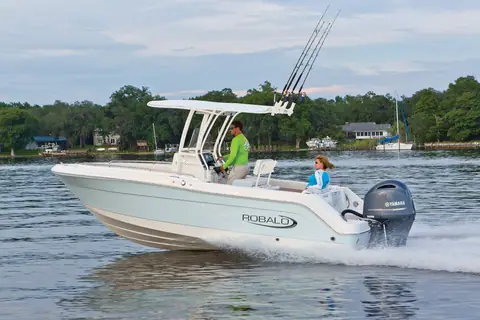
Robalo R222
Center Consoles & Offshore Boats, 22 ft
Used $28K to $80K
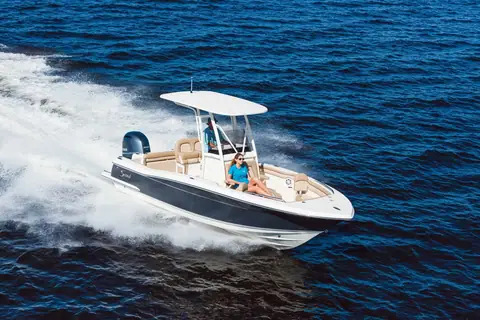
Scout 215 XSF
Center Consoles & Offshore Boats, 22 ft
Used $36K to $75K
Other Grady-White models
- Grady-White Canyon 336
- Grady-White Canyon 456
- Grady-White Express 330
- Grady-White Express 340
- Grady-White Express 370
- Grady-White Fisherman 236
- Grady-White Fisherman 257
- Grady-White Freedom 235
- Grady-White Freedom 275
- Grady-White Freedom 285
- Grady-White Gulfstream 232
- Grady-White Marlin 300
- Grady-White Seafarer 22
- All Grady-White models