Regulator Marine Center Consoles & Offshore Boats
The Original Regulator 26, a Classic Among Used Regulator Boats for Sale
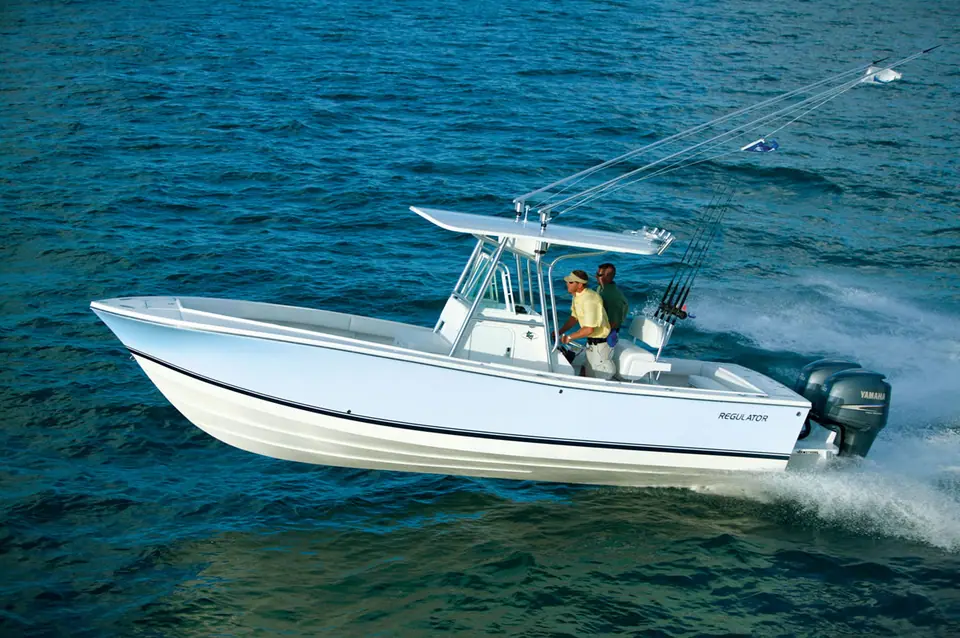
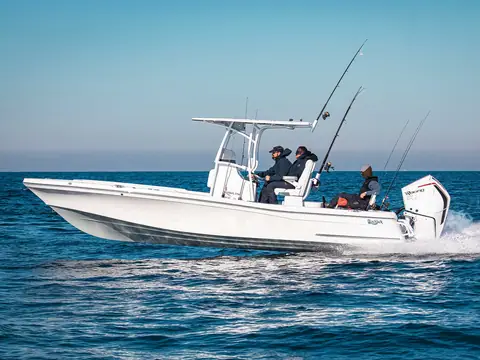
The boat that started Regulator Marine: a Lou Codega 24-degree deep-V center console built from 1990 to 2013, with more than 1,500 hulls on the water.
- Length
- 25.8 ft7.87 m
- Beam
- 8.5 ft2.59 m
- Cruise
- 2 ft0.61 m
- Cabins
- 0 (console head compartment)
- Used price
- $30K to $120K
On this page
- Overview
- Used Regulator boats for sale often start with this one
- Potter SeaCrafts, Carolina flare and a Bertram 31
- Hull 1,000, and a boat that crossed the Atlantic alone
- Deck layout and fishing gear
- Power, from two-strokes to F250s
- The 26 FS and 26 Express cousins
- Pricing and buying a 26 today
- Specifications
- Price and value
- Strengths and weaknesses
- Used buyer checklist
- Rivals
- Our verdict
- FAQ
The Regulator 26, often listed as the 26 Classic, is the 25 ft 10 in center console that launched Regulator Marine in 1990. Built until 2013 on a Lou Codega deep-V with a 48-degree entry and 24-degree deadrise, it remains a sought-after used offshore boat.
- Offshore anglers on a budget
- Canyon and Gulf Stream runs in a trailerable boat
- Owners planning a repower and refit
- Regulator enthusiasts who want the original
Used Regulator boats for sale often start with this one
Among used Regulator boats for sale, no model has a stronger following than the original Regulator 26. It was the first boat Joan and Owen Maxwell built after founding the company in 1988 in a former A&P grocery store in Edenton, North Carolina, and it stayed in production for 24 years. Saltwater Sportsman reported that more than 1,500 had been built when Regulator stopped production in 2013. Listings often call it the 26 Classic to separate it from the 26 FS forward-seating version and the much later 26XO crossover, which is a different boat.
That long run means you can buy a 26 from almost any era, from early 1990s boats on two-stroke power to the last bracket boats on four-strokes. Prices range accordingly, but the hull, and the ride it delivers, stayed remarkably consistent.
Regulator 26 Classic by the numbers
- Displacement hull speed
- 6.4 knThe efficient cruising speed for a displacement hull of this waterline.
- Length to beam ratio
- 3.04 : 1Moderate proportions.
Potter SeaCrafts, Carolina flare and a Bertram 31
Joan Maxwell told Soundings that the couple studied the old Bill Potter SeaCrafts for their hulls, the Carolina builders for their dramatic bow flare and the Bertram 31 as the standard of a workhorse when they conceived the 26. They hired naval architect Lou Codega in 1988, built a full-scale model by hand, and launched the first boat two years later. Regulator says the 26 was named the best up-and-coming center console by Sport Fishing in 1990 to 1991, and Codega says hull No. 1 is reportedly still fishing in the Bahamas.
The 26 rides a deep-V with a sharp 48-degree entry and 24 degrees of deadrise at the transom. The high, flared bow sheds water and the freeboard is carried well aft to a transom deep enough for bait wells. Regulator's one-piece fiberglass grillage stiffens the hull, and the company's construction approach, solid hand-laid glass and no wood in the hull, became its calling card.
Hull 1,000, and a boat that crossed the Atlantic alone
On August 4, 2003, the 1,000th Regulator 26 came off the line in Edenton. Soundings reported that the company was then building and selling about ten 26s a month. By then the 26 had become, in the words of Powerboat Guide quoted by Soundings, a no-compromise, all-weather trailerable fishing platform with quality construction and drop-dead good looks.
The most famous 26 never had a buyer's survey. Queen Bee, a yellow-hulled Regulator 26, was knocked out from under her owner and his brother-in-law by a breaking wave off Nantucket in August 2008. Both men reached shore. The boat drifted for more than three years and an estimated 3,500 miles before being found off the coast of Spain in January 2012, with outboards, gauges and electronics still attached. It was shipped back through Baltimore to the Edenton factory that July, and Regulator later counted the voyage among the milestones in its company history.
Deck layout and fishing gear
Fishing features ran deep for a 26-footer. Soundings listed a 700-quart wet or dry box forward in the sole, a 136-quart fish box on each side, a 32-gallon livewell in the cockpit sole, and a 16-gallon transom livewell flanked by bait boxes. Sport Fishing's 2005 description adds two recirculating baitwells, a 700-quart rod and storage locker, a raw-water washdown and Lenco trim tabs.
The console has a fiberglass-lined, stand-up head compartment with about 6 feet of headroom and a tilt-away panel for flush-mounted electronics. Seating was simple: a leaning post with backrest and rocket launcher, upgradeable to a fiberglass tackle center, plus a cushion forward of the console. A fiberglass T-top with an electronics box and outrigger bases was the most common option, along with a 54-gallon auxiliary fuel tank and a 54-gallon freshwater tank.
One thing the classic 26 has that its successors do not is a step up from the cockpit to the bow. The 25 that replaced it was designed specifically to eliminate that step.
- LOA 25 ft 10 in, beam 8 ft 6 in, 24 degrees deadrise
- Draft about 2 ft with engines up
- Fuel 176 gallons (2005 spec), 54-gallon auxiliary tank optional
- Maximum power twin 250 hp outboards
Power, from two-strokes to F250s
Typical power was a pair of 225 or 250 hp outboards. Early boats often carried 200 hp two-strokes, and by 2005 Sport Fishing listed an Armstrong dual-engine bracket, a triple battery system and twin Yamaha F250s at $117,000. Yamaha was the dominant engine brand throughout.
We did not find a published independent speed and fuel table for the original 26, so we do not quote one. Owners report it as a fast, dry boat, and Soundings' featured owner ran his 26 to the canyons for bigeye tuna and through 6- to 8-foot seas 100 miles offshore. Treat any used boat's real performance as a function of its specific engines and props, and sea trial it.
The 26 FS and 26 Express cousins
Regulator built two close relatives on the same Codega hull. The 26 FS is a family-oriented version with cushioned forward seating over insulated 143-quart lockers, a fold-down aft bench and wraparound coaming bolsters. The 26 Express, which debuted in 1993, added a small galley and a V-berth in a cuddy cabin. Both appear on the used market and share the hull's ride, but check which version a listing actually describes.
In late 2010 the 28 FS took over as Regulator's core offshore boat, and in 2014 the new 25 filled the gap left when the 26 ended in 2013.
Pricing and buying a 26 today
Soundings' market sampling in the mid-2000s found a 1993 boat with twin 200 hp two-strokes at $42,900, a 1997 at $58,995, a 1998 at $64,700 and a 2000 with twin 250s at $75,900, and its featured owner paid about $70,000 for a 2000 model. In 2026 we would expect most 1990s boats in the $30,000 to $55,000 range and late boats from 2008 to 2013 at roughly $68,000 to $120,000, with engine age and type the dominant factor.
Annual costs are modest for an offshore boat: roughly $7,000 to $15,000 for insurance, storage, twin-engine service and maintenance, plus fuel. The bigger financial decision is repowering. A 1990s boat on original two-strokes is effectively a hull purchase, and a modern pair of four-strokes can cost more than the boat.
Regulator 26 Classic specifications
| Length overall | 25.8 ft7.87 m |
|---|---|
| Beam | 8.5 ft2.59 m |
| Draft | 2 ft0.61 m |
| Fuel capacity | 176 gal666 L |
| Cabins | 0 (console head compartment) |
| Berths | 0 |
| Heads | 1 in console |
| Standard engines | Twin outboards, typically Yamaha 225 to 250 hp |
| Optional engines | Earlier boats commonly carried twin 200 hp two-strokes |
| Maximum power | 500 hp |
| Hull type | Deep-V planing hull, 48-degree bow entry, 24 degrees transom deadrise |
| Hull construction | Solid fiberglass with Regulator fiberglass grillage system |
| Builder | Regulator Marine, United States |
| Naval architect | Lou Codega |
| Other design credits | Owen and Joan Maxwell (concept) |
| Production | 1990 to 2013 |
| Status | Discontinued |
Figures come from builder documentation and independent tests where available. Displacement is usually quoted light, so a loaded cruising boat will weigh more. Compare these specs with another model.
How much does a Regulator 26 Classic cost?
Sport Fishing listed a 2005 Regulator 26 at $117,000 with twin Yamaha F250s. Soundings found 1990s boats with twin two-strokes in the $43,000 to $65,000 range and a 2000 model at $75,900 in the mid-2000s. Today the age and type of the outboards matter more than the hull year: a late boat with modern four-strokes can be worth twice an early boat on tired two-strokes.
Estimate your yearly cost
A planning estimate using common rules of thumb: insurance near 1.5 percent of value, maintenance near 3 percent, haul out and bottom paint by length. Your marina, region and use will move these numbers. Open the full cost calculator.
Versions and options
- Regulator 26 center console
- The original step-up deck model built from 1990 to 2013.
- Regulator 26 FS
- Forward-seating family version with insulated bow lockers and coaming bolsters.
- Regulator 26 Express
- Cuddy-cabin variant introduced in 1993 with a small galley and V-berth.
Regulator 26 Classic timeline
- 1988Joan and Owen Maxwell found Regulator Marine and hire Lou Codega
- 1990First Regulator 26 launches
- 199326 Express cuddy version debuts
- 20031,000th Regulator 26 built on August 4
- 2012Queen Bee, a 26 lost off Nantucket in 2008, is found off Spain
- 2013Production ends after more than 1,500 hulls; the 25 replaces it
Strengths and weaknesses
What owners like
- Legendary soft, dry Codega deep-V ride
- Solid, wood-free fiberglass construction
- Huge fishing storage for a 26-footer
- More than 1,500 built, so plenty of choice
- Stand-up console head
- Strong brand loyalty supports resale
What to weigh up
- Step up from cockpit to bow
- Narrower and straighter-sided than modern boats
- Many boats need or have had repowers
- No independent published performance data
- Older boats may carry dated wiring and electronics
Used Regulator 26 Classic buyer checklist
Take this list to a viewing. Your ticks are saved in this browser so you can come back to it.
Always commission an independent marine survey and an engine survey before you buy. How a marine survey works.
Rivals to consider
Regulator 28
The flush-deck successor that took over as Regulator's core offshore boat.
Compare side by sideContender 25 Tournament
Faster, lighter classic from the same era with a devoted tournament following.
Compare side by sideHydra-Sports 2500 CC
Another 25-foot offshore console from the period, generally cheaper.
Compare side by sideOur verdict on the Regulator 26 Classic
The original Regulator 26 is a genuine classic: the boat that built a company, proven across more than 1,500 hulls and two decades of hard offshore use. Its 24-degree Codega hull still rides as well as many newer boats, and its construction holds up. Buy it as a hull and a reputation, then price the engines honestly, and a clean 26 is one of the best-value offshore center consoles on the used market.
Regulator 26 Classic questions answered
What years was the Regulator 26 built?
From 1990, when the first boat launched, until 2013, when Regulator stopped production after more than 1,500 hulls.
Is the Regulator 26 Classic the same as the 26XO?
No. The 26 Classic refers to the original center console; the 26XO is a much later crossover model from the XO series introduced in 2019.
Who designed the Regulator 26?
Naval architect Lou Codega designed it with founders Joan and Owen Maxwell, and he has designed every Regulator since.
How much fuel does a Regulator 26 hold?
Sport Fishing's 2005 specification lists 176 gallons, and a 54-gallon auxiliary tank was an option.
What is a used Regulator 26 worth?
Roughly $30,000 to $55,000 for 1990s boats and about $68,000 to $120,000 for late boats, depending mostly on engines.
What replaced the Regulator 26?
The 28 FS became the core offshore model in 2010, and the Regulator 25 was introduced in 2014 to fill the 26's slot.
More center consoles & offshore boats to explore
Sea Hunt Gamefish 25
Center Consoles & Offshore Boats, 26 ft
Used $45K to $155K
Yellowfin 26 Hybrid
Center Consoles & Offshore Boats, 26 ft
Used $95K to $270K
Barker 26 Open
Center Consoles & Offshore Boats, 26 ft
Used $90K to $215K
BlackJack 256 Coastal
Center Consoles & Offshore Boats, 26 ft
Used $85K to $150K