Flats Cat Boat Company Center Consoles & Offshore Boats
Flats Cat Boats 21 Foot Review, the Texas Cat That Runs in Inches
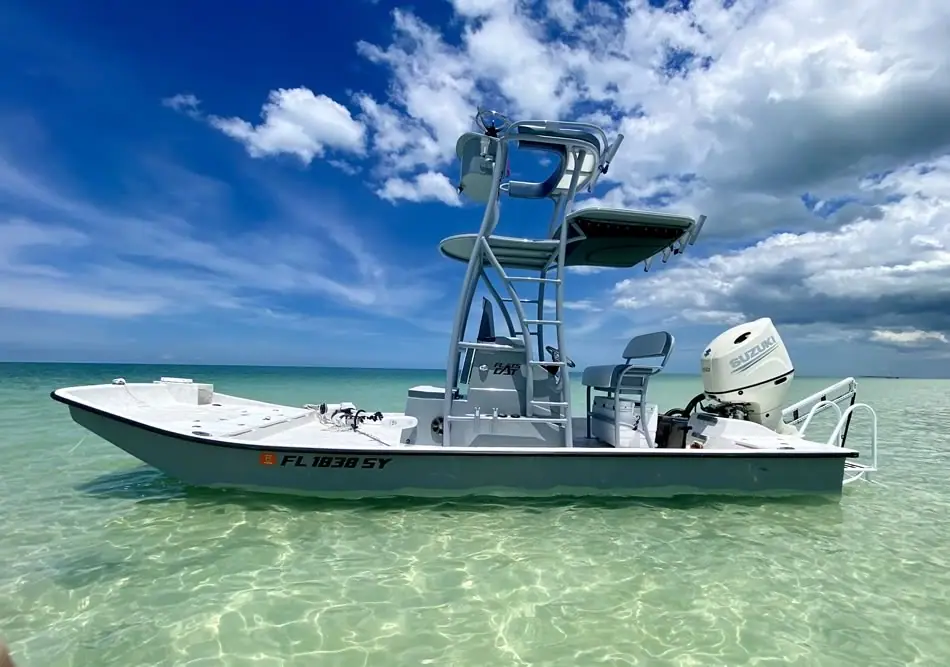
The original Flats Cat, a 21-foot patented catamaran flats boat from Rosenberg, Texas that drafts 4 inches and runs in three and a half.
- Length
- 21 ft6.4 m
- Beam
- 7.5 ft2.29 m
- Cruise
- 0.3 ft0.1 m
- Cabins
- None
- Used price
- $15K to $60K
On this page
- Overview
- What Flats Cat boats are, and where the 21 fits
- Bill Allison's patented hull
- The numbers behind the 21
- Deck layout and standard equipment
- The company after Bill Allison
- Who the 21 suits, and who it does not
- Buying a used Flats Cat 21
- Specifications
- Price and value
- Strengths and weaknesses
- Used buyer checklist
- Rivals
- Our verdict
- FAQ
The Flats Cat 21 is a 21-foot fiberglass catamaran flats boat built in Rosenberg, Texas, on Bill Allison's patented hull. It has a 7-foot 6-inch beam, weighs 1,650 lb, carries 40 gallons and is rated for 150 hp.
- Sight fishing redfish and trout on the Texas coast
- Wade fishing and marsh access
- Duck hunting in shallow flats
- Anglers with back problems who want a smoother ride
What Flats Cat boats are, and where the 21 fits
Flats Cat boats are small fiberglass catamarans built in Rosenberg, Texas, for anglers who fish the skinniest water on the Gulf Coast: back lakes, marshes and the shallow flats of Texas bays. The company builds three models today, a 17, a 19 and the 21, and the 21 is both the largest and the original. Flats Cat says its first boat was the 21 in 1991, followed by an 18.6 in 1995, the 17 in 2001 and the 19 a year later.
The builder's pitch is three words, smoothest, driest, shallowest, and the 21 is pitched as the boat for anglers who need more space, power and storage than the smaller cats. It keeps their shallow-water ability, with the same 4-inch draft at rest and 3.5-inch minimum running depth, but adds a much larger front casting platform and a smoother ride in choppy bays.
Flats Cat 21 by the numbers
- Displacement hull speed
- 6.0 knThe efficient cruising speed for a displacement hull of this waterline.
- Length to beam ratio
- 2.80 : 1Catamaran overall proportions. Wider platforms resist pitching and heel.
Bill Allison's patented hull
Flats Cat exists because of a bad back. Founder Bill Allison, a college football player, was injured and found traditional boats too hard on his spine, so he spent years drawing and researching a catamaran that would run smooth, dry and shallow. He filed for a patent in May 1988, and US Patent 4,870,919 for a catamaran type boat was granted on October 3, 1989.
The patent explains the thinking. It notes that catamaran pontoons with upswept forward bottoms generate lift and reduce pitching because the two hulls rarely hit a wave at the same instant, and it sets out the goal of a fishing boat fast enough to reach the grounds quickly yet able to cross water as shallow as three or four inches. The first boats were aluminum pontoons joined by welded beams. Allison later concluded that aluminum was too noisy and spooked fish, and moved production to fiberglass. Flats Cat also credits research help from Texas A&M.
The numbers behind the 21
Flats Cat publishes an unusually shallow-water-focused spec sheet. The 21 has a 7-foot 6-inch beam and a 7-foot bottom, weighs 1,650 pounds, and has a 27-inch transom. Take-off depth is 6 inches, minimum running depth 3.5 inches, draft at rest 4 inches, and the builder says it planes in 10 feet. Recommended power is a 150 hp outboard, mounted on a 6-inch Bob's Action Jack plate, and fuel capacity is 40 gallons.
Those figures compare with 1,400 pounds and 115 hp for the 19 on the same beam. The 21 is the one to choose if you regularly carry three anglers, fish open bay water as well as back lakes, or want more deck to cast from.
- Beam 7 ft 6 in, bottom 7 ft, weight 1,650 lb
- Draft at rest 4 in, minimum running depth 3.5 in, take-off depth 6 in
- Planing distance 10 ft
- Recommended power 150 hp, fuel 40 gal
- Transom height 27 in with a 6-inch jack plate
Deck layout and standard equipment
The deck is simple and built around poling, wading and casting. A large front casting platform has three hatches with Trim-Lok seals, and dual rear platforms carry more hatches. The console is fiberglassed to the deck, with an aluminum welded console rail, a tinted windscreen, a non-skid top and a six-switch panel. A custom leaning post with a backrest and storage, an insulated livewell with fill, recirculation and aeration, one-way scuppers that keep the boat self-bailing, pop-up cleats and hydraulic steering are standard.
The hull is foam filled and Flats Cat calls the design unsinkable. Wiring runs through a conduit from the console to the bow for the trolling motor. The listed accessories include an 8-foot Raptor shallow-water anchor, a Minn Kota iPilot package, a Wet Sounds sound bar, trim tabs, a light bar, bucket seats on Shockwave mounts, an elevated ice chest, a removable sport top and a wade ladder with a handrail. A single-axle trailer is standard, with a tandem option.
The company after Bill Allison
Bill Allison died in 2014. Gina ran the company afterward, and Chris Mapp took over in 2020. Every boat is still built start to finish in Rosenberg, from hull lamination and gelcoat to wiring and rigging. Under the new ownership, the 2024 boats moved to all-composite construction, and the company signed Sonny Cook Marine in Port O'Connor as a dealer. A 2023 walkthrough by the Texas Fishing Force channel toured the plant and introduced the 2024 model.
Flats Cat boats have also proved useful far from the fishing grounds. The company says its boats were used as rescue craft in flooded neighborhoods during Hurricane Harvey, where few other boats could maneuver in such shallow water.
Who the 21 suits, and who it does not
The 21 is a specialist. It suits Texas and Louisiana anglers who sight-cast for redfish and trout in inches of water, wade fishermen who want a stable platform to step off, and duck hunters who need to cross mud flats. The catamaran hull trades some of the predictable feel of a monohull bay boat for its shallow running and smooth ride in a short chop.
It is not an offshore boat, and it is not a family runabout. With 40 gallons of fuel and a small console, it is designed for bays and marshes. Ownership costs are low, roughly $3,000 to $7,500 a year for insurance, outboard service, trailer upkeep and fuel, which is a large part of its appeal.
Buying a used Flats Cat 21
Used Flats Cats turn up mostly on the Texas coast, often privately. Because the 21 has been built since 1991, you will see aluminum boats, early fiberglass boats and the newer composite boats under the same name. Check the hull material and year carefully, and expect the newest boats to cost several times more than the oldest.
Shallow-water boats live hard lives. Inspect the bottoms of both hulls for gouges and repairs from oyster shell and running aground, check the transom and jack plate mounting for cracks, and look for soft spots in the casting platform. Older outboards are the most common big expense, so price a repower into any boat with an old two-stroke.
Flats Cat 21 specifications
| Length overall | 21 ft6.4 m |
|---|---|
| Beam | 7.5 ft2.29 m |
| Draft | 0.3 ft0.1 m |
| Displacement | 1,65 lbs748 kg |
| Fuel capacity | 4 gal151 L |
| Cabins | None |
| Berths | None |
| Heads | None |
| Standard engines | Single outboard, 150 hp recommended, on a 6-inch jack plate |
| Hull type | Patented twin-hull catamaran flats hull with flat running surfaces |
| Hull construction | Hand-laminated fiberglass with foam-filled stringer system (early boats aluminum) |
| Builder | Flats Cat Boat Company, United States |
| Naval architect | Bill Allison (patented catamaran hull, US Patent 4,870,919) |
| Other design credits | Developed with research assistance from Texas A&M, according to the builder |
| Production | 1991 to present |
| Status | In production |
Figures come from builder documentation and independent tests where available. Displacement is usually quoted light, so a loaded cruising boat will weigh more. Compare these specs with another model.
How much does a Flats Cat 21 cost?
Flats Cat sells through a small dealer network and direct from the factory and does not publish prices, so these are our estimates for a new 21 with a 150 hp outboard, trailer and the usual shallow-water options such as a Power-Pole, trolling motor and jack plate. Used prices span early aluminum and 1990s fiberglass boats on old two-stroke engines at the bottom, and 2024 and later all-composite boats under current ownership at the top. Engine age matters more than hull age on these boats.
Estimate your yearly cost
A planning estimate using common rules of thumb: insurance near 1.5 percent of value, maintenance near 3 percent, haul out and bottom paint by length. Your marina, region and use will move these numbers. Open the full cost calculator.
Versions and options
- Aluminum Flats Cat
- The earliest boats used welded aluminum pontoons, as described in Bill Allison's patent; the builder says aluminum proved too noisy for spooky fish.
- Fiberglass 21
- Hand-laminated fiberglass hull with foam-filled stringers, built in Rosenberg, Texas.
- 2024 and later
- All-composite construction introduced under owner Chris Mapp.
Flats Cat 21 timeline
- 1988Bill Allison files for a patent on his catamaran type boat
- 1989US Patent 4,870,919 is granted on October 3
- 1991The first Flats Cat, the 21, is built
- 2014Founder Bill Allison dies
- 2020Chris Mapp takes over the company
- 2024Boats move to all-composite construction and new dealers sign on
Strengths and weaknesses
What owners like
- Runs in about 3.5 inches of water and drafts 4 inches at rest
- Smooth, dry catamaran ride in a short chop
- Light enough to tow with a modest vehicle
- Large front casting platform
- Low ownership costs
- Foam-filled, self-bailing hull
What to weigh up
- Not suited to open offshore water
- Small fuel capacity
- Limited dealer network outside Texas
- No published speed or fuel data
- Mixed fleet of aluminum, fiberglass and composite boats in the used market
Used Flats Cat 21 buyer checklist
Take this list to a viewing. Your ticks are saved in this browser so you can come back to it.
Always commission an independent marine survey and an engine survey before you buy. How a marine survey works.
Rivals to consider
Blazer Bay 2020
A conventional monohull bay boat with a more familiar ride and wider dealer support.
Compare side by sideFlats Cat 19
The smaller sister, lighter at 1,400 lb with 115 hp recommended and the same shallow-water figures.
Flats Cat 17
The smallest current Flats Cat, added in 2001, for anglers who want the lightest, easiest boat to pole and tow.
Our verdict on the Flats Cat 21
The Flats Cat 21 is a niche boat that does its job very well. Bill Allison's patented catamaran hull lets it draft 4 inches and run in three and a half, while giving a smoother ride across a choppy bay than most flat-bottom skiffs. It is not fast on paper, there is no published performance data, and it does not belong offshore, but for Texas coast anglers who live in the shallows it is a proven tool with more than three decades of history and a builder still working out of Rosenberg.
Flats Cat 21 questions answered
Where are Flats Cat boats built?
All Flats Cat boats are built in Rosenberg, Texas, by the Flats Cat Boat Company.
How shallow can a Flats Cat 21 run?
Flats Cat lists a minimum running depth of 3.5 inches, a take-off depth of 6 inches and a draft of 4 inches at rest.
What engine does the Flats Cat 21 need?
The builder recommends a 150 hp outboard on a 6-inch jack plate.
Who invented the Flats Cat?
Bill Allison, who patented his catamaran hull in 1989 and built the first Flats Cat, a 21, in 1991.
How much does a Flats Cat 21 cost?
The builder does not publish prices. We estimate $55,000 to $75,000 new with a 150 hp outboard and trailer, and $15,000 to $60,000 used depending on year and engine.