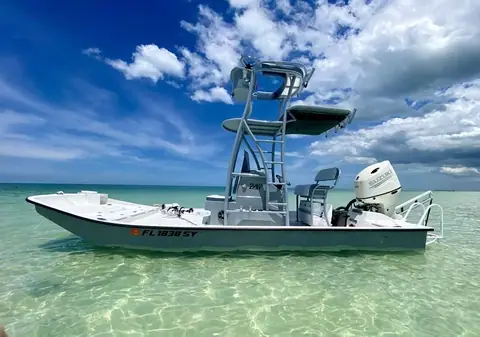
Flats Cat 21
Center Consoles & Offshore Boats, 21 ft
Used $15K to $60K
A small Texas shop near Houston that has built twin-hull shallow-water skiffs on one patented design since the early 1990s.
Flats Cat Boat Company is a Rosenberg, Texas, builder of small fiberglass catamaran skiffs for the Gulf Coast flats. Bill Allison's twin-hull patent dates to 1989, and today the shop offers 17, 19 and 21-foot models.
Flats Cat began with one man's spine. Bill Allison, a former college football player, hurt his back badly enough that pounding across a choppy bay in an ordinary skiff became more than he could stand. Rather than give up fishing, he set about designing a boat that would cushion the chop, keep spray off the crew and still float in a few inches of water. The company credits Texas A&M with helping on the research, and in October 1989 the US Patent Office granted him patent No. 4,870,919 covering the twin-hull concept.
Early prototypes were welded aluminum. Allison decided metal hulls made too much racket around wary redfish, so the line went to fiberglass. The 21-footer came first in 1991, an 18.6 arrived in 1995, and the smaller 17 and 19 were added at the start of the 2000s.
Flats Cat has always been a local operation. Hulls are laid up, gelcoated, wired and rigged under one roof in Rosenberg rather than farmed out to subcontractors. That keeps volume small but lets the shop adjust a boat to how an owner fishes.
The design idea behind every model is the same. Two narrow hulls with lifting forward sections share the work of meeting a wave, so the boat pitches less than a flat-bottom skiff, and the shallow draft lets anglers push into backwater lakes and marsh drains that a bay boat cannot reach. The trade is that a cat feels different from a monohull in a turn, and none of the range is meant for open Gulf runs.
After Allison's death in 2014, Gina ran Flats Cat for several years. Chris Mapp became the owner in 2020 and has pushed the brand forward, switching the 2024 model year to fully composite construction and adding dealers such as Sonny Cook Marine on the middle Texas coast at Port O'Connor. The company also reports its shallow boats were pressed into service as rescue craft in flooded neighborhoods after Hurricane Harvey.
Our Flats Cat 21 review covers the founding model, still the largest and the flagship of the range. It is the pick for anglers who regularly carry a third person or want the biggest casting deck, while the 17 and 19 suit solo and two-angler crews. Depth figures, weight, power and equipment are listed on the model page.
You buy a new Flats Cat from the factory or one of its few dealers, and the company keeps pricing off its website, so expect to request a quote. Resale is strongest along the Texas and Louisiana coast, where guides and wade fishermen know the name, and weaker inland where buyers are unfamiliar with catamaran skiffs. Because the badge spans aluminum, early fiberglass and modern composite boats, the asking range for used examples is wide, and the outboard's age often moves value more than the hull's.
Points to cover on any used boat:
Bill Allison designed the twin-hull skiff after a back injury, patented it in 1989 and started building the 21 in 1991.
Every boat is built at the company's own plant in Rosenberg, Texas, southwest of Houston.
Chris Mapp has owned and run the company since 2020.
Three, the 17, the 19 and the flagship 21.
Official website: flatscat.com. Yatch US is independent and not affiliated with Flats Cat Boat Company.