Contender Boats Center Consoles & Offshore Boats
Contender 35ST for Sale, Specs, Range and Ownership Guide
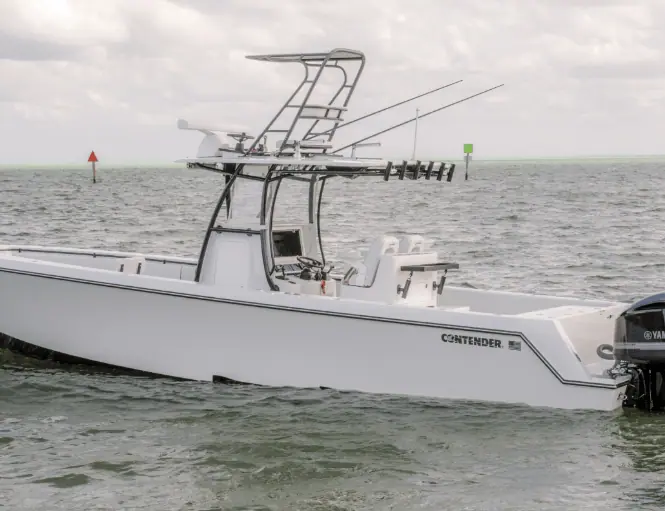
A 34-foot 8-inch twin-step tournament console with 400 gallons, triple-engine punch and a 70 mph top end, built in Homestead, Florida.
- Length
- 34.7 ft10.57 m
- Beam
- 9.8 ft3 m
- Cruise
- 28.4 kn
- Cabins
- 0 (walk-in console with head compartment)
- Used price
- $130K to $600K
On this page
- Overview
- Why the Contender 35ST for sale listings move fast
- The 400-gallon range math, from a real test
- Two steps, 24.5 degrees and a sleek flat sheer
- Deck, livewells and the coffin box trick
- Twins, triples or quads on a 35ST
- What a 35ST costs to buy and run
- Who should buy one
- Specifications
- Price and value
- Strengths and weaknesses
- Used buyer checklist
- Rivals
- Our verdict
- FAQ
The Contender 35ST is a semi-custom twin-step center console, 34 feet 8 inches long with a 9-foot-10-inch beam, 400 gallons of fuel and up to 1,200 hp. Sport Fishing tested 67.6 mph on triple Yamaha F300s and a 576-mile range at 32.7 mph.
- Offshore tournament teams
- Bahamas crossings and canyon runs
- Kite fishing for sailfish
- Anglers moving up from a 30ST or 32ST
Why the Contender 35ST for sale listings move fast
Contender describes the 35ST with uncharacteristic bluntness: fast, efficient, powerful and fishy as hell. That line is marketing, but the used market agrees. A clean Contender 35ST for sale rarely lingers in Florida, because the boat hits the sweet spot between the trailerable 30ST and 32ST and the far more expensive 39ST and 44ST. It carries 400 gallons, takes three outboards and still fits on a triple-axle trailer.
The model appeared in Sport Fishing's coverage in late 2011 and has stayed in the lineup since. Sport Fishing's buyers guides note that Contender, founded by Joe Neber in 1984 and based in Homestead, Florida, builds every boat semi-custom, and its 2022 guide credited the 35ST with top speeds around 70 mph and a range of more than 550 miles from its 400 gallons.
Its spec sheet also connects to Contender's past. The 2016 35ST figures (34 feet 5 inches, 400 gallons, 6,600 pounds dry, 1,050 hp) and its fish box sizes match the earlier deep-V 33 Tournament, whose deck Contender reused for its first stepped boat, the 33 ST. Today's spec sheet lists 34 feet 8 inches, a 9-foot-10-inch beam and a 1,200 hp rating.
Contender 35 ST by the numbers
- Speed to length ratio at cruise
- 5.17A planing cruise. Fast passages in exchange for much higher fuel burn per mile.
- Estimated range at cruise
- 501 nmUsing 90 percent of tank capacity at the cruise speed and fuel burn listed on this page.
- Fuel economy at cruise
- 1.39 nmpgNautical miles per gallon at cruise, both engines combined.
- Horsepower per ton
- 178 hpVery high power to weight, built for speed.
- Length to beam ratio
- 3.53 : 1Moderate proportions.
The 400-gallon range math, from a real test
Sport Fishing tested the 35ST with three Yamaha F300s at a wet weight of about 12,000 pounds. It planed in three seconds and reached 30 mph in six. Top speed was 67.6 mph at 6,000 rpm. The best economy came at 3,000 rpm and 32.7 mph, where the triples returned 1.6 mpg, which the magazine calculated as a 576-mile range with a 10 percent reserve. That is about 20 gallons per hour for all three engines.
The same article compared an earlier test with a pair of F350s. The twins took 2.5 seconds longer to plane, and the extra 200 hp of the triple rig gained only 1.5 mph at the top. The surprise was economy: the triples matched the twins' best mileage. In practice that means a triple-engine 35ST costs little at the fuel dock compared with twins and pays you back with holeshot, the ability to plane on two engines, and resale.
Contender's marketing director told Sport Fishing that the hull's aeration starts working around 25 to 30 mph and estimated a 10 percent gain in mileage from the steps. Boating, which used a rigged 35ST with triple 300s to evaluate a tow vehicle, weighed the boat at 11,560 pounds without its triple-axle aluminum trailer.
Two steps, 24.5 degrees and a sleek flat sheer
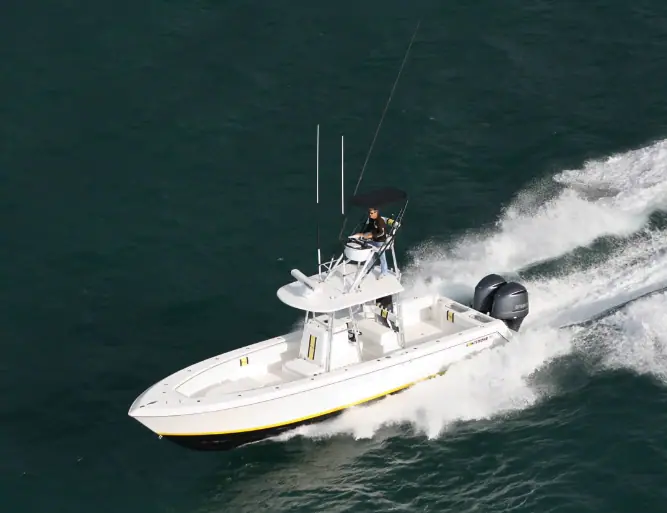
The bottom is Contender's patented dual-stepped deep-V with 24.5 degrees at the transom on the current spec sheet (Sport Fishing's older articles quote 24 degrees). Sport Fishing noted the boat tracks well in hard-over turns, an area where some stepped hulls misbehave, and that it did not feel tender at rest thanks to its beam and reverse chines. The flat sheer line gives the 35ST its low, fast profile.
Below decks Contender uses a foam-cored fiberglass stringer system with hand-laid fiberglass in multidirectional fabrics and foam flotation throughout. Above deck there is a heavy-duty rub rail and stainless steel hardware. Earlier Builder Benchmark survey coverage praised Contender's vinylester resins and barrier coats for long-lasting gelcoat, and strakes reinforced from inside before final layup.
Deck, livewells and the coffin box trick
Contender's current standard list for the 35ST includes a 208-gallon forward fish box, a 110-gallon secondary forward box or dry storage compartment, two 115-gallon aft fish boxes, under-deck rod lockers on both sides, a console front seat with cushions and cooler, a Sport console with Isinglass enclosure and side entry door, a 30-gallon fresh water system and cockpit coaming bolsters. Two 40-gallon transom livewells are fed by a stainless steel pump box with two 1,500 gph pumps.
Sport Fishing's 2024 guide adds an optional 80-gallon in-deck livewell aft of the leaning post, with each well served by its own pump in a sea chest, and a forward lounge that lifts electrically to reveal a large central storage compartment. Its earlier review described a coffin box that tilts hydraulically to port at the flip of a switch to expose a storage locker below, and a front-entry console option that tournament crews like for storing balloons and helium tanks.
Options run long: hard and soft tops, M-Series console and leaning posts, towers and second stations, teak console interior, outriggers, electric reel outlets, gulper pumps for the aft boxes, a 50-gallon additional fuel tank, windlass and anchor chute, and seating packages that make the boat more family friendly.
- Fish boxes: 208 gal and 110 gal forward, 2 x 115 gal aft
- Livewells: 2 x 40 gal transom wells, optional 80 gal in-deck well
- Fuel 400 gal standard, optional 50 gal more; water 30 gal
- Max power 1,200 hp; current Sport Fishing coverage mentions triple or quad engines
Twins, triples or quads on a 35ST
Early 35STs were rated for up to three 350s and 1,050 hp. With the rating now at 1,200 hp, Sport Fishing's 2024 guide mentions triple or quad installations. For most owners triples are the logical choice. They plane faster, keep the boat on plane if one engine fails, and Sport Fishing's test showed no penalty in best-cruise economy versus twins.
Quads make sense mostly for teams chasing top speed or carrying heavy towers and electronics. Twins remain a reasonable budget choice for anglers who fish closer to shore and want lower service costs, but they hurt resale. Check that any repowered boat stays within the rating on its capacity plate, since earlier hulls carry a lower number.
What a 35ST costs to buy and run
Plan on roughly $520,000 to $700,000 for a new 35ST in 2026 depending on power and options, and roughly $130,000 to $600,000 used. Annual costs of $20,000 to $45,000 cover insurance, storage, service on three outboards, bottom paint for wet-slipped boats, electronics updates and fuel for a typical season of 150 to 250 hours. Tournament crews running long distances will spend more on fuel alone.
Because the hull has not fundamentally changed, a well-kept early boat with fresh power can offer most of the experience of a new one. Expect the strongest prices on late-model triples with Helm Master, hardtop or tower and full glass dash; expect discounts on twins, high-hour engines and boats with neglected wiring.
Who should buy one
The 35ST is for anglers who fish offshore often, value speed and range over cabin comfort, and want a boat that can run to the Bahamas or the canyons and back on one tank. Families can make it work with forward seating and a rear bench, but there is no cabin, and the narrow beam rolls more at rest than wide family consoles. Buyers who want a cabin should look at Contender's Fisharound models; buyers who want more deck should step up to the 39ST.
Contender 35 ST specifications
| Length overall | 34.7 ft10.57 m |
|---|---|
| Beam | 9.8 ft3 m |
| Draft | 1.8 ft0.56 m |
| Displacement | 13,5 lbs6,124 kg |
| Fuel capacity | 4 gal1,514 L |
| Fresh water | 3 gal114 L |
| Cabins | 0 (walk-in console with head compartment) |
| Berths | None |
| Heads | 1 (console head, electric head optional) |
| Standard engines | Twin or triple outboards built to order |
| Optional engines | Triple or quad outboards to the 1,200 hp rating (tested with 3 x Yamaha F300 and 2 x Yamaha F350) |
| Maximum power | 1,200 hp |
| Cruise speed | 28.4 knots |
| Top speed | 58.7 knots |
| Range | 500 nm |
| Hull type | Patented twin-step (dual-stepped) deep-V, 24.5-degree transom deadrise, reverse chines |
| Hull construction | Hand-laid fiberglass with multidirectional fabric, foam-cored fiberglass stringer system, foam flotation |
| Builder | Contender Boats, United States |
| Naval architect | Contender Boats in-house design team |
| Status | In production |
Figures come from builder documentation and independent tests where available. Displacement is usually quoted light, so a loaded cruising boat will weigh more. Compare these specs with another model.
Performance data
| Test rig | RPM | Speed (mph) | Economy (mpg) |
|---|---|---|---|
| 3 x Yamaha F300 | 3000 | 32.7 | 1.6 |
| 3 x Yamaha F300 | 6000 | 67.6 | n/a |
Sport Fishing magazine test, wet weight about 12,000 pounds. Range at best economy calculated by Sport Fishing as 576 miles with a 10 percent reserve. Specs table speeds are converted to knots.
How much does a Contender 35 ST cost?
Engine count matters more on the 35ST than on smaller Contenders: triple-engine boats sell faster and for more than twins, and late boats on triple 350s or larger with Helm Master EX sit at the very top. Towers, second stations and Seakeeper-ready rigging add tens of thousands. Early boats from the first years of production with original F300s and high hours anchor the bottom of the range. Figures are our 2026 estimates for typical sail-away and brokerage prices.
Estimate your yearly cost
A planning estimate using common rules of thumb: insurance near 1.5 percent of value, maintenance near 3 percent, haul out and bottom paint by length. Your marina, region and use will move these numbers. Open the full cost calculator.
Versions and options
- Twin-engine 35ST
- Lower purchase and service cost; slower holeshot and weaker resale.
- Triple-engine 35ST
- The most common and most sought-after configuration, with equal best-cruise economy in Sport Fishing's testing.
- Tower or stand-on console boats
- Second station options for spotting fish and birds, popular with tournament teams.
Contender 35 ST timeline
- 2009Contender's first stepped hull, the 33 ST, reuses the deck of the deep-V 33 Tournament
- 2011Sport Fishing publishes its first 35 ST gallery
- 2016Sport Fishing lists 34 ft 5 in, 400 gallons and a 1,050 hp rating
- 2022Sport Fishing credits the 35 ST with top speeds of 70 mph and more than 550 miles of range
- 2026Current spec sheet shows 34 ft 8 in, 9 ft 10 in beam and a 1,200 hp rating
Strengths and weaknesses
What owners like
- 400 gallons and a tested 576-mile range
- Triple-engine holeshot with no economy penalty in testing
- Proven twin-step ride and tight turning
- Big fish boxes and customizable livewell systems
- Strong resale and national dealer support
What to weigh up
- No cabin and limited comfort unless optioned
- Narrow beam rolls at rest
- Needs a heavy truck and triple-axle trailer
- New prices have climbed sharply
Used Contender 35 ST buyer checklist
Take this list to a viewing. Your ticks are saved in this browser so you can come back to it.
Always commission an independent marine survey and an engine survey before you buy. How a marine survey works.
Rivals to consider
Yellowfin 36
Florida stepped-hull rival with a reputation for speed and custom builds.
Compare side by sideRegulator 35
Beamier and more family-oriented, with a conventional deep-V and Carolina build quality.
Compare side by sideContender 39 ST
The next size up in the same family, with more fuel and deck at a much higher price.
Compare side by sideOur verdict on the Contender 35 ST
The Contender 35ST is the boat many serious offshore anglers end up with after trying smaller consoles: 400 gallons, triple-engine power and a stepped bottom that Sport Fishing found matched twin-engine economy at 1.6 mpg while topping 67 mph. It is narrow, spartan unless optioned and expensive new, but it fishes like a tournament boat because it is one, and the hull's long, stable production run makes good used examples a smart buy. If you want range and speed more than a cabin, it belongs on your list.
Contender 35 ST questions answered
How fast is a Contender 35ST?
Sport Fishing reached 67.6 mph with triple Yamaha F300s, and its 2022 buyers guide cites top speeds around 70 mph with larger power.
What is the range of a Contender 35 ST?
Sport Fishing calculated 576 miles with a 10 percent reserve at 32.7 mph and 1.6 mpg on triple F300s, from the 400-gallon tank.
How much does a Contender 35ST weigh?
Contender lists 13,500 pounds ready to fish; Boating weighed a rigged triple-300 boat at 11,560 pounds without its trailer.
Is a 35 Contender better with twins or triples?
Triples plane faster and resell better, and Sport Fishing found their best-cruise economy equal to twin F350s.
What is the max horsepower on a Contender 35ST?
The current rating is 1,200 hp; 2016-era boats were rated at 1,050 hp.
How much is a used Contender 35 for sale?
In 2026 expect about $130,000 for an early boat to about $600,000 for a nearly new triple-engine boat.
Contender 35 ST photos
More center consoles & offshore boats to explore
Yellowfin 34 Offshore
Center Consoles & Offshore Boats, 35 ft
Used $85K to $620K
Pursuit OS 325 Offshore
Center Consoles & Offshore Boats, 35 ft
Used $200K to $600K
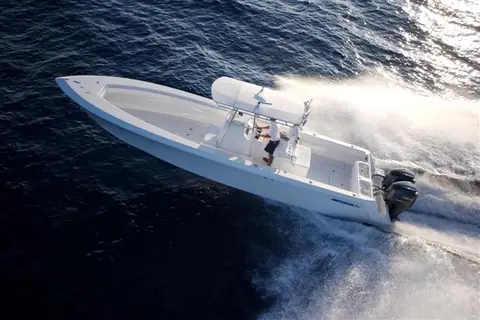
Contender 33 Tournament
Center Consoles & Offshore Boats, 34 ft
Used $70K to $165K
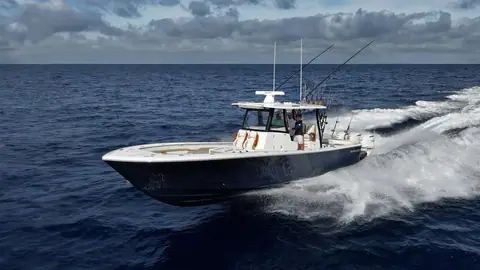
Regulator 35
Center Consoles & Offshore Boats, 35 ft
Used $640K to $800K