SeaVee Boats Center Consoles & Offshore Boats
SeaVee 290B Review and Buying Guide for Used Sea Vee Boats for Sale
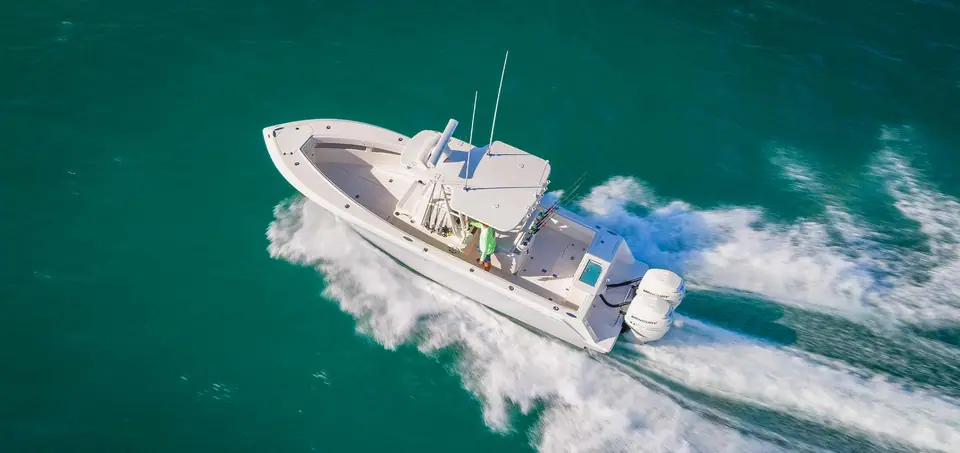
A 29-foot 6-inch, 25-degree deep-V from Miami that tows behind a pickup yet runs inlets like a much bigger boat.
- Length
- 29.5 ft8.99 m
- Beam
- 9 ft2.74 m
- Cruise
- 30.6 kn
- Cabins
- None (step-down console compartment with 6 ft 4 in headroom)
- Used price
- $135K to $265K
On this page
- Overview
- The SeaVee 290B and the 9-foot beam problem
- What changed when SeaVee rebuilt the 290 in 2018
- Three sea trials, three power packages
- How a 25-degree bottom earns its keep
- Fish boxes, wells and 21 rods
- Inside the console and at the wheel
- Towing, storing and paying for a 290B
- Shopping used SeaVee boats for sale, 290B edition
- Specifications
- Price and value
- Strengths and weaknesses
- Used buyer checklist
- Rivals
- Our verdict
- FAQ
The SeaVee 290B is a semi-custom 29-foot 6-inch twin-outboard center console, re-engineered in 2018 with a resin-infused hull, 25 degrees of transom deadrise and a 9-foot trailerable beam. Boating measured 63 mph on twin Verado 350s.
- Tournament anglers who trailer to events
- Inlet runners on the Atlantic coast
- Live-bait kingfish and sailfish crews
- Yacht owners wanting a capable tender
The SeaVee 290B and the 9-foot beam problem
Most serious offshore center consoles stopped being practical trailer boats somewhere around 28 feet, when builders pushed beams to 9 feet 6 inches and beyond to buy cockpit space and stability. The SeaVee 290B goes the other way. It keeps a 9-foot beam, only six inches over the usual 8-foot 6-inch trailer width, so the oversize permits and travel limits that apply in many states are about as light as they get for an offshore boat, and it still carries 25 degrees of transom deadrise, the kind of bottom you normally find on boats a size larger. That combination is the whole reason the boat exists, and it is why the 290B keeps showing up in searches for used SeaVee boats for sale from anglers who need to chase a tournament or a bite up and down the coast.
SeaVee itself is a Miami builder founded in 1974 by Capt. Don McGee, who sold factory direct so he could tailor each boat to its owner. Every hull is still built to order, so there is no fixed standard equipment list; there is a hull, a deck, and a long options sheet.
The 29-foot SeaVee is not new as a concept. Archived SeaVee web pages from the early 2000s list a 290 in bracket ('B') and inboard ('i') versions, in open and cuddy forms. The boat this page covers is the re-engineered 290B launched in 2018, which is the version you will meet on dealer docks and in brokerage today.
SeaVee 290B by the numbers
- Speed to length ratio at cruise
- 6.04A planing cruise. Fast passages in exchange for much higher fuel burn per mile.
- Estimated range at cruise
- 374 nmUsing 90 percent of tank capacity at the cruise speed and fuel burn listed on this page.
- Fuel economy at cruise
- 1.65 nmpgNautical miles per gallon at cruise, both engines combined.
- Horsepower per ton
- 237 hpVery high power to weight, built for speed.
- Length to beam ratio
- 3.28 : 1Moderate proportions.
What changed when SeaVee rebuilt the 290 in 2018
The headline change was construction. SeaVee moved the 290 to vacuum-assisted resin-transfer molding, which infuses the cored hull, stringers and bulkheads in one shot so they share a primary bond. Boating reported that the new boat came out about 600 pounds lighter than the previous 290 and stiffer, which let SeaVee drop from four stringers to two. The space that freed up went into larger epoxy-coated aluminum fuel tanks, and published capacity rose to 251 gallons, 19 more than the original.
The deck was redesigned too, with molded inwale trays for coiled washdown hoses, deep gutters around every hatch, and two configurations: the Open Fisherman, which keeps the bow clear, and the Luxury Edition, which adds molded forward seats with electric backrests. SeaVee backs the hull with a 10-year warranty.
One note on numbers. SeaVee's current spec sheet lists 230 gallons of fuel, 32 gallons of water and a dry weight of 6,400 pounds without engines, while the 2018 launch tests quoted 251 gallons and 5,900 pounds. Because each boat is built to order, ask for the capacity plate and the build sheet on any specific hull rather than trusting a brochure figure.
Three sea trials, three power packages
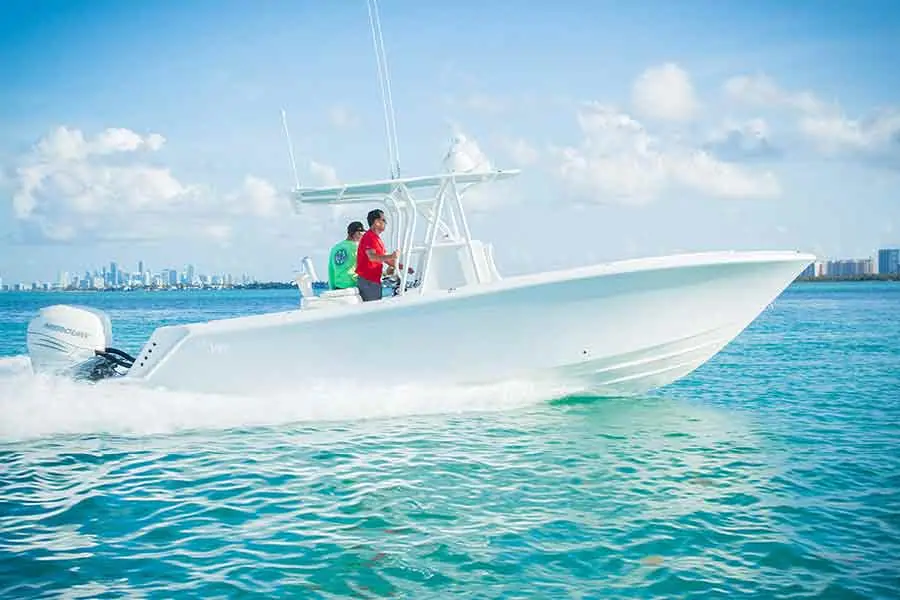
The 290B has been tested more than most 29-footers, and the numbers line up well. Boating ran it with twin Mercury Verado 350s turning Revolution 4 props of 21-inch pitch, with 140 gallons of fuel and 700 pounds of crew. It planed in 4 seconds, hit 30 mph in 6 seconds and topped out at 63 mph at 6,200 rpm. The most efficient cruise came at 4,000 rpm and 35.2 mph, burning 18.5 gph for 1.9 mpg, which Boating called remarkably efficient for a boat with 700 hp on the transom.
Salt Water Sportsman tested a 290B with twin Mercury 300 Verados out of Stuart, Florida, in an 18-knot northeaster and a 3- to 4-foot chop, then took it out through the inlet where 6-foot waves were stacking up. It reached 61.4 mph and averaged 8.25 seconds to 30 mph, and the tester reported no pounding, rattling or creaking. The magazine also estimated more than 460 miles of range at 35 mph on a full tank.
Power and Motoryacht ran a twin 350 boat in confused 4-foot slop on Biscayne Bay during the Miami show and saw better than 52 knots with five people aboard, none of whom got wet. SeaVee claims the hull planes at about 13 knots.
- Twin Verado 350: 63 mph top at 6,200 rpm; best cruise 35.2 mph at 18.5 gph (Boating)
- Twin Verado 300: 61.4 mph top; 0 to 30 mph in 8.25 seconds (Salt Water Sportsman)
- Base package: twin 250s; SeaVee says 48 to 52 mph depending on layout and engine choice
- Builder maximum on the current sheet: 700 hp, twin engines only
How a 25-degree bottom earns its keep
Deadrise numbers are easy to quote and hard to feel until wind opposes tide in an inlet. The 290B's deep-V and sharp entry let a 9-foot-wide boat run like a heavier one, and every test above was done in real chop. Bow flare throws spray down and away, and testers consistently describe the ride as dry.
The tradeoff with a narrow, deep hull is that it rolls more at rest than a beamy 28-footer with 20 degrees of deadrise. SeaVee answers with a keel pad and chines that keep drift stable, and Sport Fishing's buyers guide credits the hull with smooth drifts and strong hole shots. If you plan to bottom fish on anchor all day, sit on one at the dock in a beam swell before you buy, and compare it with a Regulator 28 or a Boston Whaler 280 Outrage, both of which are wider.
Fish boxes, wells and 21 rods
Up front, a windlass locker leads to twin forward wing compartments that double as lockable rod storage, with a big insulated fish box between them (published sizes range from about 100 to 128 gallons depending on the year). The cockpit sole adds dry storage, bilge access and an in-deck 60-gallon well that works as a livewell or a second fish box.
Bait capacity is a strength. A pressurized 50-gallon livewell sits in the center of the transom, fed by a pump box, and a smaller starboard transom well suits shrimp, crabs or a separate species. Combine all three and the 290B carries more live bait than most boats of its size.
Rods go in vertical racks on both console sides, in the gunwale lockers, in the leaning post and in the hardtop rocket launcher, up to 21 in total. The Captain's Edition leaning post adds a tackle station with eight tackle boxes, a fold-down rigging tray, five rod holders and a slide-out cooler that can be ordered with a pneumatic actuator. A heavy-duty port transom door handles big tuna and swordfish.
Inside the console and at the wheel
The dash takes two 12-inch displays side by side with room for a VHF, stereo and a switch panel, and Boating's test boat fit a pair of Garmin 7616 units. A splash cover protects the electronics. Behind the front door is a step-down compartment with 6 feet 4 inches of headroom, battery switches, a breaker panel and access to the back of the helm, and it can be fitted with a marine head.
Boating flagged one annoyance: when the forward console door is raised, it can block the view ahead from the helm. It also recommended the optional clear polycarbonate wraparound windshield for regular offshore running. Bridge clearance to a bare hardtop is about 8 feet.
Towing, storing and paying for a 290B
Plan on a tandem or triple-axle aluminum trailer and a three-quarter-ton truck. With roughly 6,000 pounds of hull, two big outboards, fuel and gear, a fully rigged 290B on its trailer will weigh around five tons, so a half-ton pickup is not the right tool for long hauls.
Fuel is the dominant running cost. At Boating's best cruise of 18.5 gph, a 60-mile offshore round trip burns roughly 35 to 45 gallons. Add twin-outboard service, insurance and storage, and most owners spend about $14,000 to $30,000 a year before depreciation.
Shopping used SeaVee boats for sale, 290B edition
Used 290Bs are not common, because owners tend to keep them or trade up within the brand. SeaVee runs a Certified Pre-Owned program for boats that go through the factory, and those listings typically carry remaining engine warranty and a factory inspection, which is worth a premium over a private sale.
Because no two hulls are equipped alike, compare boats on power, top and electronics rather than year alone. A 2019 with twin 350s and a hardtop can be worth more than a 2022 with twin 250s and a T-top. Engine hours matter more than hull age here.
SeaVee 290B specifications
| Length overall | 29.5 ft8.99 m |
|---|---|
| Beam | 9 ft2.74 m |
| Draft | 1.7 ft0.51 m |
| Air draft | 8 ft2.44 m |
| Displacement | 5,9 lbs2,676 kg |
| Fuel capacity | 251 gal95 L |
| Fresh water | 34 gal129 L |
| Cabins | None (step-down console compartment with 6 ft 4 in headroom) |
| Berths | None |
| Heads | Optional marine head in console |
| Standard engines | Twin 250 hp outboards (Mercury Verado on the 2018 base package) |
| Optional engines | Twin 300 or twin 350 hp outboards, Mercury or Yamaha; 2018 to 2020 literature quoted twins up to 400 hp |
| Maximum power | 700 hp |
| Cruise speed | 30.6 knots |
| Top speed | 54.7 knots |
| Hull type | Deep-V planing hull, 25-degree transom deadrise, sharp entry, keel pad, integrated engine bracket |
| Hull construction | Cored fiberglass, vacuum-assisted resin-transfer molded (VARTM) hull, stringers and bulkheads |
| Builder | SeaVee Boats, United States |
| Naval architect | SeaVee in-house engineering |
| Production | 2018 to present |
| Status | In production |
Figures come from builder documentation and independent tests where available. Displacement is usually quoted light, so a loaded cruising boat will weigh more. Compare these specs with another model.
Performance data
| Condition | Speed (mph) | Fuel (gph) | Economy (mpg) |
|---|---|---|---|
| Best cruise, 4,000 rpm | 35.2 | 18.5 | 1.9 |
| Wide open, 6,200 rpm | 63 |
Boating certified test, twin Mercury Verado 350, Revolution 4 14.625 x 21 props, 1.75:1 gears, 140 gal fuel, 700 lb crew. Boating published only these two points in text.
How much does a SeaVee 290B cost?
In 2018 SeaVee quoted a base price of $148,700 with twin Mercury 250 Verados, and Boating's twin 350 test boat came to $210,079. Since every 290B is built to order, two boats of the same year can differ by $50,000 or more depending on power, hardtop or tower, electronics and the Luxury Edition seating package. Twin 300s or 350s, a hardtop and a recent repower or warranty transfer carry the strongest resale premium.
Estimate your yearly cost
A planning estimate using common rules of thumb: insurance near 1.5 percent of value, maintenance near 3 percent, haul out and bottom paint by length. Your marina, region and use will move these numbers. Open the full cost calculator.
Versions and options
- 290B Open Fisherman
- Clear bow with forward fish box and lockable wing boxes, fold-down aft bench using the transom coaming as a backrest.
- 290B Luxury Edition
- Adds molded forward seats with electric backrests and storage, a removable table and a wider deluxe aft bench.
- Power packages
- Twin 250, 300 or 350 hp from Mercury or Yamaha; launch literature also mentioned twin 400s.
SeaVee 290B timeline
- 1974Capt. Don McGee founds SeaVee in Miami and sells factory direct
- 2001Archived SeaVee pages list a 29-foot 290 in bracket and inboard versions
- 2018Re-engineered 290B debuts with VARTM construction, two stringers and 251 gallons of fuel
- 2018Boating records 63 mph on twin Verado 350s; base price $148,700 with twin 250s
- 2020Sport Fishing lists the 290B in Open Fisherman and Luxury Edition versions
Strengths and weaknesses
What owners like
- Trailerable 9-foot beam with a true 25-degree deep-V
- Fast and efficient, 1.9 mpg at 35 mph on twin 350s
- Three possible livewells including a 50-gallon transom well
- Storage for up to 21 rods
- Built to order with a 10-year hull warranty
- Resin-infused hull with clean, labeled rigging
What to weigh up
- Narrow beam means more roll at rest than wider 28-footers
- Forward console door blocks the view when open
- Little standard equipment, so options inflate the price
- Few used examples, and published specs vary by year
Used SeaVee 290B buyer checklist
Take this list to a viewing. Your ticks are saved in this browser so you can come back to it.
Always commission an independent marine survey and an engine survey before you buy. How a marine survey works.
Rivals to consider
Regulator 28
Wider and heavier with a bolt-on bracket; in 2018 it listed at $206,995 with twin F300s.
Compare side by sideContender 28 Tournament
Lighter, tournament-proven Homestead boat with a similar no-frills fishing focus.
Compare side by sideBoston Whaler 280 Outrage
More family comfort and unsinkable foam construction, but less live-bait capacity.
Compare side by sideSeaVee 270Z
SeaVee's stepped bay boat for anglers who fish skinny water more than offshore.
Compare side by sideOur verdict on the SeaVee 290B
The SeaVee 290B is the rare center console that refuses to choose between trailering and bluewater. Its 9-foot beam keeps it towable, its 25-degree bottom keeps it civilized in an inlet, and the 2018 infused hull delivers big-boat speed with economy close to 2 mpg at 35 mph. It is not the most stable platform at rest and it is not cheap once you option it properly, but for an angler who wants one boat that can fish the canyon on Saturday and a tournament three states away the next weekend, there are very few better answers under 30 feet.
SeaVee 290B questions answered
How fast is the SeaVee 290B?
Boating measured 63 mph at 6,200 rpm with twin Mercury Verado 350s, and Salt Water Sportsman saw 61.4 mph with twin 300s. With the base twin 250s SeaVee quotes 48 to 52 mph.
Can you trailer a SeaVee 290B?
Yes, and Boating called it relatively easy to trailer. Its 9-foot beam is six inches over the standard 8-foot 6-inch limit, so check your state's oversize rules, and plan on a heavy-duty truck because boat and trailer weigh around five tons.
What does a SeaVee 290B cost?
The 2018 base price was $148,700 with twin 250 Verados, and Boating's twin 350 test boat was $210,079. A well-optioned new boat in 2026 typically lands between about $235,000 and $330,000.
How much fuel does the SeaVee 290B hold?
Launch tests quoted 251 gallons, 19 more than the earlier 290, while SeaVee's current sheet lists 230 gallons. Check the capacity plate on any specific boat.
What does the B in SeaVee 290B mean?
SeaVee historically used B for its bracket-mounted outboard versions and i for inboards. Today the B Series marks SeaVee's conventional deep-V models, while the Z Series uses its stepped hull.
Where can I find used SeaVee boats for sale?
SeaVee's own Certified Pre-Owned program lists factory-inspected boats, and brokerage sites carry private listings. Factory CPO boats usually command a premium for warranty and inspection.
SeaVee 290B photos
More center consoles & offshore boats to explore
Contender 30 ST
Center Consoles & Offshore Boats, 30 ft
Used $90K to $380K
Egret 290 Offshore
Center Consoles & Offshore Boats, 29 ft
Used $60K to $260K
Wellcraft 290 Coastal
Center Consoles & Offshore Boats, 30 ft
Used $40K to $150K
Freeman 28
Center Consoles & Offshore Boats, 29 ft
Used $230K to $330K