Yellowfin Yachts Center Consoles & Offshore Boats
Yellowfin 42 Offshore Review, Specs and Used Price Guide
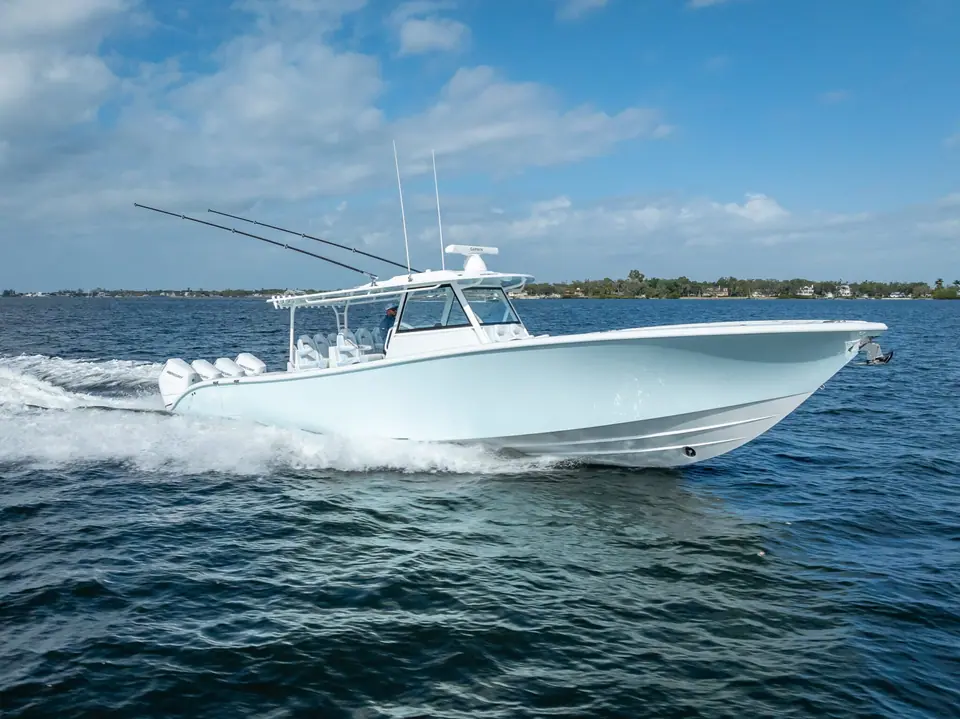
A stepped, Carolina-flared 42-foot center console with a real cabin below and triple or quad outboards up to 1,700 hp.
- Length
- 42 ft12.8 m
- Beam
- 12 ft3.66 m
- Cruise
- 35 kn
- Cabins
- 1 (sub-deck cabin)
- Used price
- $230K to $1.2M
On this page
- Overview
- The Yellowfin 42 that made Yellowfin a big-boat builder
- Variable 22-degree deadrise with Carolina flare
- Triple or quad, the 42's power debate
- Below the console, a real overnight cabin
- Gunwale gutters, an acrylic livewell and a tournament cockpit
- Construction details that hold up offshore
- How the 42 behaves when the forecast is wrong
- Used Yellowfin 42 buying advice and ownership costs
- Specifications
- Price and value
- Strengths and weaknesses
- Used buyer checklist
- Rivals
- Our verdict
- FAQ
The Yellowfin 42 Offshore is a stepped center console with a 12-foot beam, 576 gallons of fuel and up to 1,700 hp across triple or quad outboards. Built since the mid 2000s, it pairs tournament speed with a sub-deck cabin.
- Tournament teams fishing multi-day events
- Families who fish and dive
- Bahamas trips
- Owners moving up from a 36 Yellowfin
The Yellowfin 42 that made Yellowfin a big-boat builder
The Yellowfin 42 was the first time Wylie Nagler's Florida company stepped beyond fast tournament boats in the mid 30 foot range and into a center console that a family could stay aboard overnight. Sport Fishing tested an early boat in 2007 with four 300 hp Mercury Verados, listing it at $325,000 and describing it as handling like a slot car despite its size. Nearly two decades later the 42 is still in the range, now with heavier, more elaborate builds and a price that has tripled.
What makes the 42 interesting is the mix. It keeps the stepped hull and narrow-entry, flared Carolina bow that made the smaller Yellowfins famous on the tournament circuit, but it adds a real cabin below the console with a berth, a head and a shower. Yellowfin describes it as delivering true multi-day capability without giving up an ounce of fishing prowess, and that is a fair summary.
In 2026 Yellowfin introduced a new 48 Offshore to fill the gap between the 42 and the 54. The company said explicitly that the 48 bridges those models rather than replacing the 42, so the 42 continues as the brand's mid-size cabin boat.
Yellowfin 42 Offshore by the numbers
- Speed to length ratio at cruise
- 5.79A planing cruise. Fast passages in exchange for much higher fuel burn per mile.
- Estimated range at cruise
- 454 nmUsing 90 percent of tank capacity at the cruise speed and fuel burn listed on this page.
- Fuel economy at cruise
- 0.88 nmpgNautical miles per gallon at cruise, both engines combined.
- Horsepower per ton
- 190 hpVery high power to weight, built for speed.
- Length to beam ratio
- 3.50 : 1Moderate proportions.
Variable 22-degree deadrise with Carolina flare
The 42's hull uses a variable deadrise of about 22 degrees at the transom and a stepped running surface. The steps let the boat climb onto plane quickly, a trait Sport Fishing highlighted, and they reduce drag at cruise, helping the 42 deliver close to one mile per gallon at 40 mph. Above the waterline, the high, spray-deflecting bow and pronounced flare come from the Carolina sportfishing tradition and keep the deck dry in head seas.
Yellowfin's build schedule stands out. Testers have documented 100 percent vinylester resin, Baltek core in the running surfaces, Core-Cell coring elsewhere, a box stringer grid and through-bolting every six inches at the hull-to-deck joint. Those details matter in a boat that is run hard offshore and expected to last.
At 12 feet, the beam is moderate for a 42-foot center console. It keeps the ride sharp and efficient but means the 42 rolls more on the drift than the widest modern rivals, which is why many owners add a gyro.
Triple or quad, the 42's power debate
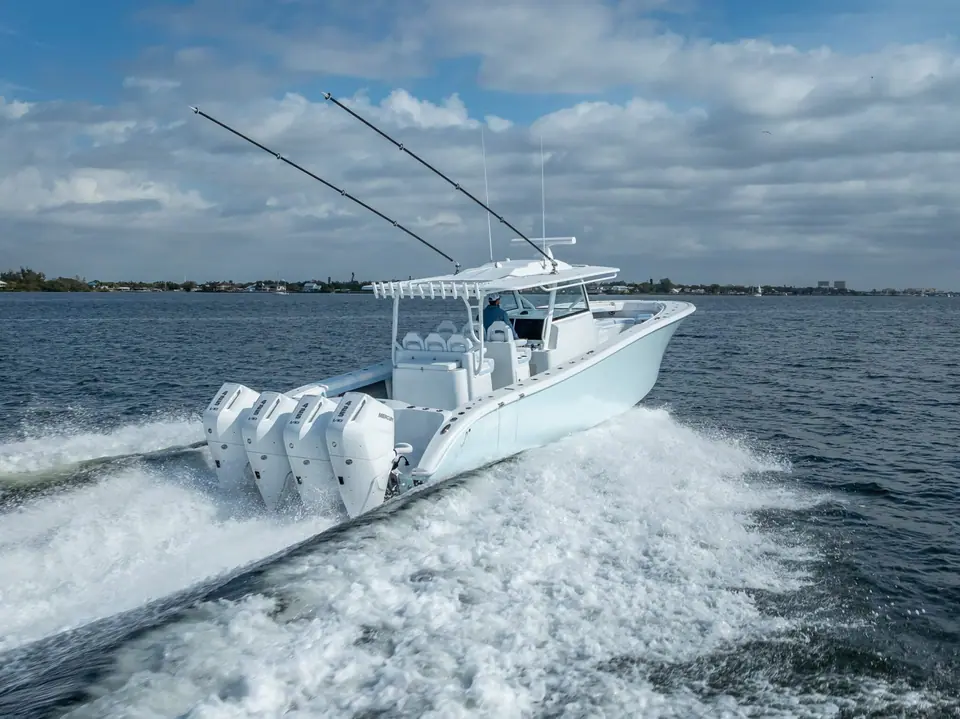
The 42 has been offered with three or four outboards. The 2007 test boat with quad Verado 300s hit 67 mph at 6,050 rpm, burning 113 gallons per hour, and cruised at 40 mph at 3,800 rpm on 40.8 gallons per hour. The 2013 test boat with triple Yamaha F350s ran 63.6 mph at the top and cruised at 40 mph at 4,200 rpm on 40 gallons per hour, about 1 mpg.
That comparison explains the debate. Quads give more top speed and stronger hole shot with a full load, plus extra redundancy far offshore. Triples deliver almost identical cruise economy with less weight on the transom and one fewer engine to service. Sport Fishing's 2018 buyer's guide reported a thrifty 500 mile range at 4,200 rpm with triple 350s.
Yellowfin now rates the 42 at up to 1,700 hp, and current boats come standard with Seakeeper Ride 750, which actively controls trim and roll underway.
- Quad Verado 300 (2007): 67 mph top, 40 mph cruise at 40.8 gph
- Triple Yamaha F350 (2013): 63.6 mph top, 40 mph cruise at 40 gph
- Maximum rated power today: 1,700 hp
Below the console, a real overnight cabin
The cabin is the 42's selling point. Under the console there are berths for two and an enclosed head with a shower, enough for a couple to sleep aboard during a tournament or a Bahamas trip. Options include air conditioning and a generator, and these are worth having in Florida heat. Used buyers should check both carefully, because a generator and air conditioning add complexity and service costs.
Above deck, current boats offer dual-row helm seating, forward seating and a choice of hardtop or tower. The space around the console makes the 42 a better family boat than a pure tournament machine, and many owners use it for diving and island hopping as much as for fishing.
Gunwale gutters, an acrylic livewell and a tournament cockpit
The 2013 test boat carried a 70-gallon livewell with an acrylic lid and a 530-quart macerated fish box, plus transom bait tubes fed by an 1,100 gallon per hour pump from a sea chest, with a second pump turning the livewell over 13 times an hour. Yellowfin cut gutters into the deck from bow to stern to give anglers secure footing when gaffing. Current builds feature a plumbed transom livewell plus a second plumbed well in the leaning post, insulated fish boxes with gulper pumps, 14 rod holders and a hardtop with seven more.
The 42's tournament reputation comes from the same DNA as the 36. It is fast enough to compete in sailfish, kingfish and offshore tournaments, and the cabin makes multi-day events more comfortable. Teams fishing in the Bahamas or the Gulf often choose it for exactly that reason.
Construction details that hold up offshore
Testers have consistently praised Yellowfin's fit and finish, including mirrorlike gelcoat and a large share of in-house manufacturing. Titanium cleats and through-hulls, C-Zone digital switching and electric steering are standard on current boats.
Since Warbird Marine Holdings bought Yellowfin in 2021, the company has invested in facilities and product development. Wylie Nagler remained as president, and the build philosophy has stayed consistent. Used buyers should still check older boats for the usual wear on hardware, wiring and pumps.
How the 42 behaves when the forecast is wrong
Every offshore boat eventually gets caught out, and the 42 handles it well. Running into a head sea, the fine entry and variable deadrise let you hold 30 mph or more where flatter-bottomed boats have to slow down, and the flare keeps spray off the helm. Down-sea, the stepped hull wants steady throttle and a little bow-up trim; drivers who chop the throttle at the top of a wave will feel the boat stuff its bow. Seakeeper Ride on current boats takes much of the work out of this.
At anchor or on the drift, the 12-foot beam means the 42 rolls more than the widest modern rivals. A gyro solves most of that and is the most popular upgrade on used boats. If the boat you are considering does not have one, factor $40,000 to $60,000 for a retrofit if roll bothers your crew.
Used Yellowfin 42 buying advice and ownership costs
Used 42 Yellowfins range from about $230,000 for early quad Verado boats to $1.2 million for nearly new examples. Early boats are good value if the engines have been replaced, but buyers should budget for a repower if the original engines are still installed. Later boats with triple or quad four-strokes, gyros and updated electronics hold their value well.
Annual costs including engine service, insurance, slip or lift fees, electronics and cabin systems run around $40,000 to $85,000 a year excluding depreciation. Fuel burn of about 40 gallons per hour at a 40 mph cruise is efficient for the size, and 576 gallons of fuel gives plenty of range.
Yellowfin 42 Offshore specifications
| Length overall | 42 ft12.8 m |
|---|---|
| Beam | 12 ft3.66 m |
| Draft | 1.8 ft0.56 m |
| Displacement | 17,865 lbs8,103 kg |
| Fuel capacity | 576 gal2,18 L |
| Cabins | 1 (sub-deck cabin) |
| Berths | 2 |
| Heads | 1 with shower |
| Standard engines | Triple or quad outboards up to 1,700 hp total |
| Optional engines | Tested with quad Mercury Verado 300 and triple Yamaha F350; current boats typically triple or quad Mercury four-strokes |
| Maximum power | 1,700 hp |
| Cruise speed | 35 knots |
| Top speed | 55 knots |
| Range | 434 nm |
| Hull type | Stepped deep-V monohull, variable 22 degree deadrise |
| Hull construction | Vinylester resin laminates, Baltek core in the running surfaces and Core-Cell elsewhere, box stringer system |
| Builder | Yellowfin Yachts, United States |
| Naval architect | Yellowfin Yachts in-house design team |
| Other design credits | Wylie Nagler (founder) |
| Status | In production |
Figures come from builder documentation and independent tests where available. Displacement is usually quoted light, so a loaded cruising boat will weigh more. Compare these specs with another model.
Performance data
| Test rig | RPM | Speed (mph) | Fuel (gph) |
|---|---|---|---|
| 4 x Mercury Verado 300 (2007) | 3800 | 40 | 40.8 |
| 4 x Mercury Verado 300 (2007) | 6050 | 67 | 113 |
| 3 x Yamaha F350 (2013) | 4200 | 40 | 40 |
| 3 x Yamaha F350 (2013) | WOT | 63.6 | n/a |
Sport Fishing magazine tests in 2007 and 2013. The 2013 top speed was measured on slack tide; fuel burn at wide open throttle was not published for that test.
How much does a Yellowfin 42 Offshore cost?
The first 42s listed around $325,000 with quad Verado 300s in 2007, and a triple Yamaha F350 boat tested at $509,140 in 2013. Today's boats with Seakeeper Ride, C-Zone, generator and air conditioning sit above $1.1 million. On the used market, the biggest swings come from engine generation, whether the cabin has air conditioning and a generator, and whether a gyro has been fitted.
Estimate your yearly cost
A planning estimate using common rules of thumb: insurance near 1.5 percent of value, maintenance near 3 percent, haul out and bottom paint by length. Your marina, region and use will move these numbers. Open the full cost calculator.
Versions and options
- Triple outboard
- The more common configuration, with near identical cruise economy to quads and less weight on the transom.
- Quad outboard
- Higher top speed and stronger performance with full fuel, plus extra redundancy offshore.
Yellowfin 42 Offshore timeline
- 1998Wylie Nagler founds Yellowfin Yachts in Florida
- 2007Yellowfin 42 tested at 67 mph with quad Verado 300s
- 2013Triple Yamaha F350 boat tested at 63.6 mph and 1 mpg at cruise
- 2021Warbird Marine Holdings acquires Yellowfin
- 2026New 48 Offshore introduced between the 42 and 54, with the 42 staying in production
Strengths and weaknesses
What owners like
- Stepped hull delivers about 1 mpg at 40 mph
- Dry ride thanks to Carolina flare
- Real cabin with berths and a head with shower
- High build quality and robust construction
- Tournament proven
- Triple or quad power options
What to weigh up
- Rolls on the drift without a gyro
- Cabin systems add maintenance
- Expensive new pricing
- Stepped hull requires an attentive driver
Used Yellowfin 42 Offshore buyer checklist
Take this list to a viewing. Your ticks are saved in this browser so you can come back to it.
Always commission an independent marine survey and an engine survey before you buy. How a marine survey works.
Rivals to consider
Contender 39 ST
Lighter and faster, with a narrower beam and a focus on pure tournament fishing.
Compare side by sideMidnight Express 43 Open
Faster and more luxurious, aimed at a different buyer.
Compare side by sideOur verdict on the Yellowfin 42 Offshore
The Yellowfin 42 Offshore is for anglers who want tournament speed and a cabin in one boat. It runs fast and efficiently, stays dry, and offers enough space to overnight in comfort. It is not the widest or most stable boat at rest, and new pricing has climbed sharply, but as a fishing machine that can also handle multi-day trips the 42 remains one of the best-balanced boats in its size.
Yellowfin 42 Offshore questions answered
How much is a Yellowfin 42?
New Yellowfin 42 Offshore boats cost around $1.15 million to $1.45 million. Used boats range from about $230,000 to $1.2 million depending on year and engines.
How fast is the Yellowfin 42?
Sport Fishing recorded 67 mph with quad Verado 300s and 63.6 mph with triple Yamaha F350s, with a 40 mph cruise in both cases.
Does the Yellowfin 42 have a cabin?
Yes. It has a sub-deck cabin with berths for two and an enclosed head with shower.
How much fuel does the Yellowfin 42 hold?
Current boats carry 576 gallons; earlier boats were listed between 571 and 600 gallons depending on the year and the source.
Is the Yellowfin 42 still in production?
Yes. Yellowfin introduced a new 48 in 2026 but stated it bridges the gap between the 42 and 54 rather than replacing the 42.
Yellowfin 42 Offshore photos
More center consoles & offshore boats to explore
Freeman 42LR
Center Consoles & Offshore Boats, 42 ft
Used $425K to $1.2M
Boston Whaler 420 Outrage
Center Consoles & Offshore Boats, 43 ft
Used $450K to $1.25M
Regulator 41
Center Consoles & Offshore Boats, 41 ft
Used $420K to $1.35M
Midnight Express 43 Open
Center Consoles & Offshore Boats, 43 ft
Used $380K to $1.5M