Contender Boats Center Consoles & Offshore Boats
Contender 24S Sport Review, Performance and Buyer's Notes
Contender's family-friendly 24-foot 6-inch console with a 22.5-degree hull, bow and stern seating, a 26-gallon livewell and a test record of 2.68 mpg.
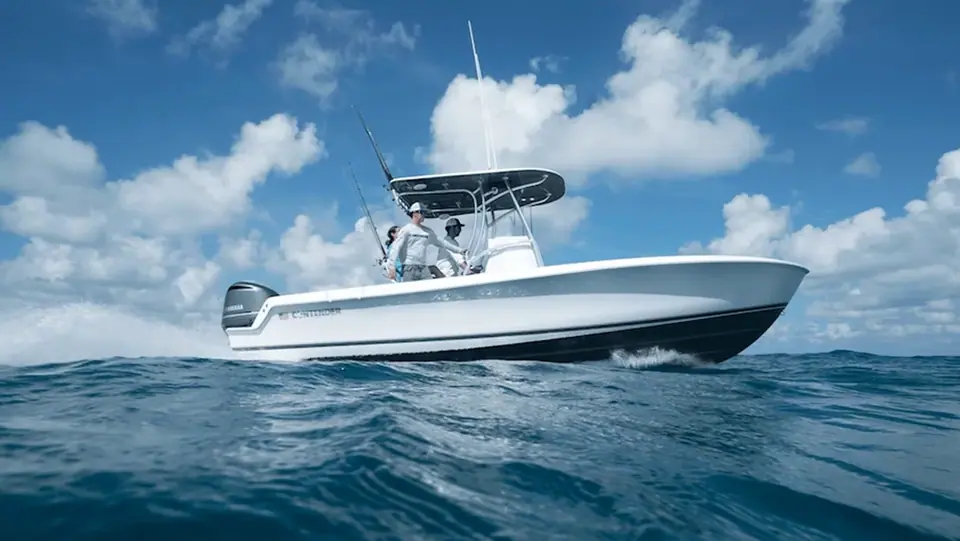
- Length
- 24.5 ft7.47 m
- Beam
- 8.5 ft2.59 m
- Cruise
- 25.6 kn
- Cabins
- 0
- Used price
- $55K to $145K
On this page
- Overview
- The Contender 24S in one paragraph
- Why the 24S uses 22.5 degrees instead of 24.5
- Seating that doubles as fishing structure
- Tested on a single Yamaha F300
- What changed between 2014 and 2026
- Who the 24S suits, and who should look elsewhere
- Ownership costs and used pricing
- Specifications
- Price and value
- Strengths and weaknesses
- Used buyer checklist
- Rivals
- Our verdict
- FAQ
The Contender 24S (24 Sport) is a 24-foot 6-inch center console launched in 2014, rated today to 400 hp, with 120 to 130 gallons of fuel, a 94-gallon forward fish box, U-shaped bow seating and a tested 53.3 mph top speed on a Yamaha F300.
- Families who fish reefs and wrecks
- Lobster divers and spearfishermen
- Single-engine economy seekers
- Trailer boaters
Contender 24S by the numbers
- Speed to length ratio at cruise
- 5.54A planing cruise. Fast passages in exchange for much higher fuel burn per mile.
- Estimated range at cruise
- 272 nmUsing 90 percent of tank capacity at the cruise speed and fuel burn listed on this page.
- Fuel economy at cruise
- 2.33 nmpgNautical miles per gallon at cruise, both engines combined.
- Horsepower per ton
- 160 hpVery high power to weight, built for speed.
- Length to beam ratio
- 2.88 : 1A beamy hull with lots of volume for its length.
The Contender 24S in one paragraph
The Contender 24S is the boat Contender built for the angler whose family also wants a vote. Launched in 2014 as the 24 Sport, it put integral seating at the bow and stern of a 24-foot 6-inch hull without giving up the fish boxes, livewell and dry ride that Contender owners expect. It is still in the lineup today as the 24S, now rated to 400 hp, with Seakeeper Ride, an Aegis battery management system and Empirebus digital switching listed among its features in the 2026 brochure.
Its role in the range is specific. The 25T is the stripped tournament entry, the bay boats chase shallow water, and the 24S is the crossover: snapper and grouper on the patch reefs in the morning, a sandbar lunch in the afternoon, lobster season in August. Contender's 2016 site called it the big brother of the 22 Sport, which Power and Motoryacht described as the first Contender under 25 feet.
Why the 24S uses 22.5 degrees instead of 24.5
Almost every Contender rides on a 24.5-degree deadrise. The 24S is the exception at 22.5 degrees, and that choice tells you what it is for. Two fewer degrees means more stability at rest and a slightly shallower draft, both valuable on a boat that will spend time anchored over a reef or drifting with kids aboard. Contender lists the current draft at 16 inches, down from 18 inches on the original spec sheet.
The ride did not suffer much in testing. Sport Fishing ran the boat out of Homestead Bayfront Park into 2- to 3-foot seas with a 15-knot east wind and reported that the hull landed smoothly off wave crests, never thumped hard, and stayed remarkably dry with the wind on the beam, which the tester credited to healthy reverse chines. Construction is hand-laid fiberglass using multidirectional fabrics over a foam-cored molded structural grid, and the tester noted no rattles or creaks underway.
Seating that doubles as fishing structure
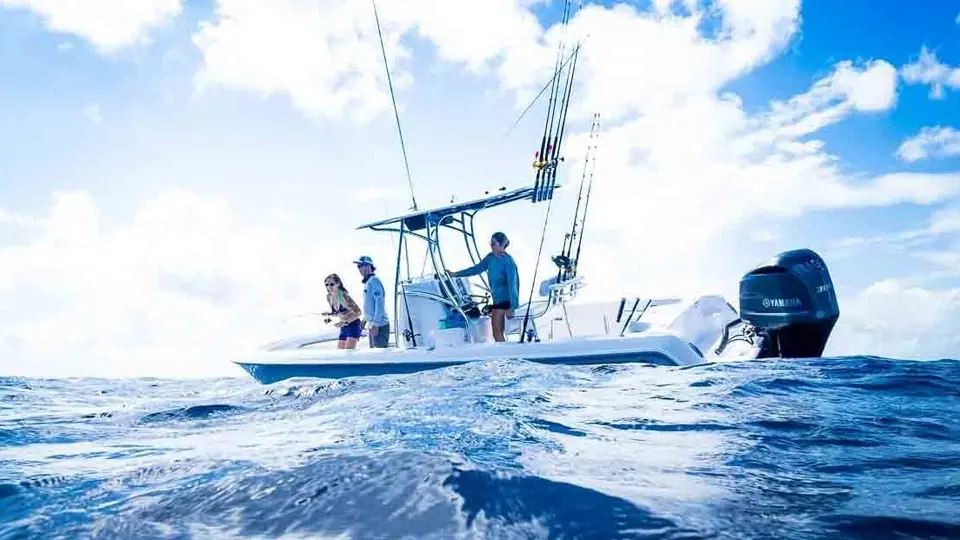
The clever part of the 24S is how its family seating works for anglers. Forward, two above-deck 59-gallon storage lockers with a removable insert between them form a U-shaped lounge with cushions, or an elevated casting platform without them. Aft, a pair of jump seats flank the transom livewell; the forward edge of the padded seats cushions your legs like coaming bolsters while fighting a fish, and the seats lift for battery and bilge access.
Fish storage is generous for the size: a 94-gallon forward fish box under the foredeck, a second forward compartment (listed at 43 gallons originally and as 44-gallon insulated in-deck storage today), and two 30-gallon aft fish boxes. The transom livewell holds 26 gallons and, in the test boat, had a latching clear-acrylic lid that sealed against a gasket. Swim platforms sit on both sides of the outboard on the integral bracket, with a pullout boarding ladder and freshwater shower to starboard.
- Two 59-gallon storage lockers under the forward seats
- 94-gallon forward fish box plus secondary forward compartment
- Two 30-gallon aft fish boxes
- 26-gallon transom livewell
- Step-down console with optional marine toilet
- Recessed bow rail and anchor nest in the locker
Tested on a single Yamaha F300
Sport Fishing's test boat carried a single Yamaha F300 V6 on the integral 15-inch bracket, turning a 19-inch-pitch three-blade Reliance stainless prop. With 82 gallons of fuel, two adults, fishing gear, a full livewell and 250 pounds of ice, it planed in 5 seconds and reached 30 mph in 9.4 seconds. Top speed was 53.3 mph at 5,900 rpm at 2.02 mpg. Contender's own lighter-load run reached 55.7 mph at the same rpm.
The most economical cruise came at 4,000 rpm and 29.5 mph, burning 11 gph for 2.68 mpg, which the magazine calculated as a 348-mile range on the original 130-gallon tank. That is genuinely frugal for a 24-foot offshore console, and it matches Contender's 2019 claim of more than 2.5 mpg at 30 mph with a single F300. Running at 37 mph at 4,500 rpm across Biscayne Bay chop was comfortable with throttle to spare.
What changed between 2014 and 2026
The core hull and layout have stayed put, but several published numbers moved. The 2014 spec sheet and the 2019 site listed 5,250 pounds ready to fish, 18 inches of draft, 130 gallons and a 300 hp maximum. Contender's current web page lists 5,000 pounds, 16 inches, 15 gallons of water, 130 gallons of fuel and a 400 hp maximum, while the 2026 brochure prints 120 gallons. The fuel guide on the company's site still lists 130.
Equipment also moved upmarket. Current boats carry a laceless soft top with spreader and puck lights, a Sport console with built-in helm pod and tilt steering, a mini fixed-back aluminum leaning post with four rod holders, a cockpit coaming bolster, Seakeeper Ride and digital switching. Options include upgraded hardtops, electric head with Y-valve, fresh and saltwater washdown, outriggers, gulper pumps, electric reel outlets, shore power and a towing bridle.
Who the 24S suits, and who should look elsewhere
The 24S is ideal for a family that fishes reefs, wrecks and nearshore weed lines and wants a boat that can make the occasional run offshore when the weather allows, as the test captain put it. Its 8-foot 6-inch beam keeps it legal to trailer, and 5,000 pounds ready to fish is manageable for a full-size pickup.
Hardcore offshore anglers who run 40 miles in a building sea should look at the 25T instead, which has the full 24.5-degree bottom, much bigger aft fish boxes and a 40-gallon livewell. Buyers who mostly cruise and swim may find more seating and shade in a dual console. The 24S sits deliberately between those worlds.
Ownership costs and used pricing
Running a single-engine 24S is about as economical as offshore boating gets. Our estimate for annual costs is $7,000 to $16,000 excluding depreciation, covering insurance, storage or a lift, one outboard service, fuel and canvas. At 11 gph cruise, a typical 150-hour season burns roughly 1,500 gallons.
Used prices track Contender's strong brand demand. Expect early boats from about $55,000 to $72,000 depending on engine hours and electronics, mid-life boats in the $85,000 to $110,000 range, and nearly new examples from about $120,000. A documented single-owner boat with a hardtop and an under-warranty engine is worth paying for.
Contender 24S specifications
| Length overall | 24.5 ft7.47 m |
|---|---|
| Beam | 8.5 ft2.59 m |
| Draft | 1.3 ft0.41 m |
| Displacement | 5, lbs2,268 kg |
| Fuel capacity | 13 gal492 L |
| Fresh water | 15 gal57 L |
| Cabins | 0 |
| Berths | 0 |
| Heads | Optional marine toilet in step-down console |
| Standard engines | Built to order, typically a single Yamaha outboard (tested with Yamaha F300) |
| Optional engines | Twin outboard rigging to the 400 hp rating |
| Maximum power | 400 hp |
| Cruise speed | 25.6 knots |
| Top speed | 46.3 knots |
| Range | 302 nm |
| Hull type | Deep-V planing hull, 22.5-degree transom deadrise, reverse chines, integral engine bracket |
| Hull construction | Hand-laid fiberglass with multidirectional fabrics and foam-cored molded structural grid |
| Builder | Contender Boats, United States |
| Naval architect | Contender Boats in-house design team |
| Production | 2014 to present |
| Status | In production |
Figures come from builder documentation and independent tests where available. Displacement is usually quoted light, so a loaded cruising boat will weigh more. Compare these specs with another model.
Performance data
| RPM | Speed (mph) | Fuel (gph) | mpg |
|---|---|---|---|
| 4000 | 29.5 | 11 | 2.68 |
| 4500 | 37 | ||
| 5900 | 53.3 | 26.4 | 2.02 |
Sport Fishing magazine test, single Yamaha F300, 19-inch Reliance three-blade prop, 82 gallons of fuel, two adults, gear, full livewell and 250 lb of ice. The 5,900 rpm fuel flow is derived from the published 2.02 mpg; 4,500 rpm speed was reported without fuel data.
How much does a Contender 24S cost?
Contender does not publish retail pricing, so the new range is our estimate for a single Yamaha 300 to 350 package with the standard soft top, Seakeeper Ride and modest electronics; a fiberglass hardtop, head and twin power push it higher. On the used market, early 2014 to 2016 boats with original F300s are the value entry, while 2022-on boats with the 400 hp rating and digital switching fetch the most.
Estimate your yearly cost
A planning estimate using common rules of thumb: insurance near 1.5 percent of value, maintenance near 3 percent, haul out and bottom paint by length. Your marina, region and use will move these numbers. Open the full cost calculator.
Versions and options
- 24 Sport (2014 launch)
- 24 feet 6 inches, 5,250 lb ready to fish, 18-inch draft, 130 gallons, 300 hp maximum, built in Homestead.
- Current 24S
- 5,000 lb ready to fish, 16-inch draft, 400 hp rating, Seakeeper Ride, Aegis battery management and Empirebus digital switching; fuel listed as 120 to 130 gallons depending on the document.
- 22 Sport (sister model)
- Smaller 22-foot 6-inch sibling with 100 gallons and a 300 hp limit, described as the first Contender under 25 feet.
Contender 24S timeline
- 1984Contender Boats founded by Joe Neber in South Florida
- 201424 Sport introduced; Sport Fishing tests it out of Homestead
- 201624 Sport sits in the Sport Series beside the 22 Sport and 28 Sport
- 2019Factory claims more than 2.5 mpg at 30 mph on a single F300
- 202624S brochure lists 400 hp, Seakeeper Ride and digital switching
Strengths and weaknesses
What owners like
- Tested 2.68 mpg at 29.5 mph on a single F300
- Seating that converts to a casting platform and leg bolsters
- Big 94-gallon forward fish box and 26-gallon livewell
- Trailerable 8-foot 6-inch beam
- Dry ride credited to reverse chines
- Swim platforms both sides of the engine
What to weigh up
- Shallower 22.5-degree bottom is not as soft as the 24.5-degree 25T in big seas
- Smaller aft fish boxes than tournament models
- Head is optional
- Published fuel capacity varies between 120 and 130 gallons
Used Contender 24S buyer checklist
Take this list to a viewing. Your ticks are saved in this browser so you can come back to it.
Always commission an independent marine survey and an engine survey before you buy. How a marine survey works.
Rivals to consider
Grady-White Fisherman 236
Grady's SeaV2 hull, strong dealer support and a family-first deck.
Compare side by sideCobia 240 CC
Wider beam, walk-in head and lower price, with a softer brand image.
Compare side by sideEverglades 243 Center Console
Foam-filled unsinkable construction and more amenities.
Compare side by sideOur verdict on the Contender 24S
The Contender 24S is the most sensible Contender for most families: efficient on one engine, legal to trail, smart about seating, and still a real fishing boat with good box space and a 26-gallon well. It gives up a little rough-water edge to the 25T, but its tested 2.68 mpg and stable 22.5-degree bottom make it a better all-rounder. Buy one with a documented engine and a hardtop, and it will cover everything from patch reefs to a calm-day run offshore.
Contender 24S questions answered
What does 24S mean on a Contender?
24S stands for 24 Sport, Contender's family-oriented 24-foot 6-inch center console introduced in 2014.
How fast is the Contender 24S?
Sport Fishing recorded 53.3 mph at 5,900 rpm with a single Yamaha F300, and Contender reported 55.7 mph with a lighter load.
What is the Contender 24S fuel economy?
Its best tested cruise was 29.5 mph at 4,000 rpm on 11 gph, or 2.68 mpg, for about 348 statute miles of range on 130 gallons.
What is the max horsepower on a Contender 24 Sport?
Current boats are rated to 400 hp. Early 24 Sports were listed at 300 hp.
What is the Contender 24S price?
Contender does not publish prices. We estimate new boats at about $125,000 to $170,000 and used boats from roughly $55,000 to $145,000.
Does the Contender 24S have a head?
A marine toilet is optional inside the step-down console, and an electric head with Y-valve is on the current option list.
Contender 24S photos
More center consoles & offshore boats to explore
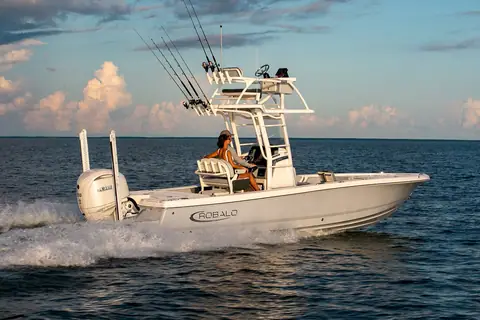
Robalo 246 Cayman SD
Center Consoles & Offshore Boats, 25 ft
Used $68K to $125K
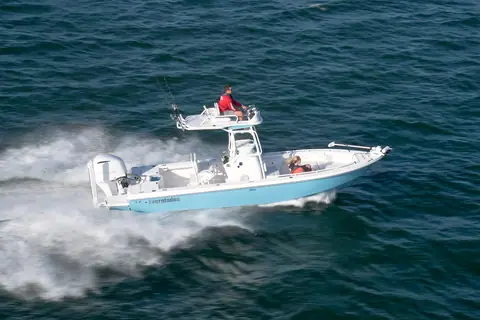
Everglades 243CC
Center Consoles & Offshore Boats, 24 ft
Used $40K to $175K
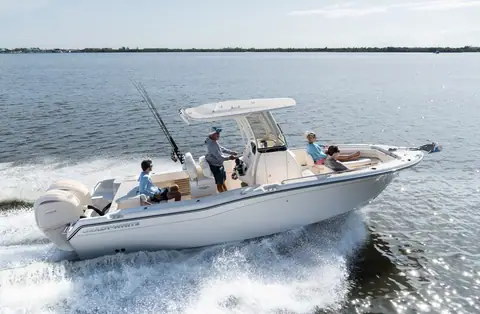
Grady-White Fisherman 257
Center Consoles & Offshore Boats, 25 ft
Used $55K to $205K
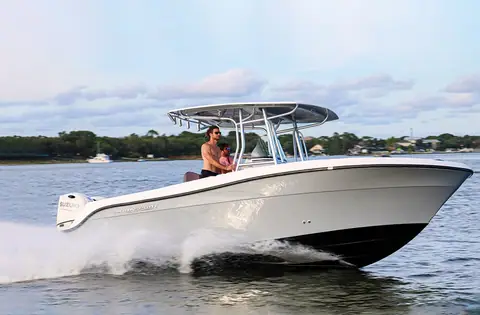
Aquasport 2500 CC
Center Consoles & Offshore Boats, 25 ft
Used $45K to $95K