Westport 112 Raised Pilothouse Review and Used Buying Guide
Nearly 70 hulls of the same Jack Sarin design made the Westport 112 the closest thing the superyacht world has to a production benchmark.
- Length
- 111.7 ft34 m
- Beam
- 23.8 ft7.24 m
- Cruise
- 22 kn
- Cabins
- 4 guest staterooms (5 with optional on-deck master) plus 2 or 3 crew cabins
- Used price
- $3.2M to $9.5M
On this page
- Overview
- How the Westport 112 became the default 100-footer
- Jack Sarin's hull and the Westport way of building
- The country kitchen and the four stateroom plan
- Crew requirements and the quarters that keep crew happy
- MTU 16V2000 performance and real-world range
- Running costs and charter prospects
- Refits, resale value and buying smart
- Specifications
- Price and value
- Strengths and weaknesses
- Used buyer checklist
- Rivals
- Our verdict
- FAQ
The Westport 112 is a four-stateroom, composite raised pilothouse motor yacht built in Washington State from 1998, with twin MTU (later some Caterpillar) diesels, a 22 knot cruise and a 2,500 nautical mile range at 12 knots.
- First time superyacht owners
- Owners who cruise the US East Coast and Bahamas
- Buyers planning an interior refit
- Pacific Northwest and Alaska cruising
Westport 112 by the numbers
- Speed to length ratio at cruise
- 2.23Runs in the semi-displacement range, faster than a trawler but thirstier per mile.
- Horsepower per ton
- 29 hpModest power to weight, efficiency over outright speed.
- Length to beam ratio
- 4.70 : 1A slim, easily driven hull.
How the Westport 112 became the default 100-footer
In 1998 very few American marinas had berths for yachts over 100 feet, and the semi-production superyacht barely existed as a category. Westport, a Pacific Northwest yard that had moved from commercial boatbuilding into yachts, was selling its 92-foot series well, and its owners wanted more crew space and larger staterooms. The answer was the Westport 112 raised pilothouse, drawn by Seattle naval architect Jack Sarin around a cored composite hull.
The first boat, Ubiquitous, turned out to be prophetically named. Power and Motoryacht counted at least 65 hulls completed with more in build, and Yachting later cited nearly 70. No other yacht over 100 feet has been built in anything like those numbers, and that volume is the single most important fact for a buyer. It means parts, knowledge, crew experience and comparable sales exist for this yacht in a way they simply do not for one-off builds.
Westport has since moved on to newer designs, most recently the W117 at 35.76 meters, but the 112 remains its signature product and the boat by which every American raised pilothouse is measured.
Jack Sarin's hull and the Westport way of building
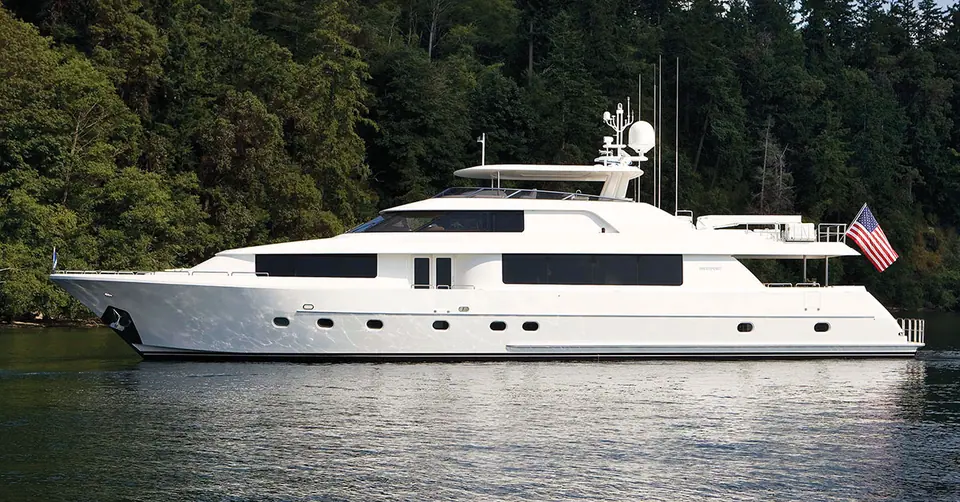
The 112 is a semi-displacement yacht that can plane, built in fiberglass with Airex and foam coring. That construction keeps half-load displacement to about 275,000 pounds on an actual 111 foot 8 inch hull, which is light for the size and the reason a pair of mid-sized MTUs can push it to the mid 20s. The beam is 23 feet 9 inches and the draft just 5 feet 6 inches on Westport's 2016 sheet (a later sheet lists 6 feet), shallow enough for the Bahamas, the Intracoastal Waterway and Pacific Northwest anchorages that keep deeper yachts offshore.
Westport's sales team describes the boat as an SUV on the water, and the phrase fits. Systems are deliberately simple and the exterior is easy to maintain. Through at least 2015 every 112 used MTU 16V2000s of the same footprint, with variants swapped only to meet changing EPA rules, but by 2017 Westport's specification sheet listed twin 1,900 hp Caterpillar C32 ACERTs, so check which engines a late hull carries. Hulls built after about 2004 commonly have a 16-inch Wesmar bow thruster with four control stations, a 65 kW Northern Lights generator, Naiad stabilizers and a VIC monitoring system.
Because the yard engineered the boat for worldwide use, many hulls were built with 50 and 60 cycle electrical capability and enough air conditioning for the Middle East. That makes the 112 an easier yacht to move between the US, the Caribbean and the Mediterranean than many American builds.
The country kitchen and the four stateroom plan
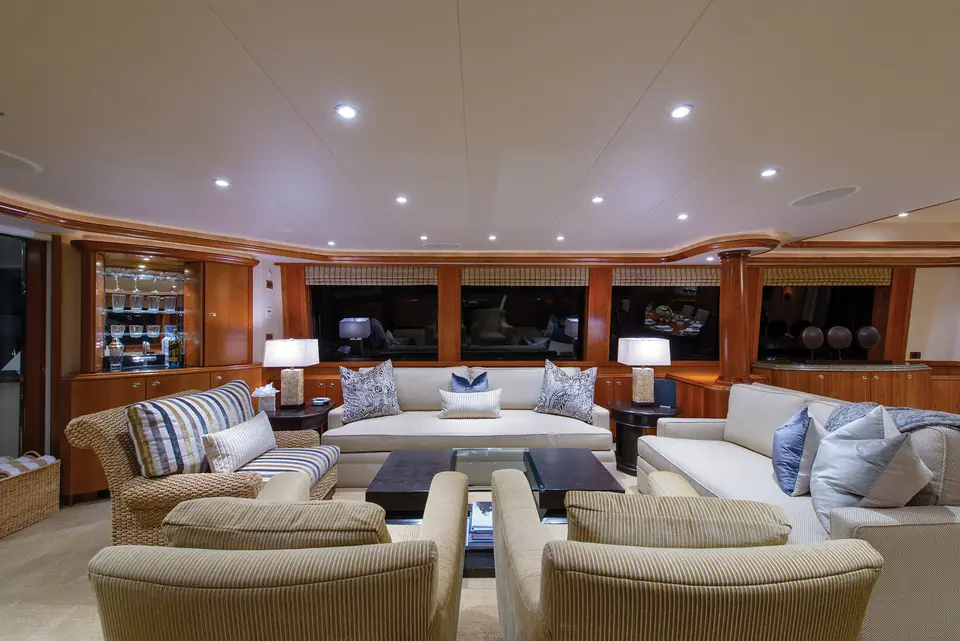
The main deck runs from a large aft cockpit with dining for eight into a full-beam salon, a formal dining area and then the feature that sells more 112s than anything else, the country kitchen. Instead of a hidden crew galley, the 112 has a large U-shaped galley with an island, bar stools and a dinette, where owners and guests gather with the chef. Experienced buyers walk in, smile and stop arguing.
Below, the original 1998 plan remains the most popular. A full-beam master sits amidships with a settee, a VIP is forward, and two mirror-image guest staterooms sit between them, each large enough to pass for a VIP on smaller yachts. From 2012 Westport offered a five stateroom version with an on-deck master in place of the country kitchen, aimed at buyers in Europe, Asia and the Middle East. It sold, but most American buyers kept the kitchen.
The flybridge typically carries a Jacuzzi, a bar, a hardtop helm area and space for chaise lounges aft, with a crane for PWCs or a tender on many hulls.
- Full-beam salon with formal dining for eight
- Country kitchen with island, dinette and bar seating
- Four en suite guest staterooms as standard
- Optional five stateroom, on-deck master layout from 2012
Crew requirements and the quarters that keep crew happy
Westport put real thought into crew space. Aft of the engine room, the boats Power and Motoryacht reviewed have three crew cabins: one with an en suite and walkaround queen for the captain, one with side-by-side twins and one single. Westport's later specification shows two crew staterooms, each with a private head, for up to four crew. Fit and finish rivals the guest staterooms, and that matters for retention, which is the hidden cost driver of any yacht this size.
Most 112s run with four or five crew. A private program usually has a captain, a mate who doubles as engineer, a chef and one or two stewardesses. Some owners in the Pacific Northwest run with three and add day help for guest trips, but for charter or extended cruising four to five is the right number. In 2026 that team is likely to cost several hundred thousand dollars a year in salaries alone, with the captain the largest single line.
MTU 16V2000 performance and real-world range
Later MTU hulls carry twin 16V2000 diesels of about 2,000 hp each, while earlier boats have 16V2000 variants rated around 1,800 hp, and some late hulls were specified with 1,900 hp Caterpillar C32s. Westport quotes a 22-knot cruise and a 24 to 25 knot top speed, and Power and Motoryacht cited 26 knots for the 2,000 hp boats, depending on load and bottom condition. At 12 knots Westport quotes about 2,500 nautical miles from roughly 5,500 gallons of fuel, although listings for some hulls quote a more conservative 1,800 nautical miles at that speed.
Westport does not publish a fuel curve. Burn at a fast cruise is heavy, while the builder's 2,500 nm range at 12 knots on 5,480 gallons implies little more than 25 gallons per hour at that speed, which is why range-minded owners slow down. Most owners settle into long runs at displacement speed and use the extra power to beat weather or close a gap between ports. The hull is not a bluewater passagemaker in the trawler sense, but 112s have cruised the Mediterranean, New Zealand and the length of the Americas with professional crews.
Running costs and charter prospects
The 10 percent rule works well on the 112. A boat worth $6 million costs roughly $550,000 to $900,000 a year to operate, depending on crew size, cruising area and how hard it is used. Salaries take about half, then maintenance, insurance, dockage and fuel. Haul outs, bottom paint, running gear service and generator overhauls are predictable because thousands of these tasks have already been done on sister ships.
Charter is viable but competitive. Weekly rates for 112s in the Bahamas, Florida and New England vary widely with age and refit, and they are quoted plus expenses. The four stateroom layout limits guests to eight or nine, which is fine for families but less attractive than newer five stateroom yachts for groups. Owners who charter 6 to 10 weeks a year can typically recover a meaningful share of running costs.
- Crew salaries: the largest single cost, typically several hundred thousand dollars a year
- Maintenance and yard reserve: about $120,000 to $220,000 per year
- Insurance: roughly 1 to 1.5 percent of hull value
- Dockage for 112 feet in South Florida or New England: $60,000 to $150,000 per year
Refits, resale value and buying smart
Westport's in-house brokerage has said owners sometimes sold a 112 for close to what they paid, and a decade ago the yard noted used examples from $5 to $10 million against a new price of about $13 million. In 2026 the realistic range is about $3.2 million for an early boat needing work to $9.5 million for the latest, best kept hulls.
The 112 is a favorite refit platform because the bones are good and the layout does not need to change. A 2023 project on the 112 Montrachet at Safe Harbor Lauderdale Marine Center replaced the HVAC system, lightened the interior with beadboard and white fabrics and updated every head in six months without moving a bulkhead. That is the template: buy a mechanically sound early hull, spend $700,000 to $1.5 million on interior, AV and HVAC, and own something that feels close to new for half the price.
Westport 112 specifications
| Length overall | 111.7 ft34 m |
|---|---|
| Beam | 23.8 ft7.24 m |
| Draft | 5.5 ft1.68 m |
| Displacement | 275, lbs124,738 kg |
| Fuel capacity | 5,48 gal20,744 L |
| Fresh water | 1, gal3,785 L |
| Cabins | 4 guest staterooms (5 with optional on-deck master) plus 2 or 3 crew cabins |
| Berths | 8 guests in four staterooms, 4 to 5 crew |
| Heads | 4 guest en suites plus crew heads |
| Standard engines | 2 x MTU 16V2000 diesels, about 1,800 hp each on earlier hulls and about 2,000 hp each on later MTU hulls |
| Optional engines | 2 x Caterpillar C32 ACERT (1,900 hp each) listed on Westport's 2017 specification |
| Maximum power | 4,000 hp |
| Cruise speed | 22 knots |
| Top speed | 25 knots |
| Range | 2,500 nm |
| Hull type | Semi-displacement planing hull, raised pilothouse |
| Hull construction | Composite fiberglass with Airex and foam coring |
| Builder | Westport Yachts, United States |
| Naval architect | Jack Sarin |
| Other design credits | Westport in-house interior team |
| Production | 1998 to present |
| Status | Discontinued |
Figures come from builder documentation and independent tests where available. Displacement is usually quoted light, so a loaded cruising boat will weigh more. Compare these specs with another model.
How much does a Westport 112 cost?
The 112 has the deepest resale market of any American yacht over 100 feet, so values are driven less by year than by engine hours, refit history and interior condition. A 2002 hull with continuous professional crew asked about $4.3 million in 2024, and a heavily upgraded example asked $4.95 million the same year. Late hulls with modern MTUs, a refreshed interior and zero speed stabilizers sit at the top of the range.
Estimate your yearly cost
A planning estimate using common rules of thumb: insurance near 1.5 percent of value, maintenance near 3 percent, haul out and bottom paint by length. Your marina, region and use will move these numbers. Open the full cost calculator.
Westport 112 timeline
- 1998Westport and Jack Sarin develop the 112 raised pilothouse; first hull Ubiquitous follows
- 2004Later hulls standardize Naiad stabilizers, a 65 kW Northern Lights generator and VIC monitoring
- 2012Optional five stateroom layout with an on-deck master introduced for export buyers
- 2015At least 65 hulls completed, making it the most built yacht over 100 feet
- 2024Nearly 70 hulls in service; early boats ask around $4.3 to $5 million
Strengths and weaknesses
What owners like
- Deepest parts, crew and resale support of any yacht over 100 feet
- Country kitchen and four true en suite guest staterooms
- Excellent crew quarters for the size
- Shallow 5 foot 6 inch draft
- 22 knot cruise with genuine long range at displacement speed
- American built with simple, proven systems
What to weigh up
- Traditional styling looks dated next to modern widebody designs
- No beach club or garage on most hulls
- Four stateroom plan limits charter guest count
- Older hulls need costly HVAC, electronics and interior updates
- Fast cruise fuel burn is heavy
Used Westport 112 buyer checklist
Take this list to a viewing. Your ticks are saved in this browser so you can come back to it.
Always commission an independent marine survey and an engine survey before you buy. How a marine survey works.
Rivals to consider
Hatteras 100 Raised Pilothouse
The other American benchmark, heavier and more traditional, with fewer hulls and a thinner resale market.
Ocean Alexander 88 Motoryacht
Smaller and newer, owner-operator friendly, for buyers who want to downsize crew.
Compare side by sideAzimut Grande 35 Metri
A faster, more modern Italian raised pilothouse with carbon superstructure but higher running and service complexity.
Compare side by sideSunseeker 100 Yacht
A modern British alternative with a beach club and garage, at roughly double the price of a mid-life 112.
Compare side by sideOur verdict on the Westport 112
The Westport 112 is the safest big yacht purchase in America. It is not the most exciting design afloat, but no other yacht over 100 feet comes with nearly 70 sister ships, a factory that still supports them, a shallow draft, good crew quarters and a country kitchen that owners genuinely love. Buy the best mechanical example you can afford, plan a sensible interior refresh, staff it with four or five good crew and it will hold value better than almost anything else in its class.
Westport 112 questions answered
How much is a Westport 112 for sale?
Used Westport 112s generally ask between about $3.2 million and $9.5 million in 2026, depending on year, engine hours and refit history. A 2002 hull asked about $4.3 million in 2024.
How many Westport 112s were built?
Power and Motoryacht counted at least 65 hulls and Yachting cited nearly 70, making it the most built yacht over 100 feet.
How fast is a Westport 112?
Westport quotes a 22-knot cruise and about 25 knots maximum, and Power and Motoryacht cited 26 knots for boats with twin 2,000 hp MTU 16V2000s.
How many crew does a Westport 112 need?
Most run with four or five crew, typically a captain, mate or engineer, chef and one or two stewardesses, housed in two or three crew cabins aft depending on the hull.
What is the range of a Westport 112?
Westport quotes about 2,500 nautical miles at 12 knots from 5,480 gallons of fuel, though some listings quote a more conservative 1,800 nm.
Who designed the Westport 112?
Seattle naval architect Jack Sarin designed the 112 for Westport, which builds its yachts in Washington State.