Riva Luxury Dayboats & Classics
Riva Aquarama, the Collector's Guide to History, Restoration and Value
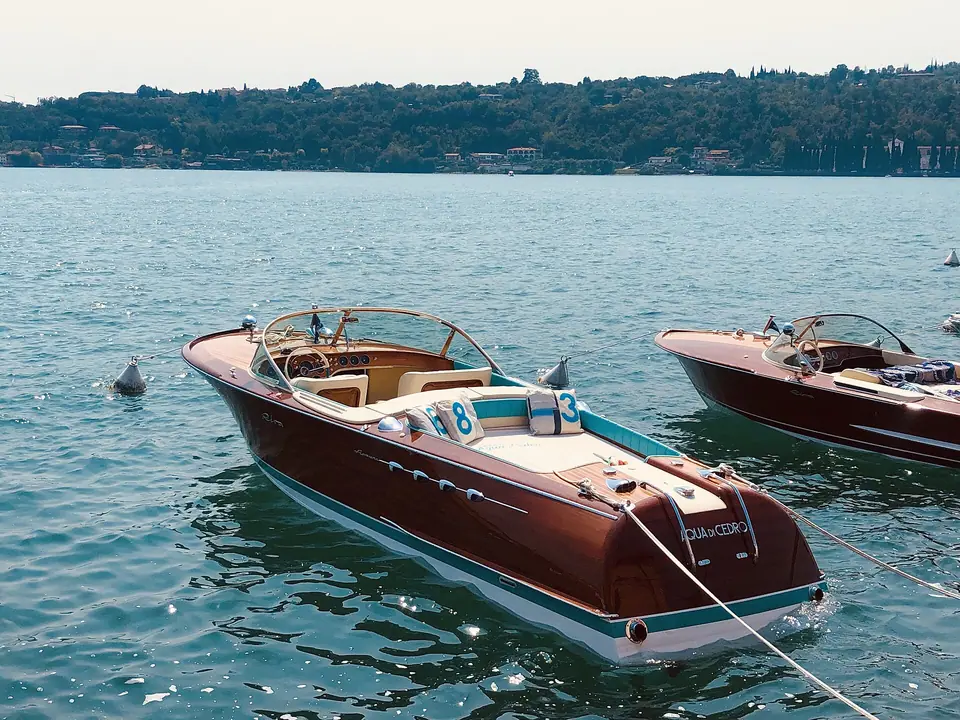
Carlo Riva's varnished mahogany runabout, built from 1962 to 1996, is the most coveted classic speedboat in the world and still a working boat on the water.
- Length
- 26.3 ft8.02 m
- Beam
- 8.5 ft2.6 m
- Cabins
- None (open runabout)
- Used price
- $450K to $1.3M
On this page
- Overview
- The Riva Aquarama story, from Sarnico to legend
- Aquarama, Super, Lungo and Special
- Mahogany, varnish and twin V8 power
- The Lamborghini Aquarama and the famous owners
- What restoring an Aquarama really involves
- Riva Aquarama price and collector value in 2026
- Living with varnished mahogany
- How to buy a Riva Aquarama for sale
- Specifications
- Price and value
- Strengths and weaknesses
- Used buyer checklist
- Rivals
- Our verdict
- FAQ
The Riva Aquarama is a twin-engine mahogany runabout built by Riva in Sarnico, Italy, from 1962 to 1996. About 768 were made across four versions, and restored boats now sell for roughly $450,000 to $1.3 million.
- Classic boat and car collectors
- Lake and Riviera day use
- Concours and classic boat shows
- Owners who want a boat that holds its value
Riva Aquarama by the numbers
- Displacement hull speed
- 6.4 knThe efficient cruising speed for a displacement hull of this waterline.
- Length to beam ratio
- 3.09 : 1Moderate proportions.
The Riva Aquarama story, from Sarnico to legend
The Riva Aquarama is to classic boats what the Ferrari 250 GT is to classic cars, and the comparison is not lazy. Both were built in Italy in the early 1960s by a family firm, both were bought by film stars and industrialists, and both became the benchmark against which everything else is judged. Jeremy Clarkson once called the Aquarama the most beautiful thing ever made, and few people who have seen one under way would argue.
Riva itself dates back to 1842, when Pietro Riva began building boats in Sarnico on Lake Iseo in northern Italy. By the 1950s Carlo Riva had turned the yard into a builder of luxury mahogany runabouts aimed at a wealthy international clientele on the Riviera and the Italian lakes. The Aquarama, introduced in 1962 on the hull of the earlier Tritone, was the most famous of all his designs. The Riva Historical Society notes that the 1962 prototype was tested before series production got going in 1963.
The name is usually traced to Cinerama, the panoramic widescreen cinema format of the time, a nod to the boat's wraparound windshield and its wide-open view of the water.
Aquarama, Super, Lungo and Special
There is no single Riva Aquarama, and understanding the versions is the first step for any buyer. Over 34 years Riva built about 768 boats across four variants, with lengths quoted from 8.02 to 8.78 meters, roughly 26 to 29 feet.
The original Aquarama ran from 1962 to 1972 with 281 built. The Super Aquarama, with more power and a hull lengthened at the stern for bigger tanks, overlapped it from 1963 to 1971 and reached 203 boats. In 1972 Riva built just seven Aquarama Lungo boats on leftover long Super hulls, 8.72 meters long according to the Riva Historical Society, and they are among the rarest of all. Finally the Aquarama Special, produced from 1972 until 1996 starting with hull 503, accounted for 277 hulls. It kept the earlier running surface but added a longer, more raked transom with built-in bathing steps and platform, and it was the longest-lived variant.
- Aquarama: 1962 to 1972, 281 built
- Super Aquarama: 1963 to 1971, 203 built
- Aquarama Lungo: 1972, 7 built
- Aquarama Special: 1972 to 1996, 277 built
Mahogany, varnish and twin V8 power
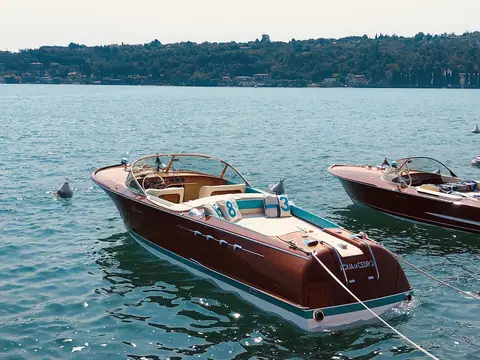
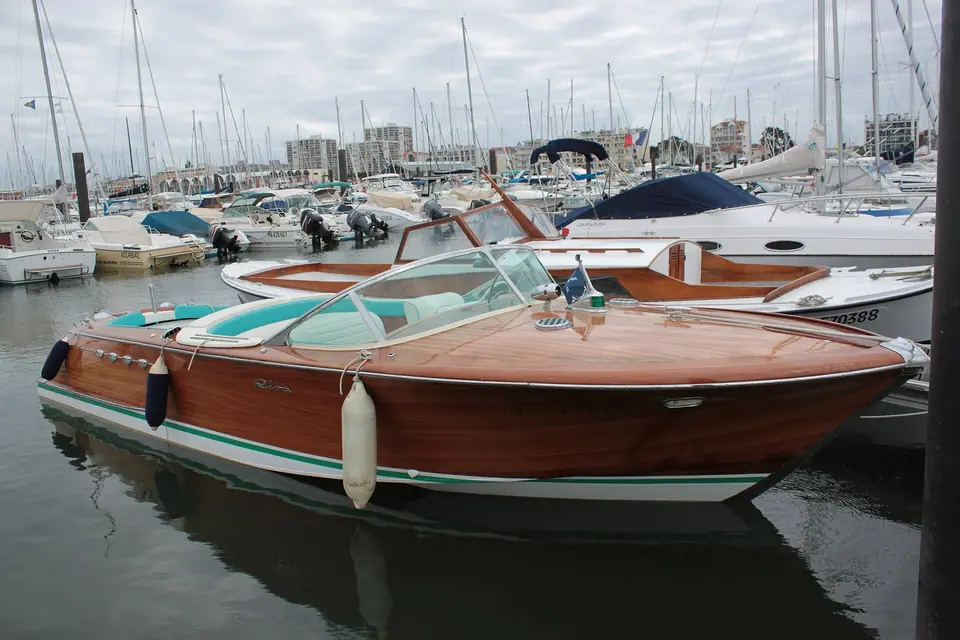
Every Aquarama has a mahogany hull and deck finished in deep, glossy varnish, with chrome deck hardware and a pale vinyl or leather interior. The layout is simple: a forward cockpit with the helm and a bench seat behind the windshield, a second bench behind, and a large sun pad over the engine compartment aft. A boarding ladder at the stern made it a swimming boat as much as a speedboat, and that use is a big part of its appeal.
All versions are twin-engine boats. Power ranged from about 185 to 400 horsepower per engine depending on year and version, with Cadillac and Chrysler engines among those used in the early years and, from the 1967 series, Riva engines developed with Crusader. Period top speeds ran from the mid-40s to around 50 knots depending on engines, remarkable for a wooden runabout of the 1960s and 1970s.
For US owners there is a practical bonus. The Riva-Crusader engines are based on American V8 blocks, so parts and skilled mechanics are easier to find in the US than many European buyers assume.
The Lamborghini Aquarama and the famous owners
The most famous single Aquarama is hull 278, ordered by Ferruccio Lamborghini in 1968 and fitted with two 350 bhp Lamborghini V12 engines from the 350 GT instead of the usual V8s. Its later owner swapped the V12s for V8s, and the boat was rediscovered in 2010 and restored with V12s again. Its restorers call it the fastest Aquarama, with a quoted 48 knots, and it is the reason people search for a Riva Aquarama Lamborghini today.
Riva's client list in the 1960s reads like a film festival guest list. Brigitte Bardot, Sophia Loren and Peter Sellers are among the stars most often associated with Rivas of the era, along with European royalty and industrialists. Aquarama Specials also appear on screen in GoldenEye and Ocean's Twelve.
Provenance adds real money at the top of the market, but only when it is documented. A bill of sale, period photographs or Riva archive records are what turn a story into value.
What restoring an Aquarama really involves
Many Aquaramas on the market today have been restored at least once, and the quality of that work is the single biggest variable in value. A full restoration means stripping the hull to bare wood, replacing rotten frames and planks with properly seasoned mahogany, refastening, rebuilding or replacing the engines, rechroming hardware, renewing upholstery and applying many coats of varnish.
Done properly at a specialist yard, a full restoration commonly costs $250,000 to $500,000 or more and can take a year or longer. Specialist restorers on Lake Iseo and Lake Como, where the boats were born, carry the deepest knowledge, though skilled wooden boat yards in the US do excellent work too.
Originality is a balance. Collectors prize original hull wood, matching engines and correct hardware, but nobody wants rotten wood preserved for its own sake. The best restorations replace what must be replaced with period-correct materials and document every step with photographs.
- Ask for the full photographic record of any restoration
- Check how much original hull wood remains
- Confirm engines are period-correct or document any upgrades
- Verify who did the work and when
Riva Aquarama price and collector value in 2026
Restored Aquaramas generally sell between about $450,000 and $1.3 million in 2026. Early 1960s boats in concours condition with original engines sit at the top, Super Aquaramas follow closely, and Aquarama Specials from the 1980s and 1990s are the most accessible way into the club. A Lungo, with only seven built, is rare enough that prices are set boat by boat.
Values have climbed steadily for two decades, driven by the boat's fame, a fixed supply and strong demand from Europe, the Middle East and the US. That said, condition dominates. A tired boat with a bad restoration can be worth less than a good unrestored project, because undoing poor work is costly.
Riva has kept the spirit alive in fiberglass with the Aquariva, introduced in 2000 under Ferretti ownership. It offers the look with modern reliability, but collectors treat it as a separate market.
Living with varnished mahogany
Owning an Aquarama is part boating, part curatorship. Budget about $25,000 to $70,000 per year excluding depreciation for indoor storage, varnish maintenance, engine service, insurance and transport to shows. The boat should live indoors when not in use, ideally in climate-controlled storage, and come out for the season rather than sit in a slip.
Insurance is usually written on an agreed-value basis with a classic boat specialist. Keep the valuation current, because restored Aquaramas have outrun many policies written a decade ago. Varnish needs touch-ups every season and a full revarnish every few years, depending on sun exposure.
On the water the boat is surprisingly practical. It runs fast and true, it is easy to drive, and it draws crowds at every dock. Use is good for it. Wooden boats that are run, cleaned and dried properly tend to age better than ones left sitting.
How to buy a Riva Aquarama for sale
Supply is thin, so the best boats often change hands privately through specialist brokers and classic boat events before they reach public listings. Engage a surveyor experienced specifically with Riva and wooden runabouts, not a generalist, and budget for a full out-of-water inspection including moisture readings.
For US buyers, factor in shipping from Europe, import duties and the cost of adapting any non-US equipment. Check that the hull identification and engine numbers match the documentation. And remember that a cheap Aquarama is almost always the most expensive one to own.
Riva Aquarama specifications
| Length overall | 26.3 ft8.02 m |
|---|---|
| Beam | 8.5 ft2.6 m |
| Cabins | None (open runabout) |
| Berths | None |
| Heads | None |
| Standard engines | Twin gasoline V8 inboards, 185 to 400 hp each depending on year and version |
| Optional engines | Period engines included Cadillac and Chrysler units, followed from the 1967 series by Riva engines developed with Crusader |
| Maximum power | 800 hp |
| Hull type | Planing V-bottom runabout, twin screw |
| Hull construction | Varnished mahogany planking on mahogany frames |
| Builder | Cantiere Riva, Italy |
| Naval architect | Carlo Riva |
| Other design credits | Riva yard design office under Carlo Riva |
| Production | 1962 to 1996 |
| Status | Discontinued |
Figures come from builder documentation and independent tests where available. Displacement is usually quoted light, so a loaded cruising boat will weigh more. Compare these specs with another model.
How much does a Riva Aquarama cost?
Version, originality and the quality of the restoration matter far more than year. Early 1960s Aquaramas and Super Aquaramas with original engines, matching hull numbers and documented histories command the highest prices, while later Aquarama Specials are more numerous and more affordable. Unrestored project boats can be found for $150,000 to $350,000, but a proper restoration can easily cost as much again. Celebrity provenance and one-offs such as the Lamborghini-powered boat sit in a category of their own.
Estimate your yearly cost
A planning estimate using common rules of thumb: insurance near 1.5 percent of value, maintenance near 3 percent, haul out and bottom paint by length. Your marina, region and use will move these numbers. Open the full cost calculator.
Versions and options
- Aquarama (1962 to 1972)
- The original version on the Tritone hull, 281 built, with the shortest hull of the family.
- Super Aquarama (1963 to 1971)
- More powerful sibling with a hull lengthened at the stern for larger tanks, 203 built.
- Aquarama Lungo (1972)
- Seven boats built on leftover long Super hulls, 8.72 meters long per the Riva Historical Society.
- Aquarama Special (1972 to 1996)
- Started with hull 503. A longer, raked transom with bathing steps and platform, 277 built, the last Aquaramas made.
- Riva Lamborghini (1968)
- Hull 278, built for Ferruccio Lamborghini with twin 350 bhp Lamborghini V12 engines, restored with V12s after its rediscovery in 2010.
Riva Aquarama timeline
- 1842Pietro Riva starts building boats in Sarnico on Lake Iseo
- 1962Carlo Riva introduces the Aquarama, with series production following in 1963
- 1963Super Aquarama joins the range
- 1968Hull 278 is built for Ferruccio Lamborghini with twin Lamborghini V12 engines
- 1972Aquarama Lungo and the Aquarama Special arrive
- 1996Production of the Aquarama Special ends, closing the wooden era
- 2000The fiberglass Aquariva revives the look under Ferretti ownership
Strengths and weaknesses
What owners like
- The most iconic classic speedboat ever built
- Strong long-term appreciation for good examples
- Fast and enjoyable to drive even by modern standards
- Later engines use widely available American V8 parts
- Global collector community and specialist restorers
What to weigh up
- Restoration costs can rival the purchase price
- Varnished wood demands indoor storage and constant care
- No cabin or head
- Wide quality gap between good and poor restorations
- Very few examples in the US market
Used Riva Aquarama buyer checklist
Take this list to a viewing. Your ticks are saved in this browser so you can come back to it.
Always commission an independent marine survey and an engine survey before you buy. How a marine survey works.
Rivals to consider
Chris-Craft Launch 27
A modern fiberglass runabout with classic American styling, far cheaper and easier to own.
Compare side by sideBoston Whaler 13 Sport
The American design icon of the same era, at the opposite end of the price and complexity scale.
Compare side by sideDonzi 16 Classic
A 1960s American performance classic with fiberglass simplicity and a strong collector following.
Compare side by sideHinckley Picnic Boat
A modern classic for buyers who want timeless styling and modern reliability.
Compare side by sideOur verdict on the Riva Aquarama
The Riva Aquarama is the rare classic that lives up to its legend. It is beautiful, quick, enjoyable on the water and a proven store of value when bought right. Buy on version, hull number, documentation and restoration quality rather than on gloss, use a specialist surveyor, and plan for indoor storage and annual varnish work. Do that, and an Aquarama can be both the most rewarding boat you ever own and one of the soundest.
Riva Aquarama questions answered
How much is a Riva Aquarama?
Restored Riva Aquaramas generally sell for about $450,000 to $1.3 million in 2026. Project boats can be cheaper, but restoration costs are high.
How many Riva Aquaramas were built?
About 768 across four versions: 281 Aquaramas, 203 Super Aquaramas, 7 Aquarama Lungos and 277 Aquarama Specials.
When was the Riva Aquarama made?
From 1962 to 1996. The original Aquarama ended in 1972, and the Aquarama Special continued until 1996.
What is the Riva Aquarama Lamborghini?
Hull 278, an Aquarama ordered by Ferruccio Lamborghini in 1968 and fitted with two Lamborghini V12 engines. It has since been restored with V12 power.
How fast is a Riva Aquarama?
Period top speeds ran from the mid-40s to about 50 knots depending on engines, with twin engines of up to 400 hp each.
Does Riva still make the Aquarama?
No. Production ended in 1996. Riva's fiberglass Aquariva, launched in 2000, carries on the look.