Chris-Craft Luxury Dayboats & Classics
Chris-Craft Commander: History, Models and Classic Buying Guide
Chris-Craft's first all-fiberglass cruisers, launched with the 1964 Commander 38 and grown into a family of models with a devoted owners' club.
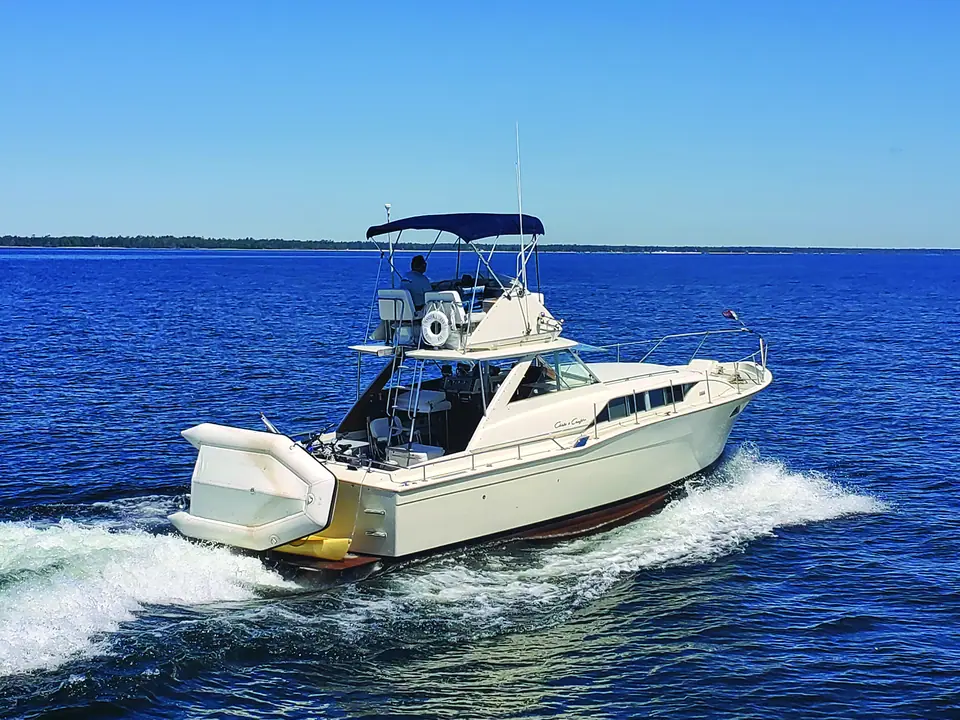
- Length
- 35 ft10.67 m
- Beam
- 13 ft3.96 m
- Cruise
- 3 ft0.91 m
- Cabins
- 1 forward owner's cabin plus convertible salon (35 Commander)
- Used price
- $15K to $480K
On this page
- Overview
- Why the Chris-Craft Commander Club exists
- A secret project in Holland, Michigan
- The 1964 Commander 38: specs and price
- The 35 Commander sport bridge, a Great Lakes favorite
- The 2016 revival: Commander 42
- Buying a classic Commander today
- Running costs and what Commanders are worth
- Specifications
- Price and value
- Strengths and weaknesses
- Used buyer checklist
- Rivals
- Our verdict
- FAQ
The Chris-Craft Commander name arrived in 1964 on the 38-foot Commander, the company's first all-fiberglass inboard cruiser. The line grew to dozens of models and spawned the Chris-Craft Commander Club; the name returned briefly on a 2016 Commander 42.
- Classic boat enthusiasts
- Great Lakes and inland cruising
- Owners who enjoy restoration projects
- Buyers who value club community
Chris-Craft Commander by the numbers
- Displacement hull speed
- 7.4 knThe efficient cruising speed for a displacement hull of this waterline.
- Length to beam ratio
- 2.69 : 1A beamy hull with lots of volume for its length.
Why the Chris-Craft Commander Club exists
Few production cruisers have an owners' group as active as the Chris-Craft Commander Club. It began in February 1999 as an online forum and email list, grew into annual rendezvous, local meets, a newsletter called Styled in Fiberglass, a model registry and a deep online archive of manuals and maintenance know-how, and it remains dues-free. Members come mostly from the United States, with others in Australia, Sweden, Italy, France and Britain.
The reason is the boats. The Commander name marks the moment Chris-Craft, the company that defined the mahogany runabout, committed to fiberglass. The club counts Commander models from 19 to 60 feet, and Soundings notes that the fleet eventually reached 60 feet. For a buyer, that history means parts knowledge, owner advice and a ready market of enthusiasts.
A secret project in Holland, Michigan
Chris-Craft had experimented with fiberglass by 1955, but as Power and Motoryacht's history puts it, early attempts had not worked out. By the early 1960s America's biggest boatbuilder was losing ground to Hatteras, Bertram, Boston Whaler and Sea Ray, whose glass boats promised low maintenance while Chris-Craft salesmen still preached wood.
In 1962, Soundings reports, Chris-Craft set up a fiberglass research center in Pompano, Florida, and a Fiberglass and Tooling Activity Division in Holland, Michigan, under longtime designer and engineer Bill Mackerer. The work was done in strict secrecy: shop windows were sealed, doors locked, and not even dealers were told. The company had been sold by the Smith family in 1960, and its new owners needed a modern product.
The 1964 Commander 38: specs and price
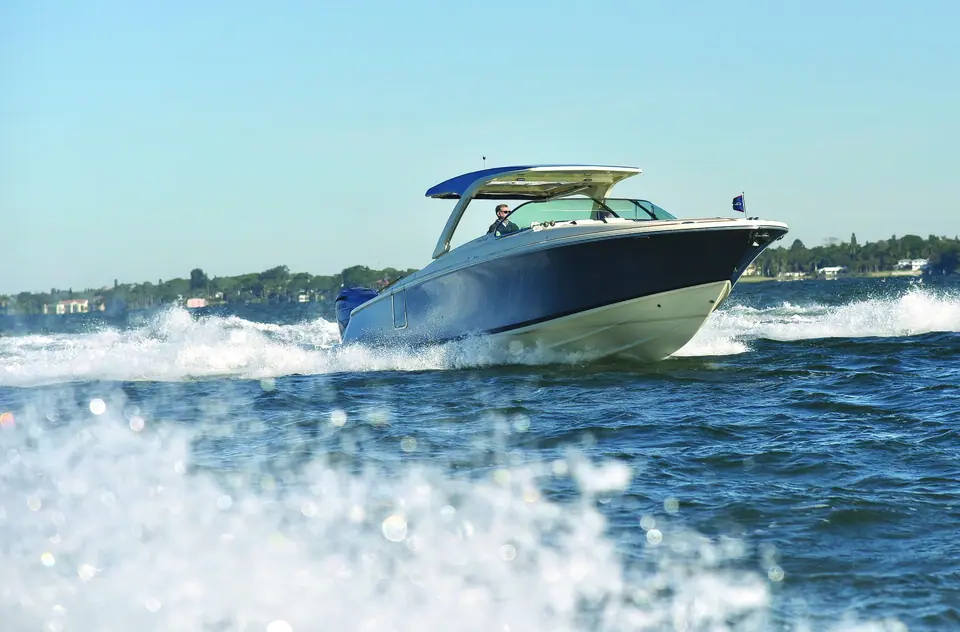
The result debuted in 1964: the 38-foot Commander express cruiser, Chris-Craft's first all-fiberglass inboard cruiser and one of the biggest fiberglass boats in production at the time. It kept the brand's signature rounded bow and smooth horizontal lines on a gleaming white hull, so it looked like a Chris-Craft while being built like nothing the company had made before.
Soundings gives the details. The modified-V hull was about an inch thick, power was twin 210 or 275 hp V-8s for a top speed in the 20s, tankage was 200 gallons of fuel and 75 of water, and draft was just 3 feet. The Commander slept six using a master stateroom, a convertible day sofa and the dinette, had two heads, and a galley with a refrigerator, three-burner electric range and oven. A flybridge was optional. Prices were $29,990 with the 210s and $31,990 with the 275s.
Chris-Craft built 262 Commander 38s from 1964 to 1969, in express, sedan and sportfish versions, then redesigned the boat and kept it in production through the mid-1970s.
- 1964 Commander 38: twin 210 or 275 hp V-8s, top speed in the 20s
- 200 gallons fuel, 75 gallons water, 3-foot draft
- Sleeps six with two heads
- 262 built from 1964 to 1969
The 35 Commander sport bridge, a Great Lakes favorite
The 35 Commander is the best-documented smaller model, and its specifications are the ones shown on this page. Soundings reports that more than 164 were built between 1969 and 1972. It measures 35 feet overall with a 13-foot beam, 3-foot draft, 14,500 pounds displacement, 175 gallons of fuel and 70 of water, and came with twin 230 hp GM-based Chris-Craft V-8 gasoline engines.
The layout is classic late-1960s family cruiser. An aft deck about 10 feet wide sits on the same level as a hardtop-covered bridge deck with a lower helm to port and a companion bench to starboard, and a centerline ladder climbs to a flybridge. Below, a dinette converts to a double, a lounge converts to upper and lower bunks, the L-shaped galley has an electric stove, oven, sink and refrigerator, the head has a shower, and an owner's V-berth sits forward behind a door.
One owner profiled by Soundings repowered with 425 hp Crusaders and found the boat squirrely until a yard ground down a built-in trim lip at the transom edge. It is a good example of the kind of model-specific knowledge the Commander Club exists to share.
The 2016 revival: Commander 42
Chris-Craft reclaimed the name in 2016 for an all-new Commander 42, developed in a joint venture with Italian builder Austin Parker. Unlike the classics, it was a New England lobster-style open boat with twin Volvo Penta IPS600 D6 engines of 435 hp each, two cockpit areas, one open aft and one under a hardtop that could be enclosed with sliding doors, a large bow sunbed, a cockpit galley, sleeping for five below and a head with separate shower.
Chris-Craft announced plans for a Commander 36 and Commander 52 to follow in 2017. Power and Motoryacht ran the new 42 alongside the rest of the Chris-Craft fleet in Sarasota that summer. The Commander does not appear in Chris-Craft's current lineup of Launch, Calypso, Corsair, Catalina and Sportster models, so the 42 should be treated as a short-run modern model, not a continuation of the classic line.
Buying a classic Commander today
A 1960s or 1970s Commander is a 50 to 60-year-old boat, and the hull is usually the least of the problems. Solid fiberglass laminates of that era are thick and forgiving, while engines, fuel tanks, wiring, plumbing and wood structures such as stringers, transoms and deck cores are where money disappears.
Original gasoline V-8s should be considered end-of-life unless rebuilt or replaced, and many boats have been repowered. Fuel tanks from the period deserve particular scrutiny. Rewiring to modern standards, as the Soundings owners did with a new breaker panel and network wiring, is a major but worthwhile job.
Budget for the restoration you want before you buy. A cheap Commander can easily absorb several times its purchase price, which is why a boat whose previous owner already spent that money is often the better deal.
Running costs and what Commanders are worth
Running costs depend almost entirely on engines and condition. Twin gasoline V-8s on a 35 to 38-foot cruiser are thirsty, and annual budgets of roughly $8,000 to $25,000 for storage, insurance, maintenance and fuel are realistic before any restoration work.
Values are modest for unrestored boats and much stronger for documented restorations, especially early 38 Commanders with their historical significance. Club registries and rendezvous awards help establish provenance and can support a higher price.
Chris-Craft Commander specifications
| Length overall | 35 ft10.67 m |
|---|---|
| Beam | 13 ft3.96 m |
| Draft | 3 ft0.91 m |
| Displacement | 14,5 lbs6,577 kg |
| Fuel capacity | 175 gal662 L |
| Fresh water | 7 gal265 L |
| Cabins | 1 forward owner's cabin plus convertible salon (35 Commander) |
| Berths | 6 (V-berth, convertible dinette, lounge with upper and lower bunks) |
| Heads | 1 with shower (35 Commander); the 38 Commander had 2 |
| Standard engines | 2 x 230 hp GM-based Chris-Craft V-8 gasoline inboards (35 Commander); the 38 Commander used twin 210 or 275 hp V-8s |
| Hull type | Modified-V planing hull; specifications shown are for the 35 Commander sport bridge of 1969 to 1972 |
| Hull construction | Solid fiberglass (the Commander 38 hull was about an inch thick) |
| Builder | Chris-Craft (Chris-Craft Industries), United States |
| Naval architect | Chris-Craft engineering under Bill Mackerer |
| Other design credits | 2016 Commander 42 developed with Austin Parker of Italy |
| Production | 1964 to present |
| Status | Discontinued |
Figures come from builder documentation and independent tests where available. Displacement is usually quoted light, so a loaded cruising boat will weigh more. Compare these specs with another model.
How much does a Chris-Craft Commander cost?
In 1964 the Commander 38 sold for $29,990 with twin 210 hp V-8s and $31,990 with 275s. Today classic Commanders trade on condition rather than year: tired original boats with old gasoline engines sell for very little, while repowered, rewired and properly restored boats bring several times more. The 2016 to 2017 Commander 42, built with Austin Parker on Volvo IPS, is a modern yacht and priced in a different universe. Our ranges are estimates.
Estimate your yearly cost
A planning estimate using common rules of thumb: insurance near 1.5 percent of value, maintenance near 3 percent, haul out and bottom paint by length. Your marina, region and use will move these numbers. Open the full cost calculator.
Versions and options
- Commander 38 (1964 to 1969)
- Chris-Craft's first all-fiberglass inboard cruiser, in express, sedan and sportfish versions; 262 built.
- Redesigned 38 (to mid-1970s)
- Updated version of the 38 kept in production through the mid-1970s.
- 35 Commander (1969 to 1972)
- Sport bridge cruiser with 13-foot beam and twin 230 hp V-8s; more than 164 built.
- Commander 42 (2016)
- Modern lobster-style open boat built with Austin Parker on twin Volvo IPS600.
Chris-Craft Commander timeline
- 1962Chris-Craft opens fiberglass R&D in Pompano, Florida, and a tooling division in Holland, Michigan
- 1964The Commander 38 debuts as Chris-Craft's first all-fiberglass inboard cruiser
- 1969The 35 Commander enters production; 262 Commander 38s have been built
- 1999The Chris-Craft Commander Club forms as an online forum
- 2016Chris-Craft revives the name on the Commander 42, built with Austin Parker
Strengths and weaknesses
What owners like
- Historic first fiberglass Chris-Craft cruisers
- Thick solid fiberglass hulls
- Active, dues-free owners' club with archives and registry
- Roomy family layouts for their length
- Low purchase prices for project boats
What to weigh up
- Original gasoline engines are thirsty and aging
- Wiring, tanks and plumbing usually need replacement
- Restoration can cost far more than the boat
- Limited independent performance data
- Parts for early systems can be hard to find
Used Chris-Craft Commander buyer checklist
Take this list to a viewing. Your ticks are saved in this browser so you can come back to it.
Always commission an independent marine survey and an engine survey before you buy. How a marine survey works.
Rivals to consider
Bertram 31
The other great early fiberglass icon, more performance and fishing oriented.
Compare side by sideChris-Craft Launch 27
The modern Chris-Craft for buyers who want the heritage look with a warranty.
Compare side by sideHatteras 41 Convertible
Another early-1960s fiberglass pioneer, larger and built as a sportfisherman.
Our verdict on the Chris-Craft Commander
The Chris-Craft Commander matters because it is where America's most famous wooden-boat builder became a fiberglass builder, and the 1964 Commander 38 still carries that history in its rounded bow and thick hull. Today a Commander is a classic first and a cruiser second. The hulls endure, but engines, wiring and tanks decide whether a boat is a bargain or a money pit. Join the Commander Club before you buy, pay for a thorough survey, and favor a boat someone has already restored.
Chris-Craft Commander questions answered
What is the Chris-Craft Commander Club?
A dues-free owners' club founded online in February 1999 that runs a forum, rendezvous, the Styled in Fiberglass newsletter, a boat registry and an archive of manuals.
When was the first Chris-Craft Commander built?
The 38-foot Commander debuted in 1964 as Chris-Craft's first all-fiberglass inboard cruiser.
How many Chris-Craft Commander 38s were built?
Soundings reports that 262 Commander 38s were built from 1964 to 1969, before a redesigned version continued into the mid-1970s.
What are the specs of the Chris-Craft 35 Commander?
35 feet long, 13-foot beam, 3-foot draft, 14,500 pounds, 175 gallons of fuel and 70 of water, originally with twin 230 hp V-8s.
How much did a Chris-Craft Commander cost new?
In 1964 the Commander 38 cost $29,990 with twin 210 hp engines or $31,990 with 275s.
Does Chris-Craft still build the Commander?
No. The name returned briefly on the 2016 Commander 42, but it is not part of Chris-Craft's current lineup.
Chris-Craft Commander photos
More luxury dayboats & classics to explore
Saxdor 340 GTWA
Luxury Dayboats & Classics, 35 ft
Used $160K to $250K
Navan C30
Luxury Dayboats & Classics, 34 ft
Used $190K to $300K
Saxdor 320 GTO
Luxury Dayboats & Classics, 34 ft
Used $110K to $220K
Beneteau Flyer 10
Luxury Dayboats & Classics, 33 ft
Used $230K to $360K