Fountain Powerboats Performance Powerboats
Fountain 47 Lightning and the Lightning Family, a Buyer's Guide
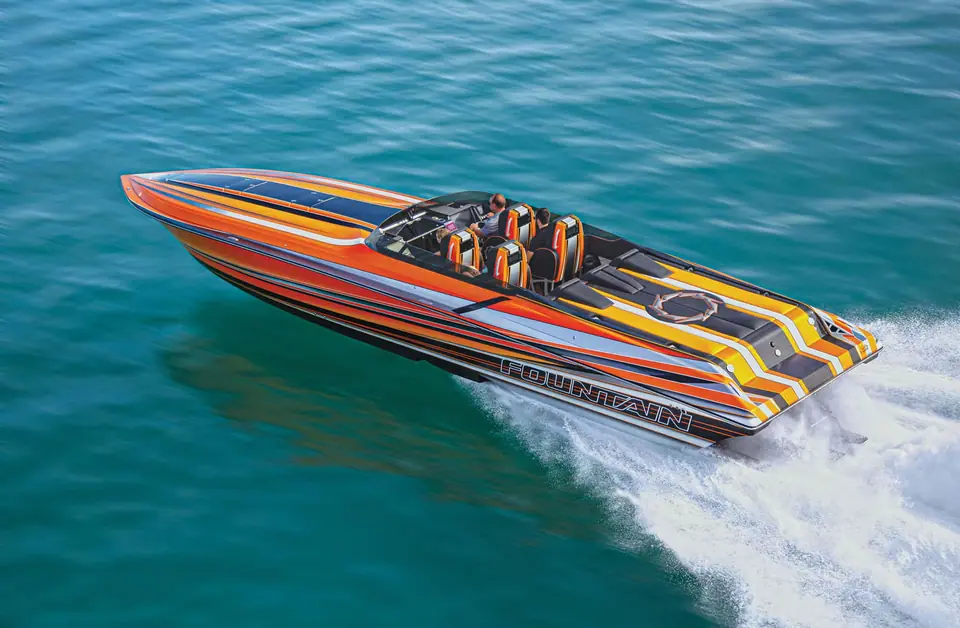
The biggest of Reggie Fountain's Lightning V-bottoms, built in North Carolina for long-distance offshore speed with a usable cabin.
- Length
- 47.3 ft14.4 m
- Beam
- 9 ft2.74 m
- Cruise
- 2.9 ft0.89 m
- Cabins
- 1
- Used price
- $110K to $380K
On this page
- Overview
- Fountain Lightning, a name built on the race course
- 35, 38, 42 and 47, how the Lightning sizes compare
- What the 47 adds over a 42
- Twin or triple engines and what they deliver
- A cabin you can actually use
- Running a big Fountain without going broke
- Survey priorities on an older Lightning
- Not the Lightning sailboat
- Specifications
- Price and value
- Strengths and weaknesses
- Used buyer checklist
- Rivals
- Our verdict
- FAQ
The Fountain 47 Lightning is the flagship of the Lightning series of offshore V-bottoms from Washington, North Carolina, a big-water performance boat usually seen with twin or triple high-output Mercury power.
- Offshore runs to the Bahamas
- Poker run enthusiasts
- Owners who want a cabin on a performance boat
- Experienced performance boat drivers
Fountain 47 Lightning by the numbers
- Horsepower per ton
- 354 hpVery high power to weight, built for speed.
- Displacement hull speed
- 8.6 knThe efficient cruising speed for a displacement hull of this waterline.
- Length to beam ratio
- 5.25 : 1A slim, easily driven hull.
Fountain Lightning, a name built on the race course
Reggie Fountain founded Fountain Powerboats in Washington, North Carolina in the late 1970s and built it into one of the best-known names in American performance boating. Fountain raced and set speed records with his own boats, and that racing work fed directly into the production models. The Fountain Lightning series became the flagship line of offshore V-bottoms, offered over the years in sizes that buyers still search for today: 35, 38, 42 and the largest, the 47.
The company has had a turbulent history, including a 2009 bankruptcy reorganization and several ownership changes. Today Fountain is part of Iconic Marine Group, still headquartered in Washington, North Carolina, and it has announced a redesigned 42 Lightning for 2027 that keeps the race-proven bottom while updating the deck, transom, cabin, cockpit and dash.
The 47 Lightning sits at the top of that family. Bigger, heavier and more expensive to run than its siblings, it was built for owners who wanted to run offshore at high speed with a real cabin and enough fuel for long runs to the Bahamas or along the coast.
35, 38, 42 and 47, how the Lightning sizes compare
Buyers shopping the Fountain Lightning family are usually choosing a size before a specific boat. Each step up adds length, cabin room and rough-water ability, and each also adds fuel burn and maintenance cost.
The new 2027 42 Lightning gives a useful reference point for the family's proportions: 42 feet long, an 8-foot 4-inch beam, 23 degrees of deadrise, around 13,400 pounds dry and 250 gallons of fuel, with twin Mercury Racing 1350 power. By comparison, Boating magazine's 2020 test lists the 47 at 47 feet 3 inches with a 9 foot beam, a 2 foot 11 inch draft, 22 degrees of transom deadrise, about 17,500 pounds and 297 gallons of fuel, rated for up to 3,100 hp.
- 35 Lightning, the entry point, trailerable and affordable to run
- 38 Lightning, the most popular size and the easiest to resell
- 42 Lightning, the classic offshore size, redesigned for 2027
- 47 Lightning, the flagship with the largest cabin and longest legs
What the 47 adds over a 42
Length is the single biggest factor in offshore ride quality. The extra five feet of the 47 lets it bridge more waves and run faster in rough conditions than a 42, which is why offshore racers have traditionally favored longer boats. The 47's extra beam also brings a more usable cabin, with room for a proper berth, a head and seating that makes an overnight trip feasible.
The cost is weight and fuel. A 47 needs more power to reach the same speed, and it burns more fuel doing it. It also makes trailering harder, since its 9 foot beam exceeds the 8 foot 6 inch standard road width, so most 47s live in a wet slip or high-and-dry storage.
Twin or triple engines and what they deliver
Fountain 47 Lightnings were built with twin or triple high-output Mercury Racing sterndrive engines, and the exact specification varies by hull and by year. Many boats have been repowered, so the engines in a listing may not be original. Always confirm the make, model, horsepower and hours of every engine.
Speeds depend heavily on power. Well-powered twin-engine boats generally run in the 70s to 80s mph, while triple-engine or high-output boats can exceed 90 mph in good conditions. Cruising speeds of 50 to 65 mph are typical for offshore runs. For a modern benchmark, Boating's 2020 test of a new 47 with staggered Mercury Racing 1350/1550 engines averaged 117.5 mph at the top running in 1,350 hp mode, with GPS runs of 125 mph on light chop. Fountain did not publish consistent official figures across the model's life, so use GPS on a sea trial to establish what a particular boat actually does.
Expect fuel burn of roughly 60 to 90 gallons per hour at a fast cruise, depending on engine count and output. That makes fuel planning essential on longer trips.
A cabin you can actually use
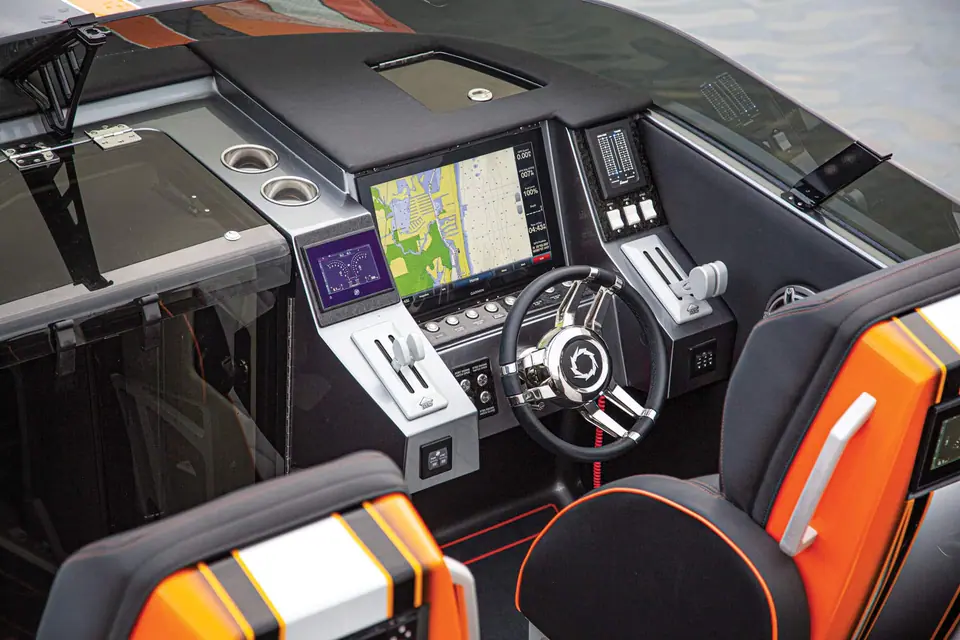
The 47 Lightning's cabin is one of its main advantages over smaller performance boats. Most have a forward berth, a seating area, a small galley or refreshment center and a head, enough for a couple to stay aboard overnight. Air conditioning appears on some boats.
The cockpit has bolster seating for the driver and co-pilot, plus additional seats or a bench for passengers. The engine compartment takes up much of the stern, and access for service is good but can be cramped on triple-engine boats.
Running a big Fountain without going broke
Plan for $30,000 to $75,000 per year excluding depreciation, with the higher figure for triple-engine boats that run hard. Slip or storage, insurance, engine and drive service, fuel and periodic rebuilds are the main costs.
Performance engines and drives need disciplined maintenance. Regular oil changes, drive inspections and adherence to rebuild schedules are essential, and owners who skip them face very expensive failures. A good performance boat mechanic is the most valuable relationship a Fountain owner can have.
Survey priorities on an older Lightning
Structural inspection is critical on any older performance boat. Stringers, the transom, engine mounts and hull-to-deck joints take extreme loads, and cracking or delamination can be costly to repair. Look for gelcoat stress cracks that might indicate deeper problems.
Then focus on engines and drives: compression and leak-down tests, drive inspections and a review of rebuild records. Check the electrical system for corrosion and amateur modifications, and test all trim, steering and hydraulic systems.
Not the Lightning sailboat
Searches for the Fountain Lightning often turn up the Lightning sailboat, a 19-foot one-design racing dinghy with a long class history. The two are unrelated. If you are looking for a high-speed offshore powerboat, you want the Fountain Lightning; if you want a classic one-design sailboat to race, you want the Lightning class.
Listing sites also lump different Fountain generations together under the Lightning name, so ask the seller for the exact length, model year and hull identification number before comparing prices.
Fountain 47 Lightning specifications
| Length overall | 47.3 ft14.4 m |
|---|---|
| Beam | 9 ft2.74 m |
| Draft | 2.9 ft0.89 m |
| Displacement | 17,5 lbs7,938 kg |
| Fuel capacity | 297 gal1,124 L |
| Fresh water | 25 gal95 L |
| Cabins | 1 |
| Berths | 2 to 4 |
| Standard engines | Twin Mercury Racing sterndrives up to 3,100 hp total on the 2020 revival (test boat: staggered Mercury Racing 1350/1550); older hulls vary |
| Maximum power | 3,100 hp |
| Top speed | 102.1 knots |
| Hull type | Offshore deep-V performance hull, 22 degree transom deadrise |
| Hull construction | Fiberglass composite |
| Builder | Fountain Powerboats, United States |
| Naval architect | Reggie Fountain and the Fountain design team |
| Status | Discontinued |
Figures come from builder documentation and independent tests where available. Displacement is usually quoted light, so a loaded cruising boat will weigh more. Compare these specs with another model.
How much does a Fountain 47 Lightning cost?
Engines determine value more than any other factor. Boats with recently rebuilt or late-model Mercury Racing power, fresh drives and documented service sell at the top of the range, while boats needing engine work trade at a steep discount because a performance engine rebuild can cost tens of thousands of dollars each. Triple-engine boats cost more to maintain, which narrows their buyer pool despite their speed.
Estimate your yearly cost
A planning estimate using common rules of thumb: insurance near 1.5 percent of value, maintenance near 3 percent, haul out and bottom paint by length. Your marina, region and use will move these numbers. Open the full cost calculator.
Versions and options
- Twin-engine 47 Lightning
- The more common configuration, easier to maintain and still very fast.
- Triple-engine 47 Lightning
- Higher top speed and stronger offshore performance, with higher maintenance and fuel costs.
Fountain 47 Lightning timeline
- 1979Reggie Fountain founds Fountain Powerboats in Washington, North Carolina
- 1990sThe Lightning series establishes Fountain as a leading offshore V-bottom builder
- 2009Fountain goes through bankruptcy reorganization and later changes ownership
- 2020Iconic Marine Group revives the 47 Lightning, and Boating's test boat averages 117.5 mph on twin Mercury Racing power
- 2026Fountain previews a redesigned 42 Lightning for the 2027 model year
Strengths and weaknesses
What owners like
- Long hull for excellent rough water performance
- Usable cabin for overnight trips
- Strong racing heritage and brand recognition
- Very high speeds with the right engines
- Lower used prices than comparable Cigarettes
What to weigh up
- Very high fuel consumption
- Expensive engine and drive maintenance
- Difficult to trailer due to its size
- Wide variation in engine specification between boats
- Older boats need careful structural inspection
Used Fountain 47 Lightning buyer checklist
Take this list to a viewing. Your ticks are saved in this browser so you can come back to it.
Always commission an independent marine survey and an engine survey before you buy. How a marine survey works.
Rivals to consider
Cigarette 38 Top Gun
Smaller and narrower with an iconic name and stronger resale values.
Compare side by sideCigarette 46 Rider
A similar-sized Cigarette with a more refined finish and higher prices.
Fountain 42 Lightning
The smaller sibling, cheaper to run and easier to sell, now being revived for 2027.
Baja 40 Outlaw
A lower-cost performance boat with a large following on the used market.
Our verdict on the Fountain 47 Lightning
The Fountain 47 Lightning is a serious offshore machine for experienced drivers who want long-distance speed with a cabin they can use. It costs a lot to run and requires disciplined maintenance, but well-cared-for boats deliver performance and rough-water ability that few others can match, often at lower prices than comparable Cigarettes. Buy on engines, documentation and structure, and a good 47 Lightning is a satisfying and relatively affordable way into big-boat offshore performance.
Fountain 47 Lightning questions answered
How much is a Fountain 47 Lightning for sale?
Used Fountain 47 Lightnings typically list between about $110,000 and $380,000, depending on year, engines and condition.
How fast is a Fountain 47 Lightning?
Speeds depend on engines. Older twin-engine boats generally reach the 70s to 80s mph, while triple or high-output boats can exceed 90 mph. Boating's 2020 test boat with twin Mercury Racing 1350s averaged 117.5 mph.
What sizes does the Fountain Lightning come in?
The Lightning family includes 35, 38, 42 and 47-foot models. Fountain has announced a redesigned 42 Lightning for 2027.
Is the Fountain Lightning related to the Lightning sailboat?
No. The Lightning sailboat is a 19-foot one-design racing dinghy, unrelated to Fountain's offshore powerboats.
Where are Fountain boats built?
Fountain Powerboats are built in Washington, North Carolina. The company is now part of Iconic Marine Group.
Is a 42 Fountain Lightning a better buy than a 47?
For most buyers, yes. The 42 is cheaper to run and easier to resell, while the 47 suits owners who need its extra size and cabin.
Fountain 47 Lightning photos
More performance powerboats to explore
Cigarette 515
Performance Powerboats, 51 ft
Used $1.3M to $1.9M
MTI-V 42
Performance Powerboats, 42 ft
Used $600K to $1.65M
MTI 390X
Performance Powerboats, 39 ft
Used $575K to $900K
Nor-Tech 390 Sport
Performance Powerboats, 39 ft
Used $200K to $840K