Eliminator Boats Performance Powerboats
Eliminator Daytona 25, the Lake Cat That Defined West Coast Go-Fast
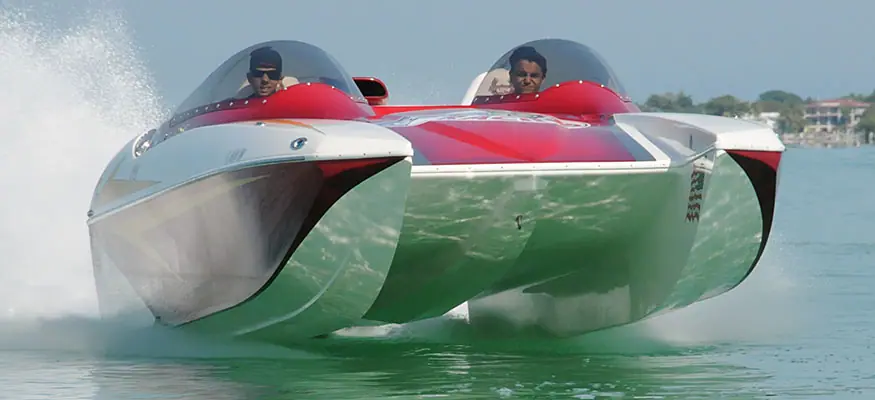
A 25-foot center-pod catamaran from Mira Loma, California, built in open bow, sport deck and walk-through cuddy forms with big-block sterndrive power.
- Length
- 25 ft7.62 m
- Beam
- 8 ft2.44 m
- Cabins
- 0 (walk-through cuddy optional)
- Used price
- $30K to $95K
On this page
- Overview
- The Eliminator Daytona in one paragraph
- An air-entrapment tunnel built for lakes and rivers
- Specs and what came standard
- Open bow, sport deck, cuddy and the ICC
- Power, speed and the 134 mph outlier
- Buying a used Eliminator Daytona 25
- What replaced the 25 Daytona
- Specifications
- Price and value
- Strengths and weaknesses
- Used buyer checklist
- Rivals
- Our verdict
- FAQ
The Eliminator 25 Daytona is a 25-foot, 8-foot-wide tunnel-hull sport catamaran built by Eliminator Boats in Southern California from around 2000 into the 2010s, typically with single MerCruiser big-block sterndrive power, 70 gallons of fuel and seating for six to eight.
- Lake Havasu, Colorado River and big-lake boating
- Poker runs and sandbar days
- Owners who want a classic go-fast cat on a budget
- Restoration and repower projects
Eliminator 25 Daytona by the numbers
- Displacement hull speed
- 6.5 knThe efficient cruising speed for a displacement hull of this waterline.
- Length to beam ratio
- 3.13 : 1Catamaran overall proportions. Wider platforms resist pitching and heel.
The Eliminator Daytona in one paragraph
If you grew up around Lake Havasu, the Colorado River or the Southern California lakes, you know the Eliminator Daytona. Eliminator Boats was founded in 1969 by Bob Leach, later called the Godfather of West Coast custom boating, and Speed on the Water reported that the company built upward of 300 boats a year at its peak in the 1990s and early 2000s. Its Eagle series were V-bottoms, but the Daytona catamaran line is what made the name: Speed on the Water credits the Daytona with popularizing the center-pod cat design that became a West Coast staple.
The 25 Daytona is the model most buyers mean when they search for an Eliminator Daytona 25 for sale. It is a 25-foot, 8-foot-wide sport cat that Eliminator offered with a full open bow, a conventional sport deck or a walk-through cuddy, usually with a single big-block MerCruiser sterndrive. In a 2001 brochure page, Eliminator called it the boat that had profoundly changed the high-performance sport boat market.
An air-entrapment tunnel built for lakes and rivers
Eliminator's 2000 description placed the 25 Daytona at the upper edge of the lake tunnel market. Its bottom, which the company called powerboating's most accomplished, award-winning air-entrapment design, traps air in the tunnel between the sponsons to lift the boat and reduce wetted surface. The promised result was a clean, exhilarating ride with a predictable, sticky stance under power, which is exactly what a driver wants at speed on flat water with friends aboard.
That design is optimized for lakes, rivers and protected bays. Like most sport cats of its size and era, it is not an offshore boat; treat open-water chop with respect, and expect it to need an experienced hand in rough conditions or in tight turns at speed. Buyers coming from V-bottoms should take a proper ride before committing.
With a 96-inch beam the 25 Daytona is street-legal to tow without permits in most states, a key reason it became a Havasu and Parker Strip regular.
Specs and what came standard
Eliminator's published specifications barely changed across the model's life: 25 feet overall, 96 inches of beam, 70 gallons of fuel and seating for six to eight. Weight with engine was given as 3,600 pounds in 2000 and 4,000 pounds on later pages from 2003, 2008 and 2016, likely reflecting heavier big-block engines and more equipment. The company listed sterndrive and outboard propulsion, recommending MerCruiser power.
The 2000 standard list started with a 350 V-8 and included five-color gelcoat graphics, a bilge pump and blower, powder-coated gauge bezels, a custom steering wheel with powder-coated hub, tach, oil, water, fuel, volt and trim gauges for sterndrive boats, custom color-coordinated upholstery, 40-ounce carpet, a ski locker, swim step, running lights, a speedometer and four deck cleats. Everything else, and on an Eliminator that meant almost everything, was custom.
Every Eliminator was built as an individual order, with the customer choosing colors, graphics, interior layout and power. That makes each used 25 Daytona different, and graphics and upholstery quality are a big part of value.
- Length 25 ft, beam 96 in, fuel 70 gal
- Weight with engine about 3,600 lb (2000) to 4,000 lb (later listings)
- Seating capacity 6 to 8
- Layouts: open bow, sport (standard) deck, walk-through cuddy; ICC canopy version from 2003
Open bow, sport deck, cuddy and the ICC
The open bow is the family and sandbar choice, with seating forward. The conventional sport deck is closed forward and cleaner aerodynamically, and the walk-through cuddy gives a small enclosed space for gear or a quick change. In 2003 Eliminator added the 25 Daytona ICC, short for Integrated Cockpit Canopies, which brought a canopy-style cockpit treatment to the model. A 2012 factory listing described a new 25 Daytona ICC as a bowrider walk-through with Livorsi Monster gauges and custom Latham controls.
Listings use all of these names loosely. Before you compare prices, confirm the deck type in photos and ask whether the boat has an ICC canopy, because the ICC boats are newer and generally worth more.
Power, speed and the 134 mph outlier
Eliminator did not publish a speed and fuel table for the stock 25 Daytona, and we found no independent magazine test, so we leave speed figures blank. What the record does show is how far owners take these boats. Factory pre-owned listings describe boats with MerCruiser 496 HO engines and Bravo One drives as typical, and an 8.2 Mag was the quoted package on the 2012 ICC. One 2003 boat with a Whipple-supercharged 496 HO built by Horizon Motorsports was advertised at 670 hp and 95 mph by GPS, a seller's claim rather than a test.
At the extreme, Brendan Alvarez of PSI Racing bought a 25 Daytona new in 2008 and later ran it to 134 mph at the 2013 Lake of the Ozarks Shootout with a turbocharged in-line six-cylinder engine and an IMCO SC drive. That is a purpose-built shootout boat, not a guide to what a stock example will do, but it shows the hull's capacity for power.
For fuel, plan around big-block consumption. With 70 gallons aboard, a hard-running 496 HO boat will not cover the distances of a V-bottom offshore boat; lake days with a fuel stop are the norm.
Buying a used Eliminator Daytona 25
Most 25 Daytonas on the market date from the early 2000s to the early 2010s. In 2026, expect roughly $30,000 to $95,000, with the 2016 factory listings (a 2001 at $47,500, a 2003 at $59,500 and a 2007 at $72,500) giving a sense of how they held value. Low engine hours, a fresh drive, clean gelcoat graphics and recent upholstery matter more than year.
Have a performance-boat specialist survey the engine with compression and leak-down tests, inspect the drive and transom assembly, and check the sponsons and tunnel for impact damage. Annual costs of about $5,000 to $12,000 cover insurance, storage, sterndrive and engine service and a summer's fuel; supercharged boats cost more to maintain.
Eliminator is still in business in Mira Loma, under ownership led by Jake Fraleigh since the late-2018 purchase by Revline LLC, and it still services and refreshes older boats. Its crew refreshed the interior of Alvarez's Daytona after he bought the boat back in 2016, a useful option for owners restoring an older hull.
What replaced the 25 Daytona
The Daytona series no longer appears on Eliminator's model list, which now centers on Speedster catamarans and Fundeck models. The closest descendants are the outboard-first 25 Speedster unveiled at the 2019 Desert Storm Poker Run and the 255 Speedster, a 25-foot 5-inch, 100-inch-beam cat weighing 2,690 pounds that is offered with single or twin Mercury Racing outboards or inboard options from Ilmor, Mercury and Teague. Founder Bob Leach died in late 2025 at 85, but the company continues to build boats in his tradition.
Eliminator 25 Daytona specifications
| Length overall | 25 ft7.62 m |
|---|---|
| Beam | 8 ft2.44 m |
| Displacement | 4, lbs1,814 kg |
| Fuel capacity | 7 gal265 L |
| Cabins | 0 (walk-through cuddy optional) |
| Berths | None; seating for 6 to 8 |
| Heads | None |
| Standard engines | Single V-8 sterndrive (350 V-8 listed as standard in 2000; MerCruiser power recommended) |
| Optional engines | Big-block MerCruiser sterndrives such as the 496 HO and 8.2 Mag, outboard power, or custom racing engines |
| Hull type | Tunnel (center-pod catamaran) air-entrapment hull |
| Hull construction | Fiberglass with gelcoat graphics |
| Builder | Eliminator Boats, United States |
| Naval architect | Eliminator Boats in-house (founder Bob Leach) |
| Status | Discontinued |
Figures come from builder documentation and independent tests where available. Displacement is usually quoted light, so a loaded cruising boat will weigh more. Compare these specs with another model.
How much does a Eliminator 25 Daytona cost?
Eliminator's own pre-owned listings give useful anchors: a 2001 25 Daytona Standard Deck with a 496 HO and 200 hours was offered at $47,500 in 2016, a 2003 boat with a Whipple-blown 496 HO at $59,500, and a 2007 Open Bow with a 129-hour 496 HO at $72,500. In 2012 the factory quoted a new 25 Daytona ICC walk-through bowrider at $99,000 with an 8.2 Mag against a $120,000 replacement cost. Today engine condition, drive type and graphics or upholstery condition drive the price; heavily modified race boats trade outside normal ranges.
Estimate your yearly cost
A planning estimate using common rules of thumb: insurance near 1.5 percent of value, maintenance near 3 percent, haul out and bottom paint by length. Your marina, region and use will move these numbers. Open the full cost calculator.
Versions and options
- 25 Daytona Open Bow
- Bowrider layout with forward seating, the most family-friendly version.
- 25 Daytona Standard (Sport) Deck
- Closed-bow sport deck layout.
- 25 Daytona Walk-Through Cuddy
- Small walk-through cuddy forward.
- 25 Daytona ICC
- Integrated Cockpit Canopies version introduced in 2003; offered later as a walk-through bowrider.
Eliminator 25 Daytona timeline
- 1969Bob Leach founds Eliminator Boats in Southern California
- 2000Eliminator's website presents the 25 Daytona as a new leader in the upper end of the lake tunnel market
- 200325 Daytona ICC (Integrated Cockpit Canopies) appears among new models
- 2013A turbocharged 2008 25 Daytona runs 134 mph at the Lake of the Ozarks Shootout
- 2018Eliminator is bought by Revline LLC, led by Jake Fraleigh
- 2025Founder Bob Leach dies at 85
Strengths and weaknesses
What owners like
- Iconic West Coast sport cat with strong brand following
- Trailerable 8-foot beam
- Stable, predictable tunnel-hull ride on flat water
- Handles very large power for its size
- Factory still supports and refurbishes older boats
What to weigh up
- Not suited to rough open water
- Small 70-gallon tank with thirsty big-block power
- No published factory performance data
- Custom one-off builds make comparisons hard
Used Eliminator 25 Daytona buyer checklist
Take this list to a viewing. Your ticks are saved in this browser so you can come back to it.
Always commission an independent marine survey and an engine survey before you buy. How a marine survey works.
Rivals to consider
Eliminator 255 Speedster
The modern Eliminator sport cat, lighter and offered with outboards or Ilmor and Mercury inboards.
Donzi 22 Classic
A smaller, classic V-bottom alternative for buyers who want rough-water manners over tunnel-hull speed.
Compare side by sideSkater 388
A far larger and more expensive race-bred catamaran for owners ready to move up.
Compare side by sideCigarette 38 Top Gun
The East Coast offshore V-bottom icon, bigger and built for open water rather than lakes.
Compare side by sideOur verdict on the Eliminator 25 Daytona
The Eliminator 25 Daytona is a slice of West Coast performance-boating history: a trailerable 25-foot center-pod cat that made Eliminator's name and still turns heads at Havasu. It is fast, stable on flat water and endlessly customizable, and used prices are reasonable. It is not an offshore boat, it drinks fuel and every example is different, so buy on engine condition and a specialist survey rather than paint. A clean, well-powered Daytona remains one of the best-value ways into the go-fast catamaran world.
Eliminator 25 Daytona questions answered
What is an Eliminator Daytona?
The Daytona series is Eliminator Boats' line of tunnel-hull sport catamarans, built in Southern California and credited with popularizing the center-pod cat on the West Coast.
How big is the Eliminator 25 Daytona?
It is 25 feet long with a 96-inch beam, carries 70 gallons of fuel and seats six to eight.
How fast is an Eliminator Daytona 25?
Eliminator never published a stock speed figure. A seller advertised 95 mph for a supercharged 670 hp boat, and one heavily modified race boat reached 134 mph at a shootout.
What engine is in a 25 Daytona?
Most have single MerCruiser big-block sterndrives such as the 496 HO or 8.2 Mag; Eliminator also offered outboard power.
How much is a used Eliminator 25 Daytona worth?
Roughly $30,000 to $95,000 in 2026, depending on year, engine condition and layout.
Is the Eliminator Daytona still made?
No. Eliminator's current range focuses on Speedster cats such as the 255 Speedster and on Fundeck models.