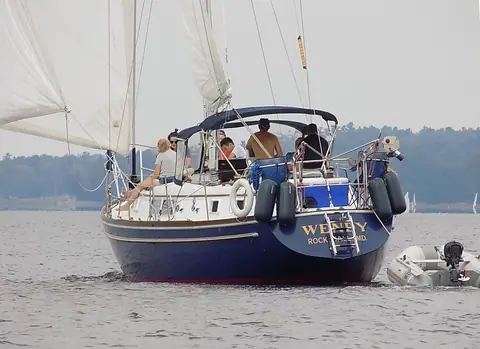
Gulfstar 50
Cruising Sailboats, 50 ft
Used $60K to $170K
Florida-built fiberglass sailboats and powerboats from 1970 to 1990, best remembered for roomy center-cockpit cruisers and charter yachts.
Gulfstar Yachts built sailboats from 36 to 63 feet and powerboats from 36 to 72 feet around Tampa Bay from 1970 to 1990, when Viking Yachts took over its assets. Founder Vince Lazzara came from Columbia Yachts.
Vince Lazzara was one of the pioneers of fiberglass sailboat building and a co-founder of Columbia Yachts. When he sold his share he signed a two-year non-compete, built houseboats while he waited, and in 1970 opened Gulfstar on Florida's Tampa Bay. The first Gulfstars were inexpensive, beamy boats, and some hulls were even shared between sailboats and trawlers to keep costs down.
By the mid-1970s Gulfstar was losing market share, and Lazzara, not wanting to be remembered for low-quality boats, reorganized the company. He brought in Ted Hood for several designs, built better and faster yachts and expanded the Sailmaster series. In 1984 Gulfstar added the twin-engine Sailcruiser motorsailers, and many owners consider the early and mid-1980s the brand's golden era. As Lazzara's sons Richard and Brad took larger roles, production shifted toward powerboats. Talks with Viking Yachts began in 1986, and in 1990 Viking bought Gulfstar's assets, ending the brand.
Caribbean charter fleets did more for Gulfstar's reputation than any boat show. In 1975 Bill Stevens, who ran Stevens Yachts in Grenada, looked over the new Gulfstar 50, gave Lazzara a list of changes that would suit charter guests and long-term cruisers alike, and then placed an order for ten. The Moorings, through its founder Charlie Cary, came into the deal as well, and before long the factory was shipping 37s, 43s and 50s to charter bases.
That charter connection is why the Gulfstar 50 is the model we profile in depth. It ran from 1975 to 1980, roughly 172 were built, and most left the plant as center-cockpit ketches with a sloop rig offered as the alternative and a Mark II version later sharing the hull. Layout, rig, engine and keel details live on its model page; at the brand level, the 50 is the clearest example of Lazzara's push toward bigger, better-finished cruisers after the budget boats of the early 1970s.
Gulfstar has had no factory behind it since 1990, so owners lean on clubs such as GulfstarOwnersClub.com, whose library collects model information, and on ordinary marine suppliers. Condition and refit history therefore decide everything. Asking prices for a 50 usually fall somewhere around $60,000 to $170,000; boats with new engines and rigging sit near the top, worn ex-charter boats near the bottom. Couples moving aboard on a tight budget still seek them out as affordable liveaboards.
On a 45 to 50 year old Gulfstar, a survey should look hard at:
Vince Lazzara, who had co-founded Columbia Yachts, started Gulfstar near Tampa Bay, Florida, in 1970.
No. Viking Yachts bought Gulfstar's assets in 1990, so all Gulfstars are bought used.
The larger center-cockpit models, especially the 50, offer a lot of space for the money, but condition varies widely and a thorough survey is essential.
Yes. Gulfstar built powerboats from 36 to 72 feet, and production shifted toward power in the later 1980s.