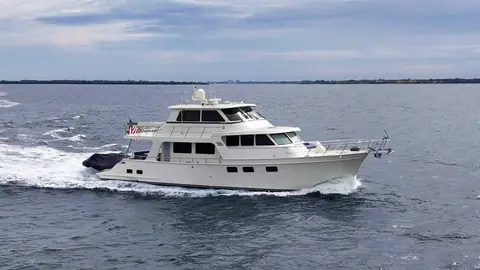
Marlow Explorer 58E
Trawlers & Explorer Yachts, 71 ft
Used $1.3M to $2.5M
A Florida company that designs cruisers able to cross oceans at trawler speed or sprint at 20 knots, built in its own yard in southeast China.
Marlow Yachts designs and sells its Avalon, Explorer, Voyager and Prowler cruisers from Palmetto, Florida, and builds them at its own shipyard in Fujian, China. Founder David Marlow shaped the brand around range plus speed.
Marlow Yachts carries the stamp of one demanding personality. David Marlow had a reputation in the cruising-powerboat world for insisting on things being done his way, by his builders and by the writers who tested his yachts. He started working on what became the Explorer in the middle of the 1990s, turned sketches into full-scale drawings in 1996 and by 1998 was collaborating with Massachusetts naval architect Doug Zurn, who shares design credit for the first 57C, 61C and 65C. Marlow's ambitions reached beyond powerboats too: he later acquired Hunter Marine, run for a period as Marlow-Hunter. He died at 82, and Yachting ran its tribute in November 2025.
The company works from Palmetto, Florida, near Snead Island, where it designs, sells and supports its boats through Marlow Marine Sales. Construction happens at the Marlow and Norsemen yard at Chi Hu in Fujian, close to Xiamen, which picked up the first World Yachts Award for Environmental Consciousness in 2007.
Two ideas run through the whole range. The first is the Velocijet Strut Keel: rather than hanging shafts from open struts, Marlow wraps each shaft in its own foil-section keel. The company says this shields the props, smooths water flow to them and keeps the boat tracking straight down big following seas. The cost is some drag at trawler speeds, so a Marlow burns more fuel at displacement pace than a single-engine trawler, but it can open up to around 20 knots when a front is coming.
The second is construction. Marlow laminates Kevlar-glass hybrids over Core-Cell foam with vinylester and modified epoxy resins, and infuses the entire sandwich in one pass, a process it says removes the secondary bonds where fiberglass boats often fail. Large one-piece molds keep the number of seams small.
Marlow organizes its current boats into four families: Avalon, Explorer, Voyager and Prowler. The Explorer range is the core, with models stepping up from the 53E. Our Marlow Explorer 58E review covers the mid-size Explorer that took over from the long-running 57E in 2014 and is still offered today. Its bridge choices, interior plan, range figures, engine options and price history are detailed on that page.
Marlow buyers are a loyal group who want offshore capability without being stuck at 8 knots forever, and the company stresses how well its yachts hold value. Admirers point to the finish quality and the protected running gear, while skeptics cite system complexity and thirst at high speed. The factory in Palmetto remains the main support channel and encourages owners to use OEM parts, and many Florida yards are familiar with the boats. Used Marlows usually trade through brokers.
Survey points for any used Marlow:
In Marlow's own shipyard at Chi Hu in China's Fujian Province, near Xiamen, with design, sales and support in Palmetto, Florida.
Marlow's patented twin keels, each enclosing a propeller shaft, which protect the props in a grounding and help the boat hold a straight course in following seas.
Not strictly. They are semi-displacement cruisers that can loaf along at trawler speed for range or run far faster when needed.
David Marlow conceived the Explorer and shared design credit on the first models with naval architect Doug Zurn of Marblehead.
Official website: marlowyachts.com. Yatch US is independent and not affiliated with Marlow Yachts.